

Table of Contents
Key takeaways
- Adoption stalling after a few months, supports tickets surging, and low activation and feature usage are signals your onboarding playbook is broken.
- Outdated, static, and one-size-fits-all content, demonstrating features instead of quick wins, and failure to measure metrics predicting renewal are common mistakes.
- To fix onboarding: define activation milestones, map the customer journey, segment users, blend self-serve with human support, and establish feedback loops.
Customer success teams spend weeks perfecting onboarding sequences, rehearsing demos, and building slide decks. They watch completion rates climb and feel satisfied. Then, six months later, those same “successfully onboarded” customers don’t renew.
What happened there? What if your customer onboarding playbook is the problem?
Your customers might not be churning because they don’t find value in your product, but because of how you introduced them to it.
This blog post reveals the most common onboarding mistakes that lead to churn, and shows you how to redesign your playbook to drive activation, adoption, and ultimately, renewals.
What you will learn:
- How to identify if your playbook is outdated or misaligned with customer goals
- The seven onboarding mistakes that kill renewals
- A framework for building an onboarding strategy that directly improves retention
- How to measure onboarding effectiveness beyond completion rates
The warning signs your customer onboarding playbook is broken
You probably won’t notice the problem immediately. Satisfying completion rates and positive initial feedback can make you think your onboarding program works.
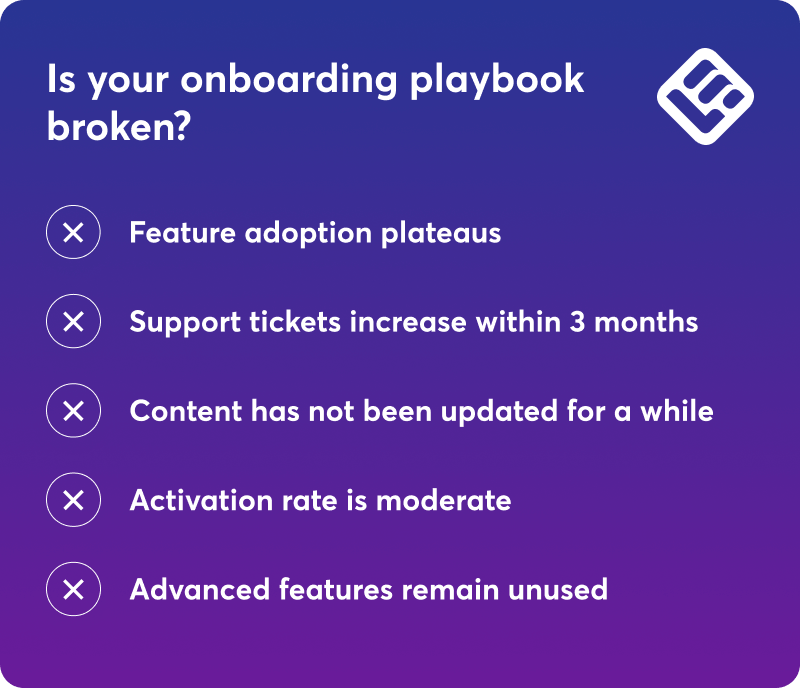
But after a while, you start realizing that:
- Feature adoption plateaus after the first 30 days
- Support tickets surge 60-90 days post-onboarding
- Your onboarding content hasn’t been updated in over a year despite product changes
- Most customers use only a fraction of your product’s capabilities
- Your completion rate is impressive, but your activation rate is moderate
If any of these sound familiar, your onboarding playbook is undermining your efforts to retain customers.
The seven onboarding mistakes that kill renewals
The following seven onboarding mistakes are common, and are silently killing renewals.
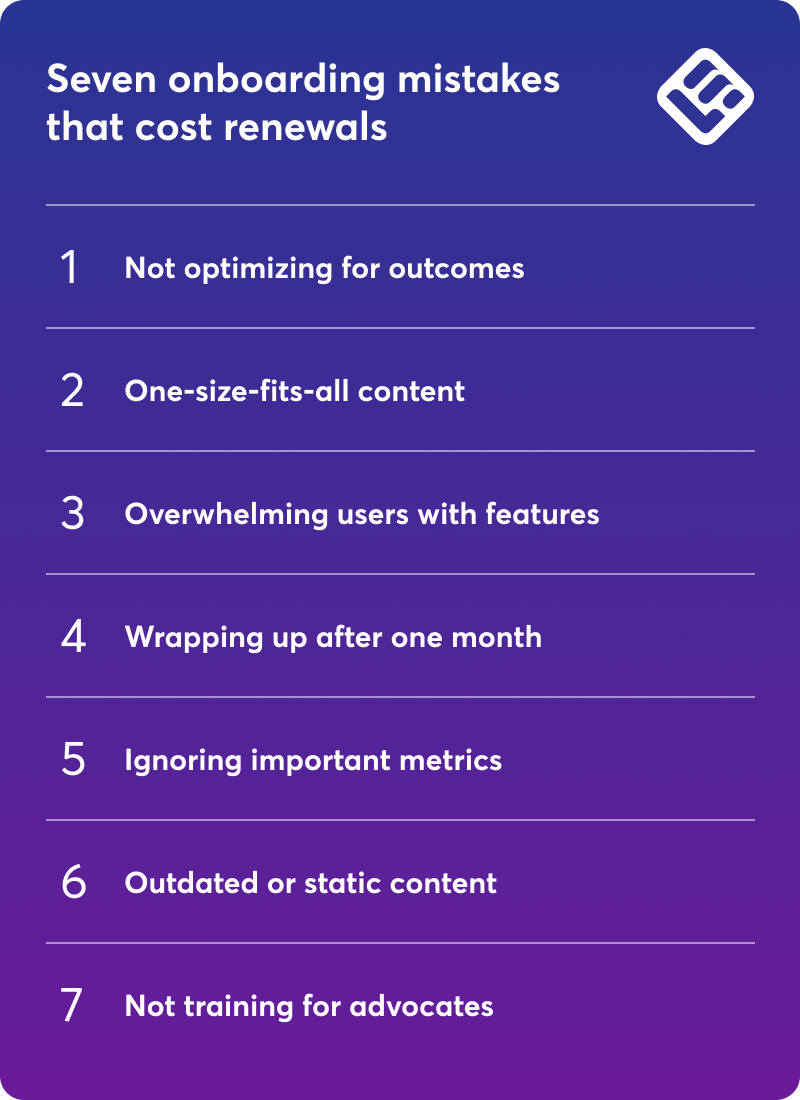
Mistake one: You’re optimizing for completion, not for outcomes
You track completion rates religiously, and celebrate when customers complete onboarding. But completion does not equal activation.
A customer can attend every demo, check off every task, and still have no practical understanding of how your product solves their actual problem. When renewal time arrives, they’ll remember the tool they paid for but never truly adopted.
Mistake two: Your onboarding is one-size-fits-all
Here is what one-size fits all look like:
- Every customer (enterprise or SMB, technical or non-technical) gets the same playbook
- You show all features to all customers, regardless of their use case
- Your email sequences are identical for every persona
Consider this: a marketing manager and a data analyst buy the same tool for completely different jobs to be done. When you treat them identically, you waste the marketing manager’s time on technical features they’ll never touch, and you under-serve the data analyst who needs deeper training on advanced capabilities.
Both leave feeling like the product isn’t quite right for them.
Mistake three: You front-load features instead of quick wins
What new customers need is a quick win, one moment where your product solves a real problem. Instead, week one of your onboarding covers 15 features in exhaustive detail. You’re proud of it. You’re showing customers “everything the product can do.”
The result? Customers leave those demos impressed but overwhelmed, retaining almost nothing.
Mistake four: You wrap up onboarding after one month
There’s no structured learning path beyond the basics. Your onboarding runs for 30 days, then CSMs hand customers off to support.
But the customer journey doesn’t end at day 30.
Customers who only learn basic features never discover the advanced capabilities that drive stickiness. They never develop workflows that make your product indispensable. When renewal time comes, they’re using 20% of what they paid for and questioning whether they really need it.
The answer, increasingly, is no.
Mistake five: You’re not measuring the metrics that predict renewals
You track onboarding completion rates and time to value. Those are your north stars. But you can’t answer this question: “Which customers who completed onboarding actually renewed?”
Most teams optimize for vanity metrics instead of leading indicators of retention like feature adoption depth or engagement frequency.
If you can’t connect onboarding activities to renewal rates, you’re flying blind. And you’re likely investing resources in activities that don’t matter while neglecting the ones that do.
Mistake six: Your content is outdated, boring, or both
Your onboarding videos reference a UI that changed six months ago. Training materials are text-heavy and static, with no interactivity.
Outdated content does two kinds of damage. First, it confuses customers and wastes their time. Second, it ends up flooding CSMs with questions that are left unanswered.
Boring content has its own cost: it fails to engage. And when learners aren’t engaged, they don’t retain the information and likely won’t adopt your product fully.
Mistake seven: You’re not enabling champions, just training individuals
Your onboarding focuses on the person who signed up. You don’t identify or develop internal champions within customer organizations. There’s no plan for knowledge transfer when the original user leaves.
Single-user adoption is fragile. When that one trained person leaves the company or changes roles, your product becomes “that tool nobody knows how to use.” Without internal champions who can train others and advocate for your product internally, adoption doesn’t expand, putting renewal at risk.
The framework for building a retention-focused customer onboarding playbook
Now that you know what not to do, here’s the framework for building not just an onboarding sequence but a true SaaS renewal playbook.
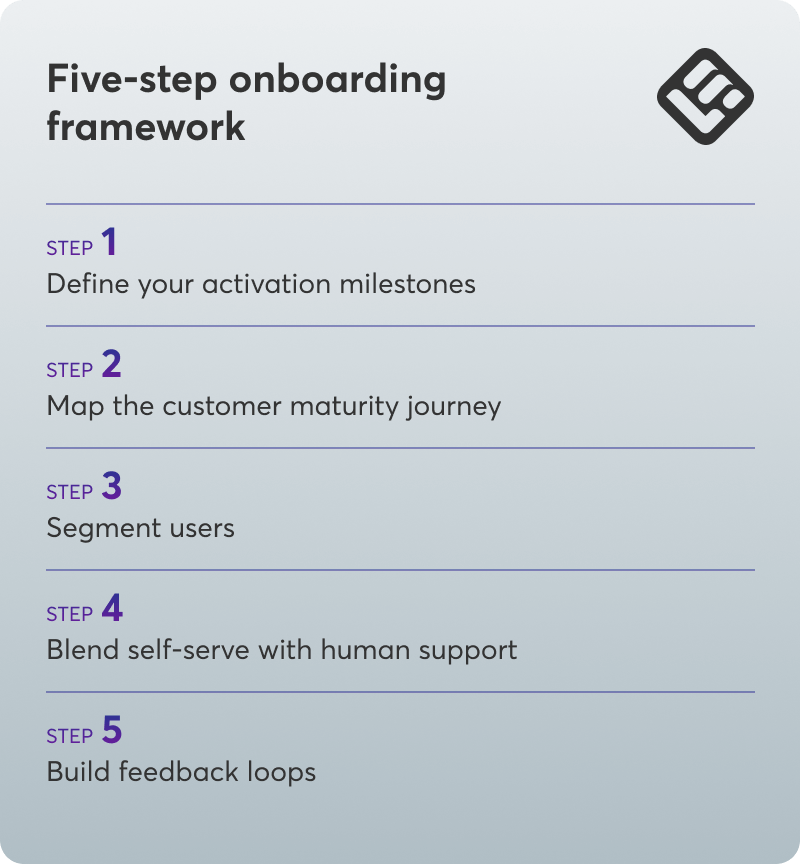
Step one: Define your activation milestones
Work backward from retention data. Which customer behaviors in the first 90 days correlate most strongly with renewal? These become your activation milestones: the non-negotiable outcomes your onboarding must achieve.
For example:
- Customer has used 3+ core features at least 5 times each
- Customer has invited and activated 5+ team members
- Customer has achieved a specific measurable outcome using your product
Notice what’s missing? Vanity metrics about watching videos or attending demos, because these do not predict renewals.
Step two: Map the customer maturity journey
Not all customers are ready for the same content at the same time. Create distinct learning paths for different maturity stages:
| Audience | Timeline | Focus | Purpose | |
|---|---|---|---|---|
| New users | Week 1-2 | Quick wins and basic navigation | Get to value fast | |
| Active users | Week 3-6 | Workflow optimization and integrations | Embed your product into their day | |
| Power users | Month 2-6 | Advanced features, automation, best practices | Unlock deeper value | |
| Champions | Month 3+ | Strategic use cases, ROI tracking, team enablement | Create internal advocates | |
Each stage builds on the last. Release content based on readiness signals, not arbitrary schedules. Let customers progress when they’re ready, not when your calendar says so.
Automating content delivery based on user behavior is a game changer. For this, you’ll need a training platform like LearnWorlds that communicates with your CRM and product analytics tools and delivers the right content based on triggers you set.
💡Read our blog post Start here: three repeatable customer success processes to automate for impact to learn more about how automations work.
Step three: Segment by use case, role, and company size
Create 2-4 onboarding tracks based on who’s using your product and why. Take a project management tool: a creative director and an engineering manager need entirely different things from it. A small company of 10 people and an enterprise of a 1000 also have different needs.
Here’s what this looks like in practice:
By role
- Creative director → Visual boards, file sharing, client feedback, deadlines
- Engineering manager → Sprint planning, developer tool connections, automation, reporting
- Operations lead → Templates, repeating tasks, team dependencies, resource planning
By company size
- Small teams → Fast setup, ready-made templates, core features only
- Growing companies → Team permissions, basic customization, integrations
- Large organizations → Advanced access controls, custom fields, enterprise reporting
Each track shows customers what matters to them. The creative director never sees sprint planning. The engineering manager skips the file proofing demo.
💡With features like User Groups, Tagging, Learning Programs, and Multiple Schools, LearnWorlds allows you to segment your users and build separate, branded learning environments for them. Even if you serve completely different audiences, everyone will enjoy a personalized learning experience.
Step four: Blend self-serve with human support
It’s important that your onboarding book combines scalability with personalization:
Self-serve content: Offer always-on training with asynchronous online courses, interactive walkthroughs, video tutorials. These scale efficiently and let customers learn at their own pace. Make them interactive to maintain engagement.
Human touch points: Plan for CSM check-ins at critical milestones and live Q&A sessions. These add personalization and catch customers before they get stuck.
💡 Build self-serve content fast with LearnWorlds’ intuitive content authoring tool: ebooks, PDFs, quizzes, and surveys can be built from scratch while the video editor allows you to edit and add interactivity to static videos. Content creation and course creation are supercharged with our built-in AI Assistant.
Curious to know how other teams use AI in customer education? Access our 2026 State of AI in Customer Education report including benchmarks, budgets, and ROI insights from 270+ leaders.
Step five: Build feedback loops
Your customer onboarding playbook should evolve continuously in order to stay current. That means:
- Survey onboarded customers to understand what worked and what didn’t
- Track where customers drop off or disengage
- Survey churned customers to identify flaws in your onboarding process
Establish quarterly playbook reviews to incorporate product changes and new insights
Measuring onboarding effectiveness beyond completion rates
If completion rates don’t predict customer success renewals, what metrics do? Here are the ones that actually matter:
- Activation rate: Percentage of customers who reach your defined activation milestones
- Feature adoption depth: Average number of core features used regularly, not just once
- Engagement frequency: How often customers return in the first 90 days
- Team expansion: Percentage of accounts with 3+ active users by day 60
- Time to first win: Days until customer achieves their primary use case
- 90-day retention: Percentage of customers still active after 90 days
- First renewal rate: Percentage of cohort that renews after year one
- Net revenue retention by onboarding cohort: Compare cohorts that completed strong onboarding versus those that didn’t
- Support ticket volume: Tickets per customer in months 2-6 should decrease with better onboarding
Why? Because these metrics connect onboarding activities to business outcomes. They tell you whether your playbook is actually working, not whether customers showed up. And when conversations for new investments in customer education come, these metrics will get you the green light from leadership.
💡LearnWorlds offers deep reporting, plus a HubSpot LMS integration to connect learning and business outcomes. Our webinar “Grow your funnel: How to use customer education to attract and retain customers” explains how to attract leads, nurture prospects, and close more deals by connecting HubSpot and LearnWorlds.
Making the change without disrupting operations
You don’t have to rebuild everything overnight. Here’s how to restructure your customer education strategy over three months:
Month one: Diagnose and prioritize
- Audit your current onboarding playbook against the seven mistakes
- Run retention analysis to identify your true activation milestones
- Survey recent customers about their onboarding experience
- Identify the highest-impact area (segment or use case) to fix first
Month two: Pilot improvements with one segment
- Redesign the onboarding track based on the framework
- Create or update 5-10 key content pieces
- Test internally and launch
Month three: Measure, iterate, and expand
- Track results for your pilot cohort
- Gather qualitative feedback from CSMs and customers
- Refine based on what’s working and what isn’t
- Expand the improved playbook to additional segments
Treat your playbook as a living document and update it regularly especially as new features are released but also based on CSM feedback and retention data.
Where to start
If you recognized your team in the mistakes above, you already know the answer: your onboarding playbook is probably costing you renewals.
But, knowing the problem exists and knowing what to fix are different questions. Start with one concrete action this week: identify your true activation milestones. Find the behaviors that predict renewal.
Then audit your current playbook against those milestones. The gap between where customers are after onboarding and where they need to be for renewal success? That’s your roadmap.
Close that gap, and you’ll turn an insufficient process that costs you customers into your SaaS renewal playbook.

Androniki Koumadoraki
Androniki is a Content Writer at LearnWorlds sharing Instructional Design and marketing tips. With solid experience in B2B writing and technical translation, she is passionate about learning and spreading knowledge. She is also an aspiring yogi, a book nerd, and a talented transponster.
 Back to blog
 Scroll to top