
Table of Contents
Danielle Evans leads Customer Education at Sendoso. She has lived the math many CE leaders are familiar with: dozens of product training videos, a high number of releases every year, maintenance swallowing your roadmap if you let it, and a constant stream of “quick” requests that arrive the moment something changes.
If you’re leading a CE function in that kind of environment, one of the hardest parts is to keep things moving without becoming the bottleneck yourself.
I chatted with Danielle to understand how she keeps her team moving fast while staying aligned. She shared her day-to-day systems, the way she leads without hovering over every detail, and how she uses AI so quality stays consistent even when different people are creating the content. She also explained how she measures impact in a way leadership can actually follow.
This article is a part of the “A day in the life of a CE expert” interview series. We launched the series because customer education folks are constantly solving the same problems in parallel. These interviews are a simple way to trade notes and spark conversations in the field.
A system for moving fast without burning out
Danielle Evans leads Customer Education at Sendoso, and she brings a rare mix of speed and structure to the role. Her day-to-day is marked by high velocity, which is why she’s built a practical operating system to keep education useful without burning out the team (or herself).
Every morning, Danielle faces Slack messages coming in from different time zones and a calendar packed with cross-functional meetings. She stays productive thanks to a small system she repeats every day.
In the morning, she does a quick scan of email and Slack, then opens what she calls her productivity planner (it’s a simple-to-use Google Sheet), and chooses three priorities. It’s her way of deciding what will count as a good day before the day starts making decisions for her.
She told me she’ll often have “five to seven, or even eight” meetings, and when that happens her “brain is in a million places.” The sheet is where she returns to reset and reprioritize, and that’s how the list becomes an important filter.
If a new request comes in, she can answer it against the three priorities. Does it belong on the list, or does it bump something off? Can it wait? That sounds simple, but it’s the difference between reacting all day and staying calm while moving forward.
Danielle stops meetings around 4PM because her kids get off the bus at 3:50PM. It also gives her a way to protect a boundary without guilt:
“It’s hard to switch from work mode into mom mode. My brain is still spinning and there’s always more I could do. That’s why I keep the three priorities. If I’ve checked those off, I know I moved the important things forward. Then I’m comfortable stepping away, and I can actually give myself permission to be present with my kids.”
What a simple and clever way to protect work-life balance!
Using AI to find the real gaps and build a better roadmap
As she recently shared on LinkedIn, Danielle uses AI to stay close to the customer reality. Instead of sifting through endless CSM call summaries herself, she turns to AI for help:
“I wanted it to use our own customer data (CSM call summaries) to surface real pain points, then map those pains to our current content to spot gaps. Those gaps are opportunities for my team to create new content and training that actually move the needle for customers.”
Here’s the workflow she used that’s easy to replicate:
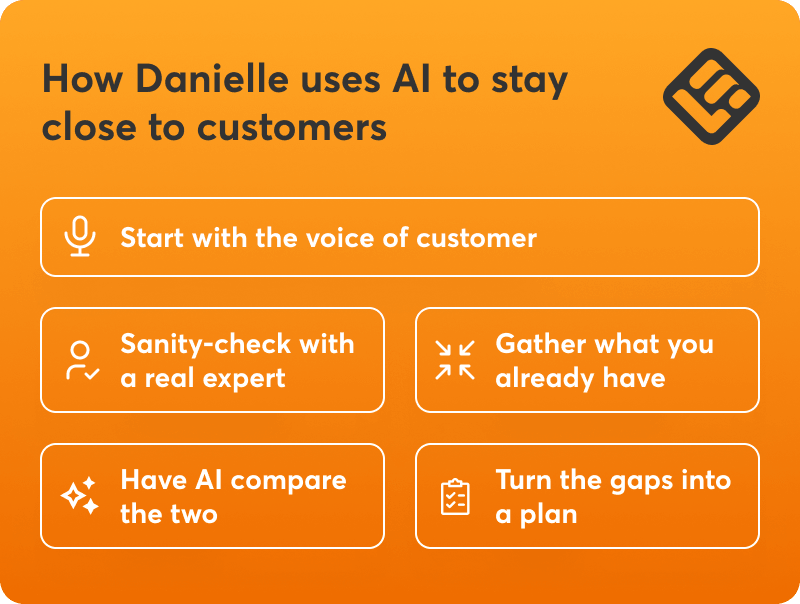
1. Start with the voice of the customer
Danielle pulled three months of CSM call summaries that mentioned international gifting (a big growth area for Sendoso) and asked AI to pull out the repeating themes. This is how she was able to learn what customers were confused about, what they kept asking for, and where they were getting stuck.
2. Sanity-check it with a real expert
Because AI can miss nuance, she had their Head of Customer Experience for EMEA review the themes. It was important to make sure it was accurate, and add the context only a human who knows the region can add.
3. Gather what you already have
Next, she collected every relevant resource they’d already published. This included Help Center articles, Sendoso University content, plus supporting marketing pieces like blogs and white papers.
4. Have AI compare the two
Then she used ChatGPT to cross-check the customer pain points against their content library and point out the gaps. These were the topics customers clearly needed help with that weren’t covered well (or at all).
5. Turn the gaps into a plan
Then she turned the findings into a roadmap and decided what to prioritize first, who needs to be involved, and what new resources would help most. There is a lot to think about, like cultural dos and don’ts, country-by-country requirements, and clear guidance on e-gifting currency and redemption.
ROI you can actually explain
Instead of trying to prove customer education with soft stories, Danielle measures something concrete: time returned to the business.
Her mental model is simple. When a customer takes a course or watches a video, that’s one less moment a CSM has to schedule, prep for, and repeat on Zoom. She then turns this into a consistent calculation with other departments:
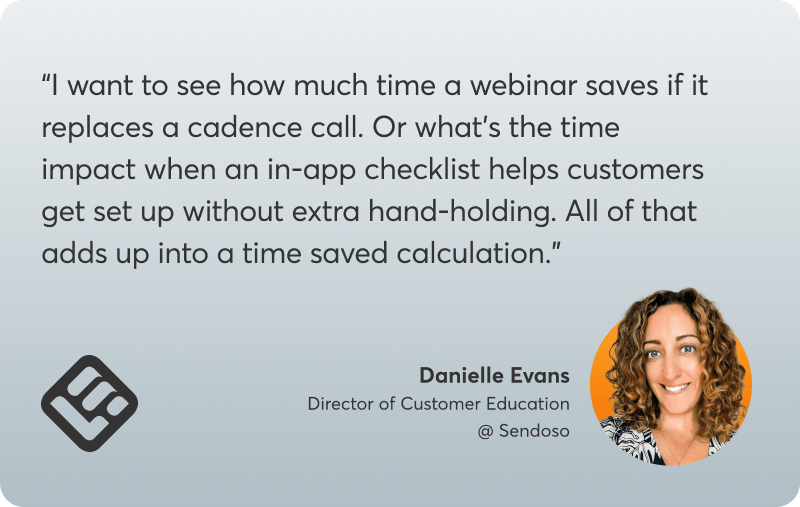
And because leadership usually wants the translation, she has it. Finance helps map those hours to a dollar value using average hourly rates by team.
But Danielle doesn’t stop there. The real question for her is whether the learning actually changes what customers do next. If you don’t tell people upfront what they’ll get out of a course, many of them won’t make time for it, no matter how good the content is.
This year, she wants to capture more customer feedback and stories. If a customer says “this helped me a lot,” that speaks volumes to leadership. Even if the story has to be anonymized or white-labeled, it’s still the kind of evidence that makes impact feel tangible.
Not everything needs to be short
Danielle has heard the “make it snackable” advice a thousand times. She understands why it’s popular. Customers are busy, we’re dealing with short attention spans, everyone’s trying to move fast. But she’s also learned that the format argument can miss the point. Some topics don’t fit into a two-minute clip without losing what makes them useful:
“Certain content requires more than that. It requires to go deeper and to have more practice. To be a little bit longer and more engaging.”
What really shaped her view was Sendoso’s certification program. It’s over an hour long and customers still complete it because the outcome is clear:
“It really opened my eyes to the fact that people still do want to invest time in something that’s important to them and that’s going to help them be successful.”
For Sendoso, the admin certification program is very important:
“We know that that is a really great indicator of successful customers because accounts with at least one certified admin spend 71% more over the last year than accounts without one. And spend is our adoption metric.”
The point is, customers will give you their time when the payoff is clear. The actual length of any type of educational asset depends on the specific use case. Forcing micro-learning as an all-time winner, with an argument that we’re all just goldfish with scattered focus… It doesn’t make sense.
Sometimes the right answer is practice and depth, other times it’s a quick help article or a short video. “It depends on the situation. It depends on the learner,” she said.
Overarching themes vs. isolated projects
One of the harder parts of Danielle’s job is keeping all of the programs from turning into separate little universes. She oversees self-paced learning, a knowledge base and chatbot, webinars, workshops, in-app education, plus enablement.
When you list it out, it sounds endless. “Yeah… it’s a lot!” she laughs. Her way of making it manageable is planning around themes:
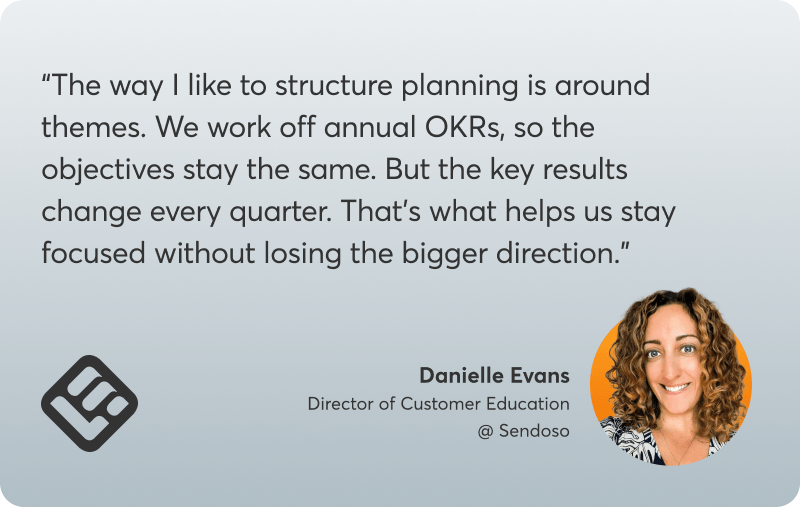
A concrete example she gave: one OKR is supporting expansion revenue, and a big piece of that is showcasing Sendoso’s international capabilities. Instead of treating “webinar season” and “course roadmap” as separate plans, the team builds a connected chain.
A live webinar owned by one person leads into a university course owned by another, and then they loop in the help center so the same resources are shared in the webinar and linked inside the course:
“We find these ways to kind of tie it together… it still feels very unified,” she said. It’s how the same message shows up consistently across the channels customers already use without the team having to reinvent it each time.”
Ownership doesn’t mean working in silos. Even though different people own different pieces, they’re constantly collaborating. They organize 1:1s with each other, swap assets, reuse a webinar recording inside a course, and generally build with overlap on purpose. Danielle credits a lot of this to the team culture and to Sendoso’s vision of keeping education “all in one place.”
Stepping out of the way
Danielle spent years being the “doer,” which gives her credibility because she knows how taxing and demanding the work can be. She’s done it all: from creating videos and updating them to working on custom training back-and-forth and “changing things 800 times.”
When she moved from being an individual contributor to a manager, she had to learn how to delegate:
“When I transitioned from being an IC to being a leader, I had to delegate. But I was so used to being the doer! I had a certain way of doing things and my own preferences. I had to step back and say: I hired this team because of what they’re good at. So I needed to let them do it, not give too much direction, not to be so hovery. As a leader, you need to trust your team. Step back and let them do their jobs.”
And she’s honest about what makes that hard. You have to fight the instinct to jump in, tweak, “fix,” and move things forward the way you would if it were still your own work.
What helped Danielle was reframing what her job is. Leadership is about building the conditions for other people to do their best work. You’re responsible for setting clear priorities, providing enough context, and the support to move fast without feeling watched. In her words, it’s “treating them like adults… and just letting their expertise shine.”
Danielle is there to guide, unblock, reprioritize when needed, and remove friction. But the difference is that she’s not trying to be the final checkpoint for everything:
“You have to actually give it up 100% and not try to hold on to things.”
Thanks to this leadership style, people at Sendoso own their work, ship with confidence, and continuously improve customer education, without waiting for permission.
–
Thank you Danielle for such an inspiring conversation!

Mia has 10+ years of experience in content and product marketing for B2B SaaS. She’s been learning online ever since she got internet access. In 2021, she helped build the customer academy for Lokalise, the leading localization platform. Her background in Comparative Literature taught her to think deeply about stories, ideas, and what truly connects people. She writes about books, learning, humans, AI, and technology.
 Back to blog
 Scroll to top