

Table of Contents
“We need a course for this.”
That sentence shows up in every CE inbox sooner or later, and it’s usually said with the best intentions. A course feels like the responsible thing to do, a concrete deliverable, something you can point to.
But when I asked Roberto Aiello what would surprise me if I shadowed him for a day, he didn’t talk about authoring tools or the production process. He said the surprising part is how much work happens before anyone ships anything.
“You need to get the right people in the room, figure out where the customer actually is in their journey, agree on what good looks like, and, most importantly, name the real problem.”
Roberto Aiello is currently a Senior Learning Experience Designer at Personio, and he’s been in customer education for over a decade, building everything from onboarding and enablement to full learning paths.
We chatted about his perfect day outside of work (spoiler alert: it involves sunshine, a long walk, time with his family, ideally with coffee and really good food in the mix), learning, and what customer education’s really about.
This article is a part of the “A day in the life of a CE expert” interview series. We launched the series because customer education folks are constantly solving the same problems in parallel. These interviews are a simple way to trade notes and spark conversations in the field.
The work before the work
Upfront work includes defining which customers are struggling, where, and why, and what knowledge gaps they have. Then it’s about deciding how to best support them. For example, if the problem happens mid-task, a course won’t help much, but a small piece of guidance inside the product will. If it’s a repeatable workflow, a quick job aid might beat a full module.
That’s the lens Roberto works through. Format follows function and training is just one tool in a much bigger kit. He comes across as a CE pro who’s equal parts designer and translator. He takes an abundance of signals from the business (support tickets, adoption friction, product changes), interprets them, and then creates learning that’s actually usable.
If you picture a customer education professional as someone writing lessons and designing courses, I’ll let Roberto ruin the illusion for you. On most days, he’s figuring out what’s going wrong and what can be improved, where users get stuck, and who needs to weigh in before the team commits to a solution.
The ability to diagnose is what makes a customer education professional a good one.
Once you see that part up close, you understand why “let’s build a course” is often the wrong starting point. The request usually arrives as a symptom of customers being stuck, adoption slowing down, or support fielding the same questions again and again.Roberto’s job is to pin that symptom to a specific moment:
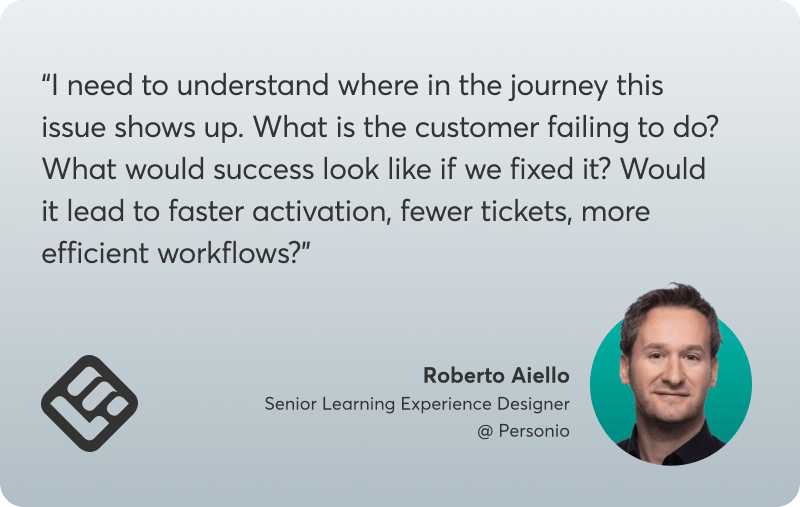
Once he has answers, he makes a recommendation people can act on. When it makes sense, he’ll loop in product, support, implementation, or a subject-matter expert early. But sometimes it’s as simple as jumping into the product himself to see it first-hand. Either way, he sanity-checks assumptions and aligns on the smallest change that could move the metric they care about.
How Roberto runs the week
Roberto has been working remote-first for years, and he talks about cross-team collaboration like it’s part of the craft. “The way we coordinate is vital,” he told me.
His weeks have a steady rhythm. Recurring touchpoints (team meetings, 1:1s, stakeholder-facing product updates), plus a few small rituals that keep everyone aligned without turning the calendar into a wall of calls.
One of those rituals lives in Slack. Every morning, there’s a simple prompt:
What’s your focus today?
Roberto likes it because it creates visibility and makes it easy to spot overlap, unblock each other, ask for help, and de-silo teams. Sometimes it’s as basic (and human) as: “Hey team, today I’m not feeling great, so I won’t be as responsive as usual.”
The work itself runs in three-week sprints. Every three weeks the team aligns on priorities, breaks the work into tasks, and splits it across the team. “I mostly run my week from my Jira board,” Roberto shared. He focuses on the tasks, while staying open to collaboration when something worth jumping on appears.
Midweek, his team protects space for deep work: “We try to keep Wednesday a no-meetings day.”
And because remote work can blur into being always available if you let it, Roberto’s intentional about making constraints visible too. Blocking time on his calendar for life logistics (like school pickup), so everyone knows what to expect. “That’s important… To be intentional and transparent, especially when working remotely,” he shared.
Why measuring customer confidence matters
Once the plan is clear and the sprint is in motion, Roberto shifts to a different kind of question:
What will change if we get this right?
For him, one of the cleanest ways to answer that is product activation. It’s specific, it’s observable, and it keeps education tied to real customer progress instead of content output:
“This is why we realigned our core learning path with activation milestones. The learning experience mirrors the steps customers need to complete to get value, and it makes sense.”
Tracking this has little to do with completion rates. Confident customers are what matters:
“We track a helpfulness score consistently above 94%, reflecting how confident customers feel after training.”
So, how is this measured then? At the end of a course, his team asks a direct question: How confident do you feel that you can go back into the product and complete your daily job? It’s a quick checkpoint on readiness. Did this experience leave the customer feeling capable, or still unsure?
That’s one of the fastest ways to tell whether learning is doing what it’s supposed to do:
“We know that an educated customer is a valuable customer,” said Roberto. He’s seen trained users stick around longer and renew more often. “You can’t always prove causality,” he said, “but the link is hard to ignore.”
Distribution is a part of deliverable
Roberto has a simple way of puncturing the “more content will fix it” instinct. Sure, your content should be of good quality. But will it matter if your customers don’t find it at the right time? “When someone puts it that way, the answer is quite obvious,” shared Roberto.
That’s why his team thinks beyond the academy from the start. If the goal is to change behavior, the work includes where the guidance will live, and how it will show up in the flow of work, said Roberto:
“Sometimes that means embedding education directly into the product experience, especially in critical moments like setup. If a customer’s struggling with a multi-step setup wizard, that’s a distribution problem as much as it is an education problem. The best help is the help you can’t miss.”
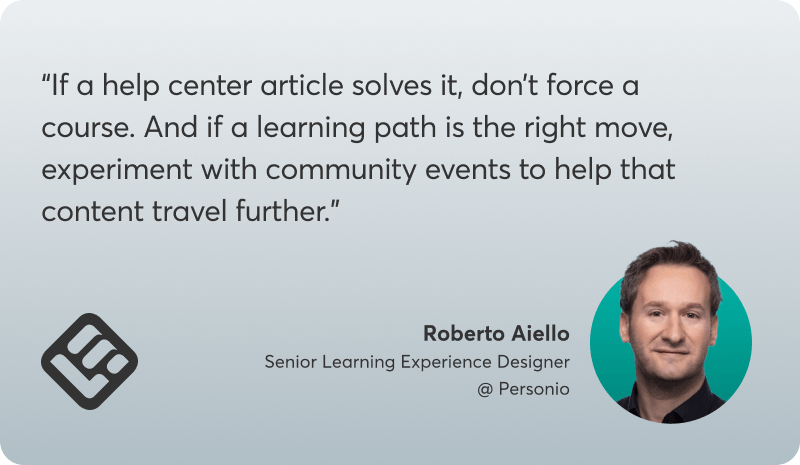
Personio’s org design makes this approach easier to execute. Roberto described how their “Voyager” team brings academy, help center, and communityunder one umbrella, which creates a natural synergy. The team can choose the best channel without handoffs or turf wars:
This really shows how educating customers is everyone’s business in a company.
Using AI, without being starry-eyed about it
Roberto is curious about AI, but not starry-eyed about it. He doesn’t talk about it as a magic wand for creating more content. The thing is, more content is often not the right answer.
Roberto sees AI as a way to get time back, so the team can spend more energy on the work that actually moves the needle. That’s more room for better diagnosis, smarter experiments, tighter alignment with product.
One example he shared from Personio was their compensation learning path:
“We used ChatGPT to draft about 70% of the content for our compensation learning path,” Roberto told me. The real win wasn’t speed for speed’s sake, but what moving faster made possible.
The subject-matter expert didn’t have to start from a blank page. They could focus on “injecting meaningful, experience-based perspectives”, which was important since you can’t really automate human judgment or examples that would be relevant for the audience in question.
Another thing he mentioned was the ability to standardize the way the team works with AI and make sure everything that gets launched is on brand:
“I created a custom internal GPT so the whole team could use it. Now everyone uses the same assistant. The workflow is more streamlined, and most of all, everything stays on brand.”
But there is a bigger strategic upside in the unglamorous parts of customer education. Content maintenance is a constant tax in SaaS. There are UI changes, updates, terminology shifts, localization.
If AI can reduce that burden, it frees CE teams up for higher-impact work: trying new approaches, connecting education more closely to product and marketing, and building experiences customers actually feel in the flow of work.
Advice for customer education leaders
Before we wrapped, I asked Roberto what he’d tell someone leading customer education, especially when the role can feel like you’re constantly asked to make training on demand (even when it doesn’t really make sense).
1. Get brutally clear on what success means inside your company
Roberto’s seen CE move across teams, and he’s felt how quickly expectations shift. If leadership expects free education to directly drive revenue, you’ll be fighting the wrong battle. Align on outcomes the business will stand behind (activation, fewer tickets, faster time-to-value) and set that expectation early.
2. Use data, but don’t ignore intuition
Roberto describes his approach as “50% data, 50% gut feeling,” which means you probably built intuition through experience. You shouldn’t ignore it, he shared:
“If you only follow what’s already proven, you’ll never try anything new.”
Well said!
3. Assume your data will be imperfect, but learn to tell the story anyway
Attribution is hard to prove. A big part of leading CE is choosing the right signals and building a narrative stakeholders can understand and trust. If value is hard to prove, it’s time to think bold, Roberto shared:
“Sometimes you might be asked to justify your existence: ‘Do we really need a customer academy?’ My answer lately is more of a thought experiment. If you’re not sure, try pausing it for a few months and see what happens. The impact tends to speak for itself.”
Lastly, you should build for what you can sustain. Stay close to the business and design within real constraints (time, people, maintenance) so what you ship can actually live long enough to matter.
Thank you Roberto, for a lovely conversation!

Mia has 10+ years of experience in content and product marketing for B2B SaaS. She’s been learning online ever since she got internet access. In 2021, she helped build the customer academy for Lokalise, the leading localization platform. Her background in Comparative Literature taught her to think deeply about stories, ideas, and what truly connects people. She writes about books, learning, humans, AI, and technology.
 Back to blog
 Scroll to top