

Table of Contents
The online learning market is expanding. To keep growing, course sellers and edupreneurs need to understand and rethink how they monetize their expertise. Using a diverse range of monetization models can help.
The new economics of online education and why diversification matters
At LearnWorlds’ fifth Worlds of Learning summit, thousands of educators and online training professionals came together to share what’s driving success in the elearning industry today. One discussion that stood out was “Adopt new monetization models for today’s market,” which explored how course sellers can move beyond one-off sales to build steadier, more predictable income.
According to our user data, nearly 80% of course creators still rely on one-time course purchases. But as the market matures, a single source of income is no longer enough to sustain engagement or profitability.
So, what can you do? During this session, I gathered valuable insights from the experts. So, in this article, I’ll break them down into a practical, data-backed guide to help you understand why diversification matters, which models are proving effective, and how to choose the right one for you.
The problem: why “selling more courses” isn’t enough for sustainable growth
In the session, our experts discussed why simply selling more courses isn’t enough to build sustainable growth over the long term.
Tell me if this sounds familiar: when revenue streams slow, your instinct is to launch another course or campaign. It works in the short term, but it’s hard to keep up. That’s because each new sale depends on more marketing and that constant push to attract new learners.
So what you get is a cycle of peaks and drops. Once your learners complete a course, there’s often no next step to keep them engaged, and revenue quickly levels off. Over time, this makes it difficult for you to plan ahead or achieve steady growth.
Relying only on one-off sales makes it challenging to develop the right business model and limits your ability to drive consistent business growth.
Why one-off sales limit sustainable growth:
As Brett Hamilton, Customer Success Lead at LearnWorlds, explained during the Worlds of Learning session:
Brett highlights a necessary truth: one-time sales can still play an important role, but they don’t provide the stability or engagement you need to grow consistently. That’s why many creators are now turning to new and more successful monetization strategies that support recurring revenue for online learning and long-term learner relationships.
New elearning business models to adopt: Subscriptions, memberships, reselling, corporate training, licensing
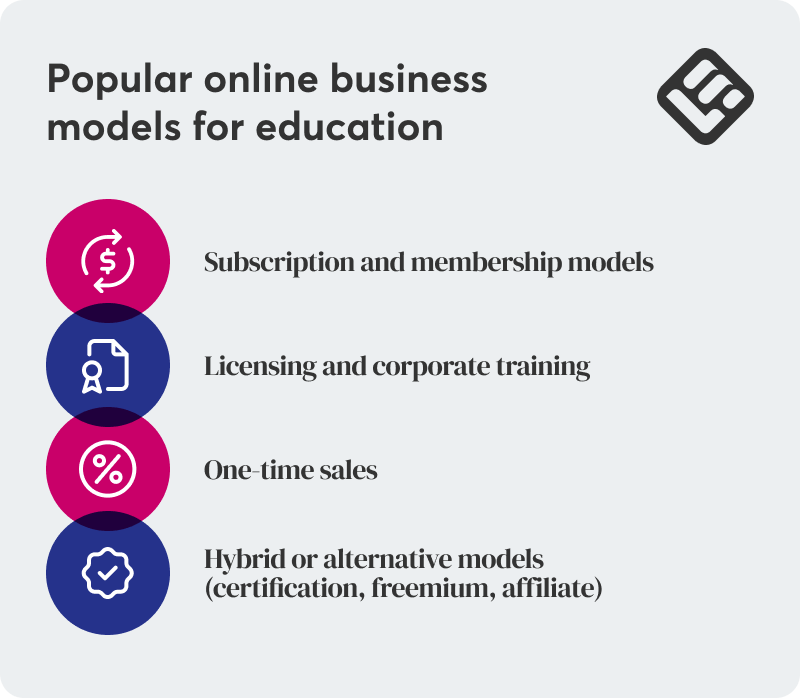
Our experts outlined several models that you can use to grow beyond one-time sales and create multiple revenue streams for online courses.
Each approach offers different advantages to help you grow your course business depending on your goals, target audience, and type of content.
4 edtech industry monetization models for online learning
Subscription and membership models
Subscription-based and membership models are now among the most effective ways to build a steady revenue stream and strengthen learner relationships. A subscription gives learners ongoing access to your content for a recurring fee, and a membership often adds community platforms or premium features that connect learners.
As Vitoriana Kotsia, Customer Success Lead at LearnWorlds, says:
What we’ve seen is a direct link here at LearnWorlds between subscriptions and success. In fact, 37% of our client base is using some type of subscription model, and the key is that they all report spikes in revenue and a threefold increase in learning engagement since they took up this model.
Successful subscription models share a few traits:
You can offer a single-course subscription, an all-access pass to your full library, or tiered pricing strategies. These could have added perks like live events, one-on-one sessions, or online community access for maximum recurring revenue streams.
According to outside research by McKinsey & Company, 30% of consumers cancel subscriptions because they stop feeling fun or fresh. For course creators, that means thinking beyond access and focusing on what keeps learners curious and motivated month after month to see financial benefits.
Vitoriana also reminded us not to get lost in the revenue aspect of these models:
“They’re not just a revenue machine. They should be a promise and a commitment from you as a course creator towards your learners that you are committed, you know, to keep offering continuous value in order to build those long-term relationships.”
Licensing and corporate training
Licensing and corporate training models expand your reach by selling your content to other businesses or institutions. Instead of selling directly to individual learners, you provide ready-made training packages that can be branded or customized for teams.
Brett breaks it down by explaining that this model often involves tailoring existing courses to fit a company’s needs. That might include:
This model is especially effective in sectors where organizations invest heavily in professional development. This could be areas like HR or IT where they want clear, measurable outcomes.
From what I’ve seen, a licensing model works best if you’re a creator who already has proven content. You want to reach new target audiences without starting from scratch.
This model type can open the door to larger contracts and recurring agreements. And long-term, it can also help you build partnerships with organizations that value consistent, high-quality training.
Before licensing digital content, consider:
One-time sales (still relevant)
Even as new monetization methods gain traction, one-time sales remain the foundation for many elearning businesses. They’re simple to set up, easy for learners to understand, and they bring in immediate revenue.
With digital platforms, creators can sell online courses and course material directly to students online, making it easier than ever to reach remote learners and build an elearning business. So despite their setbacks, they may still have a place in your business today.
Brett shared that around 80% of LearnWorlds customers have used the one-time purchase model, with nearly half reporting a 25% increase in revenue from them.

So if this is the model you’re already using, you’re in good company. And it can still deliver results when applied strategically.
You might choose this model if you:
While one-off sales don’t offer recurring income, they’re handy for helping you generate revenue quickly and attracting first-time learners to your courses.
To get more from this elearning business model, I find it helps to think about how you can guide student progress from that one-off purchase to the next step.
Brett explained how one school used a simple upsell prompt to increase repeat purchases:
“When a beginner or an intermediate completes a course…they will automatically get a pop-up that says, hey, congratulations, you completed SQL 101, here’s 10% off your next course for SQL 102.”
Used strategically, and with a strong ongoing value proposition, one-time sales can become the entry point to ongoing relationships and recurring income.
Hybrid or alternative models
You might find that your organization benefits from a combined model rather than relying on just one.
I’d say most do. These hybrid or alternative models can include certifications, coaching and consulting, affiliate marketing programs, or even a freemium model that turns free users into paying customers.
Vitoriana shared one way using a hybrid model could look like:
“There is another model that we see a lot…You offer direct access to your expertise, either this is in a one-to-one setting or a small group setting…It makes a huge difference, because while courses deliver content, what coaching and consulting can deliver is the connection, trust, and building a relationship.”
Hybrid models work well when you want to offer more than just high-quality content. For example, you might:
Each of these options comes with its own advantages and trade-offs. Hybrid models might take more effort to manage, but they can diversify your income and strengthen your value proposition.
Hybrid and alternative approaches might be best for you if you already have a solid foundation and want to expand your offerings without starting over. They can especially pay off if you want unlimited flexibility and need to reach target audiences with different needs and budgets.
Real-world proof: Data and success stories from the WOL session
During this Worlds of Learning session, two guest speakers shared how they’ve built sustainable growth through monetization models on LearnWorlds.
Angela Bush, Founder and CEO of ECE Learning Unlimited, and Jeremy Wall, CEO of GoalMakers, both run thriving elearning businesses and brought their experience to the discussion. Their stories show what diversification looks like in practice.
Jeremy described how his company evolved from in-person coaching to a scalable online learning model. Originally a five-day seminar, GoalMakers’ “mini-MBA” program moved online using LearnWorlds, then expanded through licensing and white-label partnerships with trade associations.
It’s one of the reasons we chose LearnWorlds in the first place, with this ability to create sort of bifurcated courses, programs, landing pages for all of our different partners.
Today, GoalMakers partners with more than 85 trade associations worldwide and serves over 3,000 learners. That shift helped Jeremy’s team pass $1 million in annual recurring revenue—a milestone he attributes to scaling through partnerships rather than one-time course sales.
Angela followed a different—yet no less effective—path.
She started with a single webinar for early childhood educators and turned it into a membership-based learning hub with more than 200 pieces of content and live sessions every two weeks. Over time, she layered in licensing agreements with childcare organizations, which created new B2B income while she continued to grow her member base.
Our business model now is actually multiple opportunities…We started with one webinar, and we never imagined we would be where we are today.
Angela’s membership revenue has doubled year over year, helping her build a more stable and predictable elearning business.
Together, Angela and Jeremy show how different online education monetization models can turn expertise into long-term growth.
Their stories also reflect broader LearnWorlds trends:

If you’re like me, these stats and stories might get you excited to start adopting a new course monetization strategy and models, like yesterday. But first, it’s important to figure out which elearning business models will serve you and your organization best.
How to identify your ideal monetization model to generate revenue: A working framework
Your next step is finding the elearning business model that best fits your edtech business. During the Worlds of Learning session, the team shared a practical decision framework to help you map that out.
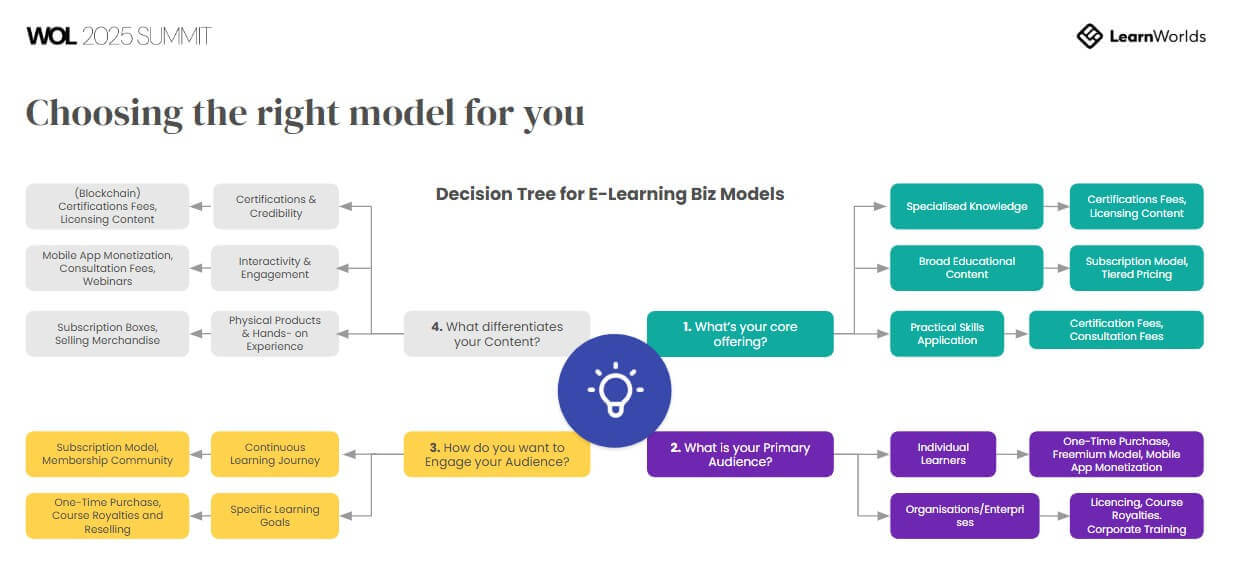
Here’s how to use this framework.
1. Start with your core offering
Think about what kind of learning experience you provide:
2. Identify your primary audience
Who are you building for?
3. Decide how you want to engage your learners
The way you interact with your learners should shape your elearning business model.
4. Highlight what makes your content stand out
Your differentiator can guide both your pricing and delivery.
While using this framework, you also want to think about matching your elearning business model to your goals, products and services, and audience.
Your learning business is built around three things: what you want to achieve, what you offer, and who you serve. The right monetization model is the one that best supports the balance between all three, with the technology to back it up.
Start with your goals. For example, if you’re looking for a predictable way to generate revenue, a subscription or membership creates steady engagement. If you’d rather work with a smaller number of clients at higher value, licensing, or corporate training may suit you better.
Then, look at your product. Specialized or accredited material works well for licensing or certification fees. Coaching, consulting, or blended learning can combine direct support with digital access for a hybrid approach.
Finally, think about your audience. Individual learners value flexibility and tend to choose self-paced or low-commitment options. Organizations want measurable results and consistency, which can make licensing or corporate programs more appealing.
Use this simple checklist to decide or refine your approach:
☑ What type of value am I providing?
☑ Who am I selling to?
☑ How often do I want to engage learners?
☑ What level of customization or interaction do my learners expect?
☑ Which elearning business model supports both my short-term goals and long-term growth?
When you can answer these five questions clearly, your best-fit monetization model usually becomes clear.
💡 LearnWorlds supports all of these approaches, so you can test, combine, and refine what works as your audience and content evolve.
Diverse monetization models support scalable growth
Sustainable monetization for edupreneurs comes from more than making a course to sell. When you add models like subscriptions, memberships, or licensing, you can create a steady income and keep learners engaged long after their first purchase.
With LearnWorlds, you can manage all these models in one place—from memberships to white-labeled corporate training—without needing to use separate tools.
Ready to find your best-fit model? Explore the monetization strategy and framework from Worlds of Learning or book a demo to see how LearnWorlds can help you grow.

Ciera Lamb
Ciera is a freelance content writer and editor connecting companies with their ideal audiences through blog articles and other online content. She approaches her writing with curiosity and research and enjoys the ever-present learning that comes with being a content writer. She is also an avid scuba diver, an aspiring Dutch speaker, and lover of all things nature.
 Back to blog
 Scroll to top
FAQ
Everything you have ever wondered, but were too afraid to ask...

Digital education can certainly be profitable, especially as the market expands and global demand for flexible learning continues to grow. Educational institutions might use online education to provide more opportunities for higher education. Companies might use it to train employees.
How profitable your business is will depend on factors like:
While there may be other business models and various monetization strategies, according to BigCommerce, these are the seven main ecommerce business models of 2025:
Related Articles