
Table of Contents
Setting the right price tag on your products can be quite challenging. Even more so is how to price an online course or a service. However, there is always that sweet spot where your course price is attractive to your learners and where you earn enough money by selling your courses.
Whether you are an experienced entrepreneur in the elearning market or a new edupreneur who’s ready to launch your online courses, we are here to help out.
There is no doubt that deciding on pricing strategies for online courses is of huge importance. Such a decision can help you achieve your business goals, from making a ground-breaking entrance to the market to tapping a new market, promoting your brand, and increasing your overall sales.
But the question remains: how much money can you make from selling online courses? You can take the following quiz and see how much money you can potentially make with an online course.
Factors to consider when pricing online courses
Your course is always worth much more than you give it credit for. That is because an online training course is the amalgam of your work, know-how, life experiences, years of learning, and education. What you are providing is a service for your potential students to share your knowledge, a highly valued commodity.
Generally, the base of your course pricing should focus on the following five pillars:
Before getting down to business and analyzing the process of pricing online courses, we will make a quick walkthrough of these five pillars.
Pricing rule of thumb
When considering the average cost of online courses, it’s a good rule of thumb to price most of your comprehensive courses well above $100.
Reserve lower price points, below $100, for shorter or introductory courses. Smaller courses might have a simpler course topic, smaller course content, or not a high added value for your target audience. Keep in mind that your whole brand identity as a quality educator is being mirrored in your price.
Some industries might come with lower price expectations. Plan ahead so that you can invest time to deep dive and research the competition, your target audiences, and your market for price benchmarks.
The high value of education
Think of Ivy League universities. Usually, their course pricing reflects their quality. Renowned universities such as Harvard, Oxford, and Yale do not charge the same tuition as a community college; they do apply a premium price.
Pricing is part of their strategy to maintain their image as a high-quality education destination, using that money to further invest in the quality of education offered.
Social and networking through an online school
When using LearnWorlds as your online course platform for creating, selling, and promoting your online courses, you give access to your learners a wealth of robust features that they can benefit from.
One of the most important benefits is the added value option to join an online community of like-minded learners. A common ground for communicating, networking, and engaging with peers. It goes beyond the standard educational experience or the simplicity of a Facebook group.
Education is not only the material
If you were to sell an ebook, you would probably price it between $10 and $20, yet you are not selling an ebook, but you are providing your learners with a wholesome educational experience that consists of reading material, workbooks, worksheets, quizzes, exams, certification, videos, and so many more learning units.
An online course is meant to be interactive, easy to absorb knowledge, and much richer in terms of learning experiences.
💡Check our step-by-step guide on how to sell your online courses.
Exclusivity of content
Online courses offer valuable knowledge not found anywhere else. Your years of experience are reflected as a high perceived value-adding content in a multimedia format for your target audience.
In the bottom line, learners, students, and clients pay an amount of money to access something they value. It is their only opportunity to get into an exclusive community with high-quality knowledge, so you should price your courses accordingly.
How to price your online course
As is expected, not all your students will have the same goals when enrolling in your courses. Some of your offerings might be considered “bonus” or overpriced and not needed by some. So if you are wondering how to price your online course, a good way to go about it is by introducing multiple courses or membership options and course bundles in different online course pricing tiers.
Different prices for the same products can also be used to test prices and give more options to potential customers. You can see the price point where people respond more.
Your end goal is to increase your conversion rate (eg more enrollments) and generate greater income. This can be achieved with different combinations of prices and student numbers. Testing different pricing strategies for online courses can help you see which ones hit the sweet spot.
How presentation and anchoring change what buyers will pay
At LearnWorlds’ 2025 World of Learning summit, in a session called “Use Buyer Psychology to Sell Learning at the Right Price,” behavioral economist Melina Palmer, pricing strategist Justin Neale, and Trainwell founder George Elossais sat down to unpack how psychology decides what people are willing to pay for training.
Palmer opened with a framework she calls “it’s not about the cookie,” built around a simple story: the same bakery, the same cookies, the same line out front, but one version of the pitch has people buying eagerly, and the other has them writing an angry review before they’ve even tasted anything. Her conclusion:
“How you present the information and all the things that happen before people get to the price is much more impactful on whether or not they’re going to buy… it also didn’t have anything to do with the price.”
Two identical offers, presented in a different order or context, can be bought or rejected for reasons that have nothing to do with the number on the price tag.
That’s exactly what’s happening with tier order. Testing different combinations of prices is one thing, but the sequence you present them in changes the outcome just as much as the prices themselves do. Palmer explains why most creators get this backwards:
“It feels natural to us to say, start low and work our way up to the most expensive thing, but our brains anchor on numbers and prices especially… 500 feels way easier when we started at 5000.”
Lead with your $5 or $5/month tier, and your $500 course reads as a big ask. Lead with a $5,000 done-with-you package instead, and that same $500 course suddenly looks like the sensible middle ground. Nothing about the offer changed, only the order in which it showed up.
Palmer pairs this with a second, related tactic: adding a tier you don’t actually expect to sell much of, purely to make your real offer look better by comparison.
“I always tell people to create a wingman for the thing that you really want to sell… its job as the wingman is to help the $500 offer look like a really great one, and help repurpose and shift that whole conversation.”
In practice, that might be a rarely-purchased $2,500 VIP add-on sitting above your core course, and its job is to make the tier below it feel like the obvious choice.
The 4 tiers of online course pricing
When pricing online courses, it’s helpful to think in tiers that reflect different learning needs, content depth, and levels of customer commitment.
The table below outlines four common pricing models, with guidance on when each is most effective.
Now let’s explore each pricing tier in more detail to help you make informed decisions when pricing courses for different audiences and objectives.
Free
Not all your courses should be paid for. You can earn a lot more than an income by giving out free courses. Free courses can generate leads for your more expensive online courses or serve as a way to showcase your expertise. It is the first point of contact to create a rapport.
Who doesn’t enjoy good communication, creating relationships, and a sense of familiarity? This is a very engaging method that will help you sell more courses.
If your business is not only about education and training, then free courses can help you attract potential customers for your other services or products. Your next customers may be people whose first online course was a freebie you provided and that they appreciated. So, they proceeded with purchasing a paid online course from you to further benefit from your expertise.
Whether the course topic is about corporate training, invitations for speakers, writing jobs, or agency work, free courses can get you closer to making a deal.
“Free” doesn’t translate to “cheap”
Keep in mind, though, that “free” doesn’t translate to “cheap.” There is a common misconception about this. You should invest quality time in the course creation of your free courses, as they must reflect your brand’s quality. These free courses set the expectations for what the customer might expect from the paid and more expensive online courses.
You shouldn’t always offer free courses, but there are times when you should. Basically, you want to give away samples of what you’ve got so that someone will have an incentive to join and take a look at it.
You can offer, for example, a free mini-course before the launch of a masterclass or major online course launch. You can give out a free course so that potential customers can review the course and see if they want to pay for full access.
Other cases when you should give out a course for free:
Paid courses
This is the most commonly used pricing strategy for online courses as it offers the basics at a price that is relatively affordable.
The price in this tier is usually low in order to meet the needs of customers who are just starting out, but are possibly not sure how long they want to stay. Bear in mind that low prices attract low-quality customers, and investing too much in it doesn’t benefit your business goals altogether.
Most paid courses come with a one-off payment.
Subscriptions
With subscriptions, you offer your customers a recurring payment option where they can pay for their membership in the course on a daily, weekly, monthly, or yearly basis. These online course pricing options allow the possibility for more alternatives to suit the financial needs and preferences of every customer.
A membership site provides gated content that gives access only to subscribers. Instead of selling one-off online courses, for example, you allow your students, clients, or fans to keep an active (paid) subscription in exchange for accessing offers, deals, and a community where they can network.
Membership sites work well with subscriptions, and they have different levels of access to suit different preferences.
Premium
For the premium course, you can charge your customers more and consider using payment plans where you can either pay once or pay for up to six months or yearly. You can go premium when you offer exclusive content or a more extended course offering more features, or an advanced course, eg towards winning certification in the medical field, etc.
Here are the most important reasons why you should start with a premium price in order to fine-tune your pricing strategies for online courses:
Great marketing approach
A higher price will allow you more flexibility when giving our discounted courses with coupons, attract a better clientele, have fewer communication hassles, and reach a higher class of clients who can afford more expensive products, and can expand your business.
Online courses are intangible products and should be marketed and priced as such.
Better advertising budget
Just selling the first few courses will enable you to spend more on advertising early on and attract more customers. A better advertising budget will help you keep up the prices and keep earning from your courses, thus creating a decent passive income with less work.
Do not compete on pricing
The worst way to do marketing is by competing on pricing. You can offer discounts to attract difficult or price-sensitive clients, but a price competition with someone who offers a cheap course is not a solution.
People buy because there is a connection—aka an overall buying experience—they perceive a higher quality or find the solution to their problems in your services.
Neale is specific about the cost of competing on price: “Don’t compete on price. I mean, you do end up attracting the worst customers, and you’ll often end up scaring away the best customers.” Price-sensitive buyers tend to be the highest-maintenance, lowest-loyalty customers a course business can take on, while the buyers who’d get the most value from a premium offer quietly self-select out the moment price becomes the main pitch.
Trainwell founder George backs this up with what he actually did in his own business, which sold insurance sales training into a market flooded with cheaper alternatives. Rather than compete on price, he changed the format entirely (swapping long recorded Zoom sessions for short, scripted, professionally produced videos) specifically so his offer couldn’t be lined up feature-for-feature against anyone else’s.
As he explains, “people always wanted to compare… but if you make it something they can’t compare, you can pick the price.” Once a buyer can’t do an apples-to-apples comparison, price stops being the deciding factor.
Partners and affiliates
Partnering with others and affiliates will be more interested in selling a premium product than a cheap one, as they will be making a bigger profit for less work.
Better education experience
A smaller group of quality learners who can afford your premium course will provide a better experience for them. People tend to connect much more in groups of 7-9 people, and even online learning can become crowded after a few dozen people in each course.
Focus on the quality of their experience and how you can offer personal guidance, training, and education to each one of your select students, and they will recommend you to more of their premium friends.
Higher course engagement
A higher price comes with a higher engagement rate. Learners will be more involved and interact more when they pay more. An impulse buy of a low-priced course is easily forgotten, but a premium course will get them engaged and focused on their learning objectives. An incentive that should also be part of the learning process.
Neale grounds this in something closer to consumer behavior than course design, using a comparison that maps directly onto premium courses:
“You go to a chemist and there’s a shelf full of painkillers. You’ve got the shop, own brand, generic painkillers for 30 cents, and then you’ve got the premium brand, which is 10 times the price… you’re not going to take a risk by buying the cheap option.”
The buyer isn’t evaluating ingredients but evaluating risk, and a higher price reads as a safer bet when the outcome actually matters to them.
What happens next is the part that matters for engagement specifically: “They will actually get a better result from it the more they pay, because their expectation is that it’s going to be better, and they actually make it better.” Applied to courses, the premium price is all about setting an expectation that makes those buyers show up, do the work, and finish in a way that a $10 impulse purchase rarely does.
💡Find out how you can set your online course pricing with LearnWorlds:
Setting up an online course pricing strategy
Understanding who your customers are can help you decide on the price. Better yet, it can help you come up with a few great online course pricing strategies.
You need to delve into more specifics and look at other underlying factors:
Calculate the value of the outcome
The most important pricing point is the value your customers will receive. How much is the course, training, or knowledge affecting their lives?
Are you doing a course that will allow someone to get their dream job, have a healthier and happier life, or just get rid of mundane everyday issues? Taking the chance to think about this is crucial because it can help you put a price on the significance your course offers to the world.
This logic gets sharper the moment your buyer is a business rather than an individual. At the same WOL session, pricing strategist Justin Neale made the enterprise version of this argument directly:
“The enterprise customers, they’re not looking for to buy your training course. They’re looking for you to solve a problem for them or to give them an outcome that they need… it’s not so much about the training course itself, it’s about the result that you will deliver.”
That distinction changes how the course should be priced. Neale’s advice: “You don’t sell your training at a cost per head… you think about what’s this value to the organization, and you price accordingly.”
In practice, this means resisting the instinct to charge per learner or per seat when the client is really buying a business outcome (faster software adoption, lower attrition, reduced risk), which is worth far more to their organization than a per-head calculation would suggest.
Consider course length
Sometimes, length matters. While most people will value highly a course that brings them quickly to their results, eg “How to fix your relationship – 2 hours of coaching,” some courses for professional education might require hours of videos, assignments, quizzes, and activities. You should take into consideration the value, the length, and your effort.
Research the competition
Whether it is other online academies, universities, or training organizations, you should know your competition and what your clients are paying for it. Competing on course pricing is not a good idea, but knowing what the market prices are in your niche can help you set up your prices accordingly.
A competitor can offer physical workshops, online training, courses in a marketplace, free YouTube videos, and email courses. Take a good look at the offering, where the free resources stop providing value, and where your competitor’s pricing begins.
You can find a 10$ course on marketplaces like Udemy or Skillshare, but does it offer the same degree of depth and instructor interactivity with you?
See if other course providers offer low, medium, or high prices for their courses, and try to understand why. Is it the value of the offering, their branding, or something else behind it? Your competitor’s price is your starting point, and from there, you can price more or less depending on where you want to position yourself.
Work with your competitors’ price expectations
In some cases, your competitors might have set a price expectation. You can work with it by:
Investing in branding and industry credibility or authority plays a huge role in selling and pricing. The more people value your personal (or company’s) brand, the more you can charge for your training courses. Being a published author, an industry expert, a speaker, getting reviews and media exposure can help to increase your prices.
Intro videos on the landing pages or free sections/courses can also increase the familiarity of the students with your brand. Guest posting on authoritative sites and getting featured in podcasts will also increase your branding.
Create income goals
Regardless of what personal goals you hope to achieve, you need to set some income goals for your courses. Is your goal to get some money on the side with minimum effort or get this into a full-time business, and what would you need to achieve that?
Initially, you should calculate any expenses for equipment and services you might need, and then set specific goals for:
As you would imagine, income goals inform the pricing strategies for online courses. Think of your current customers and network. If you have an email list of one thousand business contacts, how many do you expect to convert to paying students?
You can go with a conservative calculation, such as 1% or if you have done business with them before and you know that they could be interested, you could expect more. Would that 1% be enough to make your income goals with a 50$ pricing or a 300$ pricing? The cheaper the price, the more sales, but the less total income.
See the table below of expectations as an example for 1000 email list contacts.
One good tactic you can use is pricing highly at the beginning and getting the high-spenders early on, but later sharing a discount coupon with those who did not buy, increasing your total income potential. Just be careful not to share the discount with the customers who paid in full.
Move an audience from free to paid (without apologizing for it)
How to introduce a first paid tier to an audience used to getting everything free? Palmer’s answer refers to the framing you need to avoid:
“Don’t make it about you and be like, hey, we’ve done this for free for so long, and we just can’t do it anymore. Please help and pay us money like that. Never, ever, ever goes over well.”
The fix is introducing something genuinely new (an outcome, a format, an access level) and pricing that, instead of asking people to start paying for what they already had.
Neale supports the idea behind making that leap: “People are less price sensitive than you think… it’s all about the additional value that you’ll be bringing them.”
Show honest scarcity
Scarcity is key as it can be used as a legitimate pricing lever (and not just a marketing trick), provided it’s real. Palmer’s says: “You can really lean into scarcity as an option. So if you wanted to say that you have this for a limited number of spots.” A genuine cap on cohort size or seats builds trust. A countdown timer that quietly resets after it hits zero destroys it the moment a buyer notices.
Charge more for a narrower promise
The more specific a course is to one buyer’s situation, the more it can charge. George Elossais supports this:
“You could niche down further. So if you had a general time management community… you charge for time management for sales people, or you charge even a little bit more for time management for insurance sales people… the more it feels like it’s made for them, the more likely they are to pay.”
The pattern works well beyond fields like insurance: a course built for “small business owners” can charge less than the same course rebuilt for “small business owners in their first year of hiring.”
Understanding different ranges of course pricing
Course pricing isn’t static, and it can shift based on timing, audience readiness, and business goals. In this section, you’ll see how low and high pricing strategies serve different purposes throughout your course lifecycle.
Low pricing
During a pre-launch, an early sales period, or a testing period, you can have a lower price. This will allow you to collect testimonials, feedback, and some early clients and budget to use later on.
A deadline before a price increase is also helpful to push potential customers to buy earlier, especially if they are price-sensitive. Discounts should be a last resort for difficult customers, but they may also backfire and undervalue your course. However, avoid massive discounts and long-term discount periods.
In the following instances, a price decrease is considered to be a smart move:
High pricing
More often than not, it’s better to avoid pricing too low. Why? There are a couple of reasons:
💡If you’re still unsure about how to price online courses, consider saving the following visual guide—it might come in handy when you least expect it.
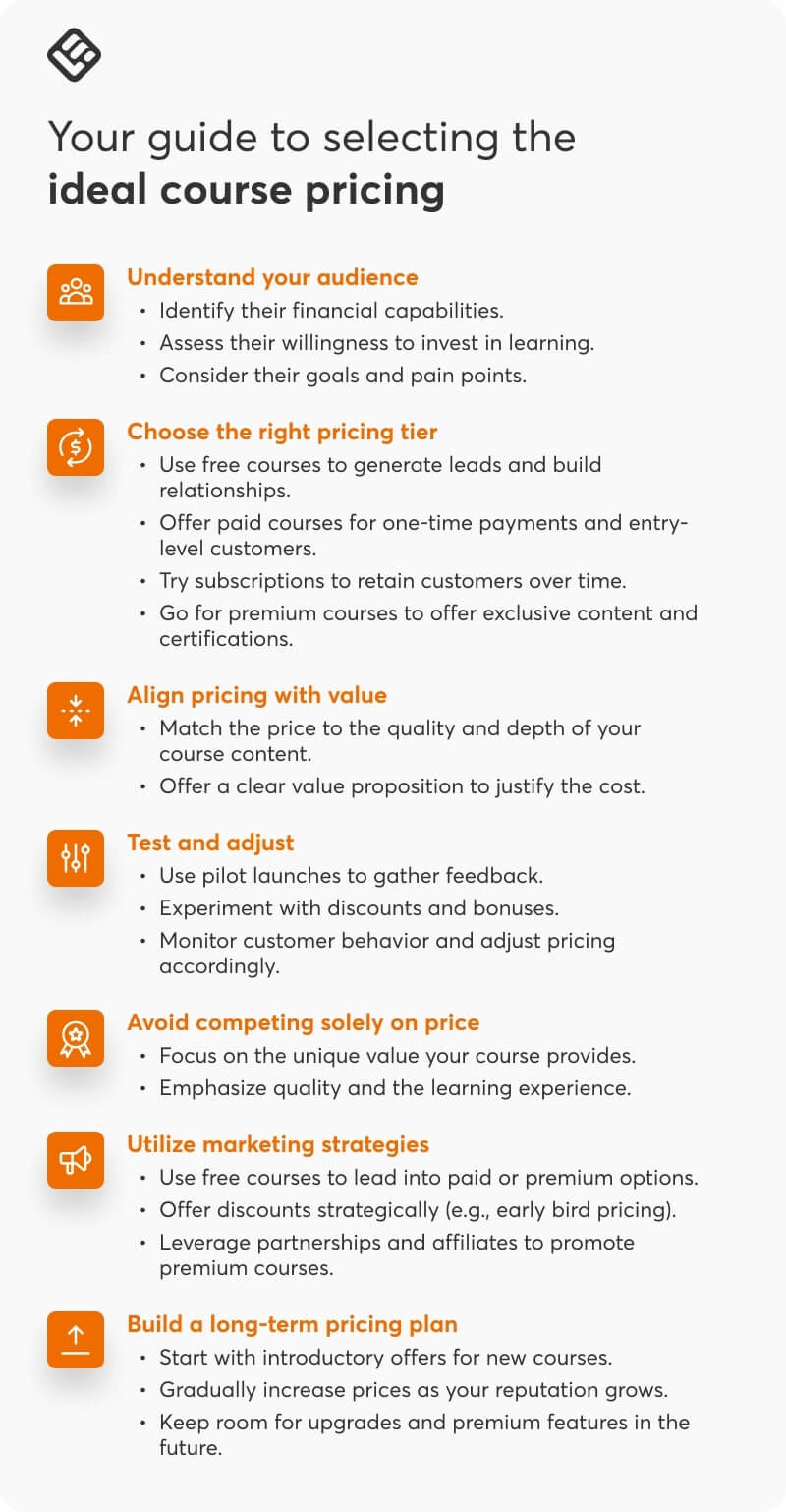
The real secret to pricing online courses: Testing and iterating
Whichever price you decide to go with when determining the price of an e-learning course, make sure to keep evaluating the quality of the course, your brand, and market trends. Test your price again and again until you find the perfect equilibrium.
Holidays and discounts help you drop your price and see your audience’s response, while exclusive content or testing a new price from a hidden page can test your audience’s willingness to go higher. Creating surveys, feedback questions, and focus groups is also great for asking your customers directly what they think of your price.
But, let’s be honest, anyone would prefer 5 x $500 rather than 100 sales for $10. When pricing online courses, you can either go for the masses or an exclusive set of premium students. You can even offer different levels of courses for different prices and see what works for you.
Tyler Denk, Co-founder & CEO at beehiiv, also shares an interesting perspective on setting the actual course price tag.
“Creators have an old-school habit of testing price points without focusing on the energy behind their offer. Course pricing generally has different audience perceptions at different times because of the psychological momentum. For instance, a customer would be highly motivated after a seminar, and that’s when even a higher price would be good for signing up the lead. However, testing the same during a mid-low energy window is difficult; it’s hard to even earn a sign-up until you have a strong value proposition. Therefore, utilizing the pre-built emotional momentum plays a crucial role in testing, altering, and optimizing their course pricing.”
Test all your theories and ideas before making a decision, and best of luck setting up your own pricing strategies for online courses.
Plan your strategy with an online course pricing calculator
Still not sure where to start pricing your course? Our online course pricing calculator helps you estimate potential revenue based on your price point, audience size, and conversion rate. It’s a quick way to test different scenarios and set realistic income goals.
Use it to explore how pricing tiers, promotional discounts, or membership models might impact your earnings—before you launch.
Make online course pricing simple with LearnWorlds’ all-in-one platform
Choosing the right online learning platform can make a big difference when pricing courses. LearnWorlds offers flexible course creation and built-in guidance to help you match your pricing strategy to your course value, audience, and goals.
Whether you’re launching your first mini-course or scaling a membership model, LearnWorlds’s solutions support multiple pricing options—so you don’t have to guess what works.
These LearnWorlds capabilities help you take control of online course pricing:
Setting pricing strategies for online courses doesn’t need to feel overwhelming. Get started with LearnWorlds today to test, adapt, and scale with tools designed for modern course creators

Kyriaki is the Organic Content Strategist at LearnWorlds, where she writes and edits content about marketing and e-learning, helping course creators build, market, and sell successful online courses. With a degree in Career Guidance and a solid background in education management and career development, she combines strategic insight with a passion for lifelong learning. Outside of work, she enjoys expressing her creativity through music.
 Back to blog
 Scroll to top
FAQ
Everything you have ever wondered, but were too afraid to ask...

Premium courses with certifications or specialized knowledge may even exceed $1000.
Compare with competitors, monitor conversions, and gather feedback to assess whether you’re ready to introduce a higher price point or adjust your messaging to reflect value more clearly.
To decide how to price your course offering, consider the duration, complexity, target audience, and the perceived value of your course. Use a tiered course pricing approach to align with learner expectations.
A stronger value proposition helps you sell your course more confidently and supports more ambitious pricing strategies.
Keep them focused and outcome-driven. Even a compact offer can support a long-term pricing course strategy.
Be sure to factor in development, marketing, and ongoing updates when setting your price—and revisit it as your offer matures.
Using a platform like LearnWorlds helps reduce the overall cost by offering built-in tools for flexible course creation, marketing, and delivery—all in one place. This makes it easier to manage your budget and focus on creating value.
Related Articles