
Table of Contents
Key takeaways
- A subscription model turns your existing course content into predictable monthly income, but it only works if you have enough content to justify recurring payment and a plan to keep adding more.
- How you package, price, and present your subscription matters as much as the content itself, from choosing between a structured path and an open library to communicating ongoing value.
- Acquiring subscribers is only half the job. Retention is what makes a subscription business financially sustainable over time.
You have built courses, grown an audience, and proved that people will pay for what you teach. But every month, you start again from scratch promoting, launching, selling. Revenue comes in when you push for it, and quiets down when you stop.
If that sounds familiar, you are not alone. The launch model works. But at some point the question changes. Not “how do I sell more courses?” but “how do I build income I can actually count on every month?”
That is what this guide is about: the decisions you need to make before you switch, how to package and price your content, and what it actually takes to keep subscribers paying month after month.
If you have the content and the audience, you are closer to making this work than you think.
Why course creators are moving to subscription-based course selling
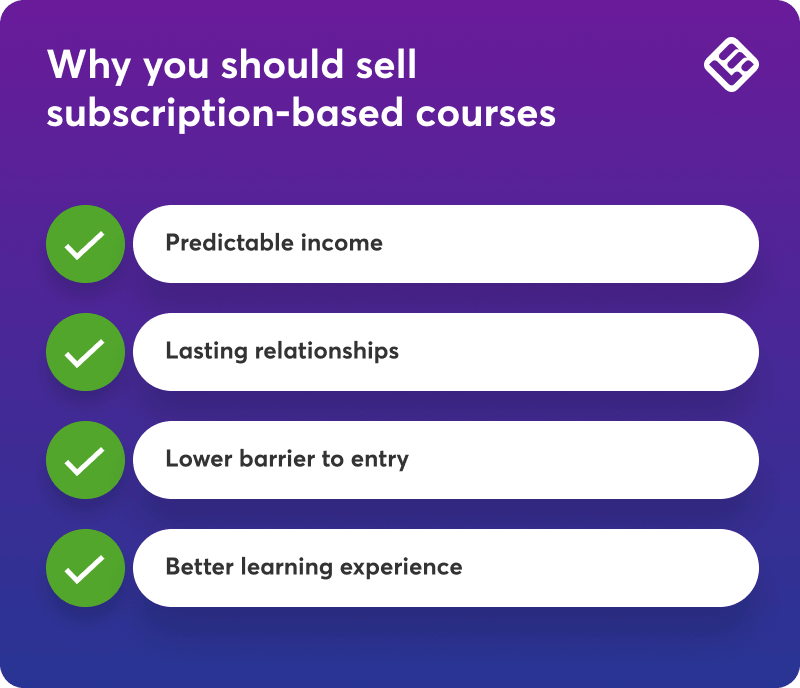
More people now prefer ongoing access to content over one-time purchases, for the same reason they prefer Spotify over buying individual albums. There’s more value in a content library than in a single item.
For course creators, the business case is equally clear. A subscription model for online courses generates Monthly Recurring Revenue (MRR): income that arrives monthly whether or not you are actively selling. That predictability allows you to plan and grow your course business more safely.
There are also specific situations where subscriptions make particular sense:
- If you regularly update your courses with new content, a subscription rewards learners for staying and upgrades their experience at no extra cost.
- If your courses carry a high one-time price, subscriptions lower the barrier to entry. Learners pay over time without committing to the full cost upfront, which widens your potential audience.
- If you want to build loyalty rather than one-off transactions, a subscription puts you in an ongoing relationship with your learners rather than selling to them once and hoping they come back.
Subscription vs one-time course sales: What changes when you move to a subscription model
A one-time sale asks “Is this course worth the price?” A subscription asks “Is ongoing access worth the monthly fee?” That is a different value proposition, and making it work requires thinking differently about three things:
- How you package content: Instead of selling individual courses, you group them into a program, like a structured learning path or a curated collection, that justifies paying month after month.
- How you think about content: You don’t need to rebuild what you have, but you do need enough of it, and a plan to keep adding more. If you currently have one or two courses and no clear roadmap for new content, a subscription is premature.
- How you measure success: Conversion rate (one-time sales) becomes less important. Now you care more about churn rate (how many subscribers leave each month) and lifetime value (how long they stay and how much they pay in total).
You can continue selling individual courses alongside a subscription. The two models coexist.
How to package your existing courses into a subscription
There are two broad ways to package your courses into a subscription: a structured learning path your learners must follow or a self-guided one they can build on their own.
| Structured learning path | Self-guided learning path | |
|---|---|---|
| Learner type | Beginner to intermediate, needs direction | Intermediate to advanced, self-directed |
| Content structure | Sequential, each course builds on the last | Independent, each course stands alone |
| Best for | Skills with a clear progression (languages, photography, coding) | Broad subjects with no single right order (marketing, cooking) |
| Commitment length | Easier to justify annual subscriptions | Better suited to monthly plans |
Structured learning path
This approach is sequential. Learners start at the beginning and progress through your courses in order, with each one building on the last. It works best when your content has a natural progression (beginner to intermediate to advanced) and when there is a clear outcome at the end.
Think of a photography school that takes learners from camera basics to lighting, composition, and editing. Or a language course that moves from everyday vocabulary and grammar through to advanced conversational skills. Learners can see exactly where they are going and how long it will take, which makes it easier to justify a longer commitment.
Self-guided learning path
This approach is open. Your courses cover a subject in depth, but learners choose what to explore and when: each course stands on its own. It works well when your audience already knows enough to decide what they need next, or when there is no single right order to learn the material.
This approach would work for a digital marketing program with separate courses on SEO, email, paid ads, and social media. Or a cooking school where learners jump between cuisines, techniques, and skill levels based on what they already know or care about.
Neither approach is better than the other. The question to ask is: does my content tell a story with a beginning and an end, or does it work more like a resource library? Your answer points to the right structure.
How to price and sell subscription-based online courses
Pricing a subscription is different from pricing a course. A few principles grounded in how this actually works:
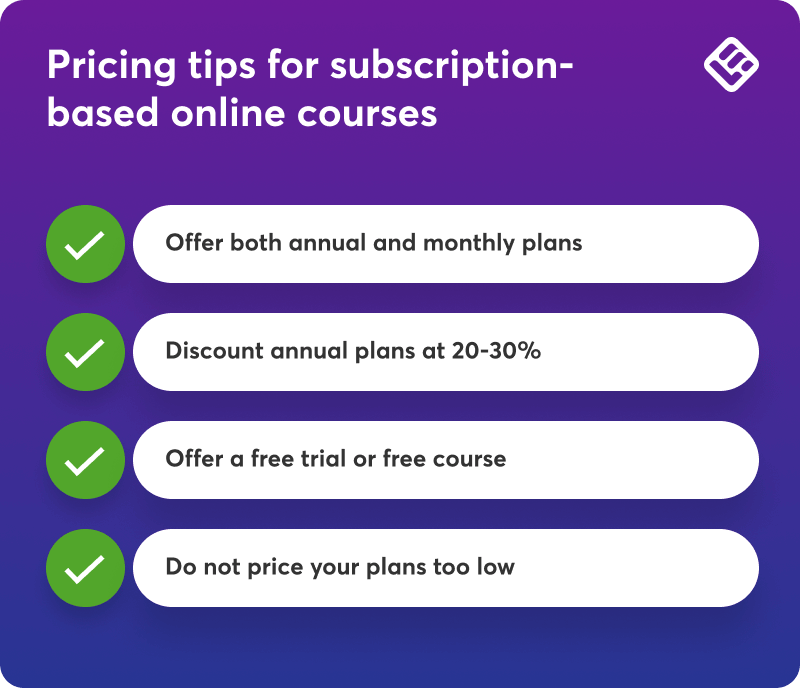
Monthly vs. annual: offer both, incentivize annual
Monthly plans lower the barrier to starting and the learner is committing to less. Annual plans are better for your business though: the churn is lower and the cash flow is steadier.
If you want to stir learners toward annual plans, price them at a 20–30% discount. A learner paying $19/month who is shown an annual option at $149 (roughly 35% off) has a clear financial incentive to commit.
Offer a free trial or a free entry-point course
Letting the learner experience the quality of the content before asking for a recurring commitment is an effective conversion mechanism.
A free introductory course, or a 7-day free trial, reduces the perceived risk of subscribing to something unknown. It also pre-qualifies subscribers: the ones who complete the free content and still subscribe tend to churn less.
Do not price too low too early
The temptation is to set a low price to attract volume. The problem is that low-priced subscribers are the first to cancel when they are not actively using the content, because the cost of cancelling feels lower than the cost of staying.
A subscriber who pays $49/month has more psychological investment in getting value from the content than one paying $9/month. Price reflects value, to you and to them.
How to create a subscription website
On to the technical details now. On your subscription page, make sure you:
- Show the full course library so learners understand the depth of what they are getting
- Communicate what gets added and how often. A subscription that feels like it will grow is worth more than one that feels static.
- Lead with outcomes, not features. “Go from beginner to confident Italian speaker in 90 days” sells better than “Gain access to 12 courses”
- Feature testimonials. Nothing converts a hesitant visitor like a learner describing a real result.
After you launch: How to retain your learners
In a subscription model, every subscriber you acquire will eventually decide whether to renew. That decision is made based on how much value they experienced during their subscription.
What drives retention in subscription-based online courses specifically:
1. Demonstrate progress. Learners who feel they are moving toward something are more likely to renew. Add certificates or badges to keep them motivated.
2. Add new content. A consistent content calendar prevents the “I’ve seen everything” cancellation. Even one new course per month gives subscribers a reason to stay.
3. Build a community. Learners connected to others churn less. Learning communities, discussion spaces, live sessions, and cohort groups create a social investment that content alone cannot.
4. Reengage learners at risk. A learner who hasn’t logged in for 30 days is at risk. An automated “here’s what you haven’t explored yet” email can win them back before they cancel.
💡Here’s what this looks like at scale: one creator grew a 200,000-member group into a 1.2-million-member community by pairing a free discovery layer with a smaller, more intimate paid space. This is the same free-plus-premium structure that keeps subscribers renewing instead of canceling.
How LearnWorlds supports subscription-based online courses
If you are building your school on LearnWorlds, the infrastructure to create subscription based offerings is already there.
Subscriptions are built on top of Learning Programs, which come in two forms:
- Learning Path for structured, sequential content
- Learning Collection for a flexible library learners explore at their own pace
Both support monthly or annual pricing and connect natively to Stripe, which handles renewals and failed payments automatically.
You can also run multiple subscriptions simultaneously (one for each Learning Program), which means you can serve different audiences or skill levels with separate offerings, all within the same school.
To get started you need a Pro Trainer plan or higher, and Stripe connected as your payment gateway. Learn more about subscription plans in LearnWorlds.
Stop starting from zero every month
If you have the content and the audience, a subscription gives you something one-time course sales never can: income you can plan around.
LearnWorlds can support this with an intuitive membership website builder, AI powered content creation, built-in community, and support for different payment and pricing options, all from one place.
Try LearnWorlds now with a 30-day free trial.
FAQs
Subscription-based learning is a model where learners pay a recurring fee, usually monthly or annually, to access a library of courses or a structured learning program. Instead of buying courses one at a time, they get ongoing access to everything included in their plan, with new content added over time. For course creators, it means predictable monthly income rather than revenue that spikes and fades with each launch.
You need three things in place before anything else: a platform that supports recurring payments, a payment gateway that handles automatic renewals (Stripe is the most widely used), and a way to gate your content so only active subscribers can access it.
Once those are set up, the practical steps are straightforward: group your courses into a program or library, set a monthly and annual price, build a subscription landing page that shows what’s included and what learners will be able to do, and add a free trial or a free introductory course to reduce signup friction.
Yes, but only if you have enough content to justify recurring payment and a plan to keep adding more. The profitability comes from compounding: every subscriber you retain adds to a revenue floor that next month’s new subscribers build on top of. A small, loyal subscriber base can generate more revenue than a large but churny one.
Start by auditing what you already have. Do your courses have a natural progression that works as a structured path, or do they work better as an independent library? Once you know what you are selling, set your pricing (offer both monthly and annual), create a free trial or entry-point course to reduce signup friction, and build a subscription page that leads with outcomes rather than a course count.
The most sustainable way to sell online courses is to combine one-time course sales with a subscription offer: the two models coexist and serve different buyer intentions. One-time buyers want a specific outcome from a specific course. Subscribers want ongoing access and growth over time.
LearnWorlds allows you to run both simultaneously: individual courses available for purchase alongside a subscription program that gives access to your full library. Building a free entry-point course or a lead magnet funnel is typically the most effective way to convert new visitors into paying learners in either model.

Androniki Koumadoraki
Androniki is a Content Writer at LearnWorlds sharing Instructional Design and marketing tips. With solid experience in B2B writing and technical translation, she is passionate about learning and spreading knowledge. She is also an aspiring yogi, a book nerd, and a talented transponster.
 Back to blog
 Scroll to top