

Table of Contents
Key takeaways
- What separates teams that get ROI from AI is operational discipline. Build the system first and treat AI as one part of it.
- Start with your biggest bottleneck. Chasing the flashiest use case is what stalls most AI projects before they show results.
- Keep a human in the loop for anything involving judgment, expertise, or public-facing content.
If you sell online courses or run a learning business, you’re producing more content than ever: blog posts, SEO pages, emails, social, and the course material itself. And you’ve probably folded AI into that work one tool at a time. Someone tried ChatGPT for a headline, someone else started using it for outlines, and now everyone has a favorite AI habit and no shared process. That works for a while. But it stops working the moment you need consistency, speed, and quality at the same time, across a growing content operation.
The shift that matters isn’t finding a better tool. It’s moving from scattered individual hacks to a system the whole team runs on. One that keeps working as your content output grows, whether you’re running a solo course creator business or a small content team.
Here’s how to make that shift, based on a recent LearnWorlds session with Margarita Loktionova, Content Marketing Lead at Semrush, and Maddy Osman, Content Operations Consultant and the Founder of The Blogsmith.
The problem: AI chaos, too many tools, no clear strategy
There’s a lot of AI hype right now, and it creates real FOMO—the sense that everyone else has cracked this and you haven’t. At the same time, plenty of businesses and reports say AI integration isn’t delivering the ROI they expected.
In most cases, the AI is doing its job. What’s missing is the content operation underneath it. Three patterns are common:
- Some teams move fast and produce a high volume of content, but quality suffers.
- Others move too slowly for what content marketing now requires.
- Only a small number build a structured, efficient content engine, and for those teams, AI is genuinely an advantage.
As Margarita put it:
“AI itself is not the difference. The operational discipline is. AI is part of the system, it’s not the system itself.”
Margarita Loktionova, Content Marketing Lead at Semrush
Expecting AI to replace your team and fix everything from day one is unrealistic. Ignoring it entirely is just as risky. The starting point is neither extreme, it’s auditing what you already have.
How to build a content system that grows with your online course business
Before adding any AI tool, analyze your existing process:
- Audit each stage: Research, writing, editing, publishing, distribution.
- Review your project management setup and how tasks actually move through it.
- Ask the team directly: Where does work get stuck? What feels unnecessary? What repeats endlessly without anyone questioning it?
Those questions point you to the tasks worth automating first—high-frequency, manual, but standardizable work. Margarita shared a real example from her own team:
“We have dozens of products, and every time a naming is changed or a new feature is added, you need to go in and edit, let’s say 200 articles. This is a real bottleneck that just dramatically needs AI and automation.”
Margarita Loktionova, Content Marketing Lead at Semrush
Once bottlenecks are mapped, three things need to be in place before scaling further:
- Clear goals: Specific objectives and metrics for what AI integration should achieve.
- Solid content operations: The audit above, formalized.
- Tools and an automation layer: Added last, not first.
Her advice on where to start:
“Start with your biggest bottlenecks and not the coolest use cases—this way you can actually see real results.”
The framework: Three levels of AI maturity
Once the fundamentals are in place, AI adoption tends to move through three distinct stages. Most teams pass through all three rather than jumping straight to the last one.
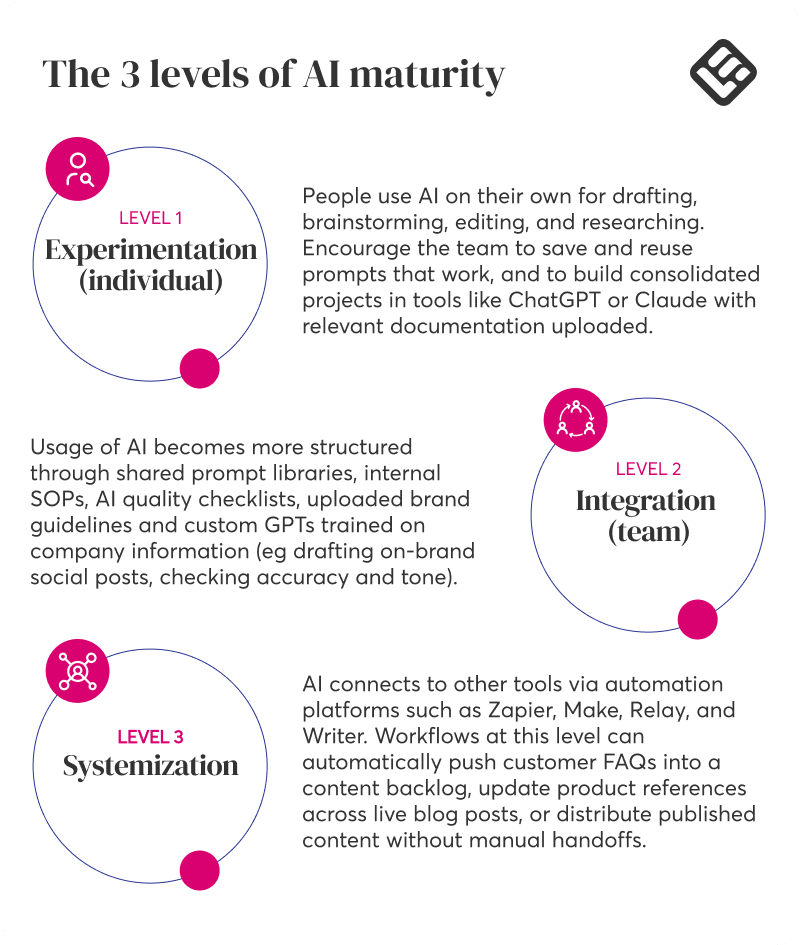
Level 1: Experimentation (individual)
People use AI on their own for drafting, brainstorming, editing, and researching. Encourage the team to save and reuse prompts that work, and to build consolidated projects in tools like ChatGPT or Claude with relevant documentation uploaded.
If you’re creating courses directly inside your platform, this is also where LearnWorlds’ built-in AI tools can absorb some of that early experimentation.
Level 2: Integration (team)
Usage becomes structured through:
- Shared prompt libraries
- Internal SOPs
- AI quality checklists
- Brand guidelines uploaded so output follows tone of voice and product facts by default
- Custom GPTs trained on company information (e.g., drafting on-brand social posts, checking accuracy and tone)
Level 3: Systemization
AI connects to other tools through automation platforms like Zapier, Make, Relay, and Writer. Workflows at this level can push customer FAQs into a content backlog automatically, update product references across live blog posts, or distribute published content without manual handoffs.
Five use cases you can implement today
You don’t need to build a full system before you see value. These five are the most concrete, verified use cases from the session, and each one solves a real bottleneck that teams actually run into.
1. Turn routine updates into a standing process
Find your version of the recurring update that eats time whenever something changes. It could be a product rename, a new feature, or a pricing update. That’s your first automation candidate.
2. Use AI for keyword and SERP research
Maddy built a tool that scrapes the top 20 search results for a given keyword, measures word count and its median, and flags outliers. It helps you set realistic length targets before you write, while the insight can still shape the draft. Pair that kind of research with the right AI-powered authoring tools so the insight actually shortens your drafting time.
3. Repurpose content across channels as a default step
Routine updates, cross-channel repurposing, and low-effort formats like help center articles are exactly where AI should start. They are frequent, manual, and standardizable. If you’re building courses on LearnWorlds, Reusable Sections does some of this systemization for you at the content-block level, so updates propagate instead of getting redone by hand.
4. Automate the parts of production that don’t need your judgment
Maddy’s example is an agent that runs daily, searches for relevant trending news, checks it against defined audience criteria, logs qualifying items to a spreadsheet, drafts on-brand social posts within platform character limits, and sends them to a human for review before anything goes live. On why that last step matters:
“That idea of having a human in the loop at the end of your automation, especially when it comes to public-facing content, is something I’d challenge you to think a lot about.”
5. Track the metrics that justify further investment
Whatever you automate, extract a number worth reporting, like time saved, faster turnaround, or direct team feedback. LMS analytics and reporting tools make this easier to pull together than a manual spreadsheet audit. Without that number, AI projects tend to stay disorganized and quietly die.
How Semrush approaches AI-led content
Semrush’s content team began with a specific, expensive bottleneck. Managing content across dozens of products meant a single naming change or new feature could require updating roughly 200 articles by hand. That recurring, high-effort, low-judgment task became their first real case for automation.
From there, their broader approach mirrored the maturity model: individual experimentation first, then structured team-level use with brand guidelines and shared tools, then connected systems for the most repetitive work.
Margarita’s team also pushed back on some of the noise around AI content. They ran internal research at Semrush on whether markers like em dashes or an estimated “percentage of AI-written content” affect performance. This was her conclusion:
“We actually did research at Semrush to prove it… no one really cares if you’re using em dashes or what percentage of your content is AI. What you should care about is: Does my content add value? Does it say something new?”
Margarita Loktionova, Content Marketing Lead at Semrush
Where AI shouldn’t lead
AI shouldn’t lead every step of your content workflow. Maddy was direct about the boundary:
“Things that involve expertise, opinions, thought leadership, case studies, and narrative control—it should really start with the human there. You can use AI for pieces of those processes, but you want to keep it human as the big thing.”
Maddy Osman, Content Operations Consultant and the Founder of The Blogsmith
And on how to think about AI’s role day to day:
“Think about AI as a brainstorming partner. It’s not something you should start from a blank page with. It’s something you use to help you strategically along the way.”
Confident, well-written, incorrect content is a real liability, especially in a regulated space. AI isn’t something to rely on yet for fact-checking its own output.
If this tension between AI efficiency and human judgment interests you, it’s worth reading why the age of AI enlightenment needs more modern-day Socrates—a deeper look at where critical thinking still has to lead.
Build the system, then let AI do its job
The teams that get real ROI from AI share one trait: they have a clear process. A documented workflow, defined ownership, and a habit of starting with the biggest bottleneck instead of the coolest idea. AI accelerates that system once it exists. But building the system is still the human’s job.
If you’re ready to move from one-off AI hacks to a system that scales with your course business, explore LearnWorlds’ AI features and the AI Course Creator to see where your own content operation can go next.

Kyriaki is the Organic Content Strategist at LearnWorlds, where she writes and edits content about marketing and e-learning, helping course creators build, market, and sell successful online courses. With a degree in Career Guidance and a solid background in education management and career development, she combines strategic insight with a passion for lifelong learning. Outside of work, she enjoys expressing her creativity through music.
 Back to blog
 Scroll to top