Table of Contents
Key takeaways
- Fill catalog gaps instantly by licensing curated, ready-to-publish courses with no extra production time needed
- Stay in control of the offer by customizing the course page, pricing, and packaging while the learning content stays protected
- De-risk expansion with pay-per-enrollment pricing by testing demand first, and only paying when learners enroll
Most academies don’t struggle to create courses. They struggle to keep their catalog moving.
You have ideas worth exploring, topics your audience keeps asking for, and opportunities that depend on expanding what you offer. But turning each of those into a course demands time, budget, and real production effort.
So things pile up. New topics get delayed. Ideas you’re not fully confident in get skipped. Gaps form in your catalog, not because you lack vision, but because building everything simply isn’t realistic.
That’s the real constraint. Not creation, but coverage. And LearnWorlds Course Hub is designed to solve that.
A marketplace built into your school
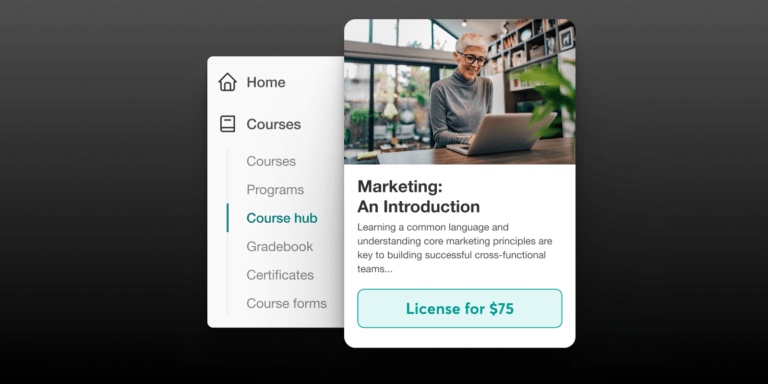
Course Hub is a built-in marketplace inside LearnWorlds, a shared space where academies can license ready-to-use, high-quality courses from other creators and offer them directly to their own learners. At the same time, it gives course creators a way to publish their content and reach academies across the entire online learning platform.
Two sides. One system. And that changes how you grow.
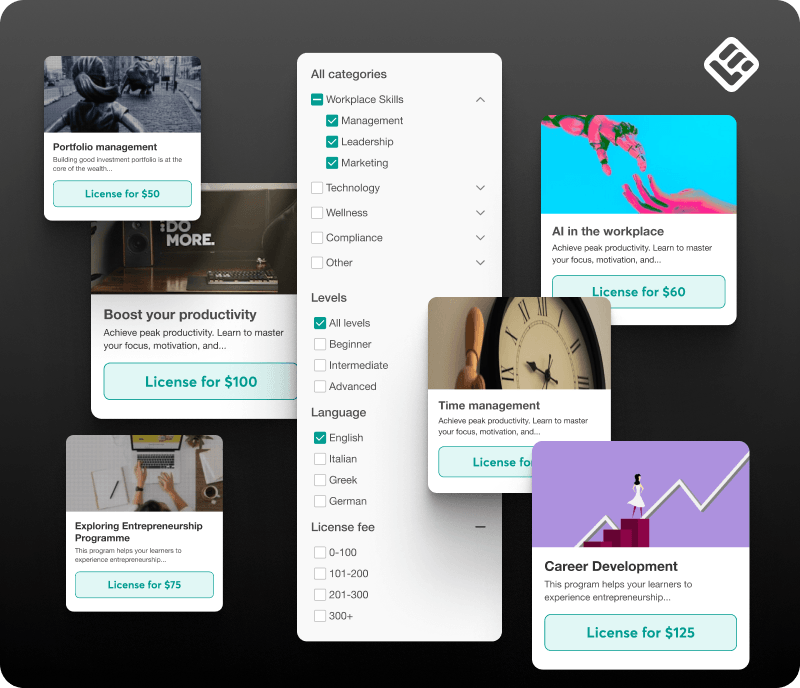
Instead of relying solely on what you build, you gain access to a curated catalog—currently 150+ courses across a wide range of topics and categories—that you can browse, license, and publish without a single content production hour. Your catalog stops being limited by your internal capacity and starts reflecting the full range of what your learners need.
Expanding your catalog without slowing down
When you need to expand your catalog, Course Hub gives you a faster path. You browse the marketplace, license a course, and it lands in your school as a draft.
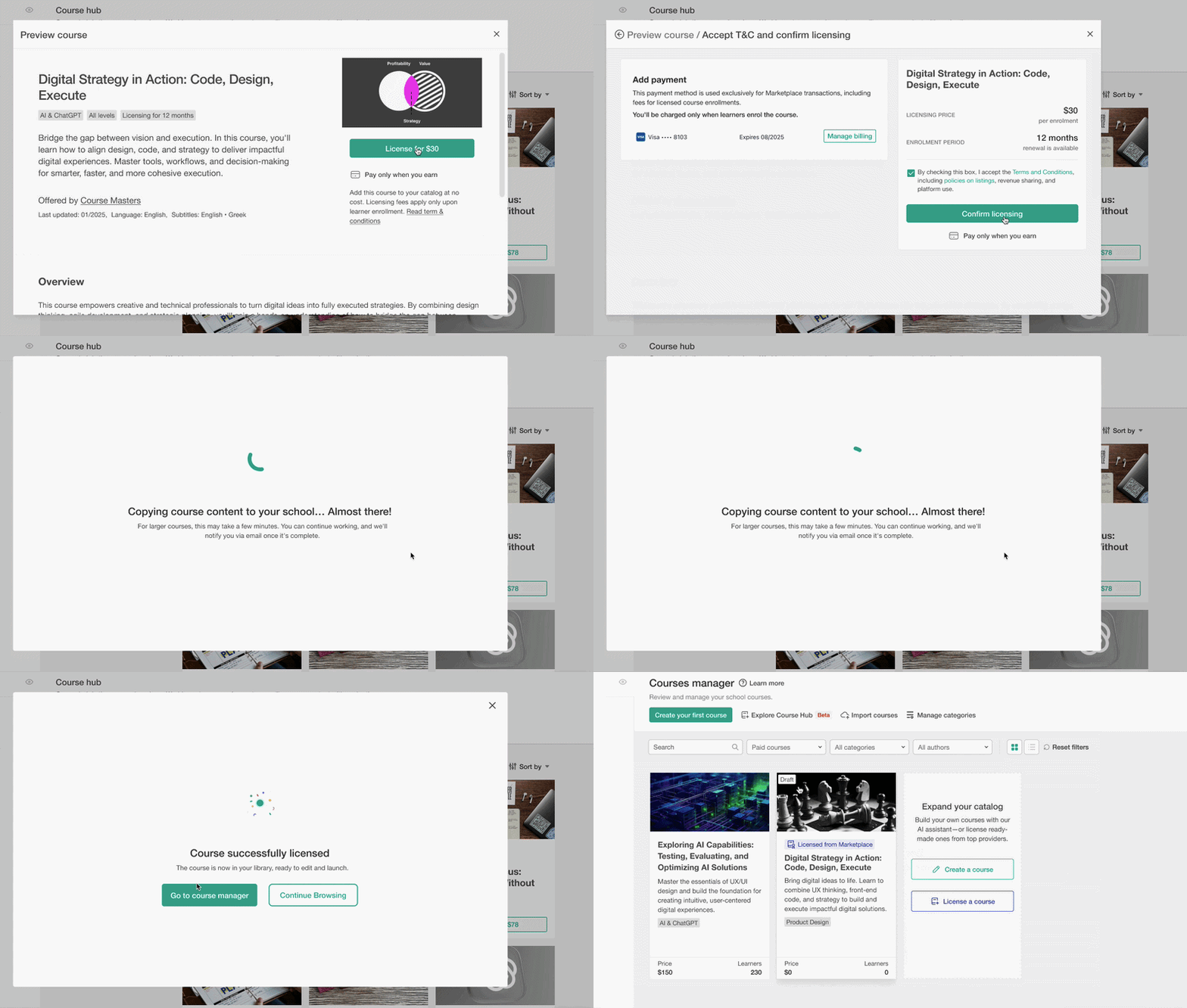
That draft state gives you time to review the content carefully, customize the course page to match your brand, set your own pricing, and decide how it fits within your offer before any learner ever sees it. You can rename the course, change the course images, configure your own enrollment rules, and integrate it into a bundle or learning path just as you would with content you built yourself.
What you cannot do is edit the learning content itself—and that’s by design, to protect the publisher’s material. But everything around it stays entirely in your control.
Crucially, there is no upfront cost. You only pay when learners enroll, which means you’re never committing budget to content before you know there’s demand for it. If you license a course and decide after reviewing it that it doesn’t quite fit, you can simply leave it in draft state until the licensing agreement expires, and you won’t pay a thing.
This makes it possible to introduce new topics without tying up resources, test whether a subject resonates with your audience before building your own version, and grow your catalog without adding production workload. Expansion stops feeling like a project and starts feeling like a decision.
When Course Hub makes a difference
Course Hub works at every stage. Whether you’re launching, growing, or already running a full training business, there’s no reason to let catalog gaps slow you down.
And if your real value lives in the room eg in the live sessions, the group programs, the one-on-one work that no course can replicate, then why spend your energy building on-demand content from scratch? License what you need, focus on where you make the most impact, and let the catalog take care of itself.
Here’s Course Hub makes a difference:
- You’re sitting on a program opportunity: this covers more ground than your catalog currently offers, and building the missing pieces from scratch isn’t realistic within your timeline or budget. Instead of turning down the work or scaling back the scope, you fill the gap, deliver the full program, and protect the relationship.
- You want to test before committing: you’re curious about a new topic or a new audience segment, but you’re not ready to invest in original content without knowing whether the demand is really there. Licensing a course lets you put something in front of your learners first and make the build decision based on actual response rather than instinct.
- Your team is stretched:a new opportunity has appeared, and there’s no realistic way to produce something new in time. Course Hub lets you move at the speed of the opportunity rather than the speed of your production pipeline.
- You need to train your own team: you want to offer your employees solid development content, but don’t have it ready, or you don’t want to spend the time building it. Course Hub works just as well for internal training as it does for external learners.
- You need to strengthen your packaging: you have strong core content, but a standalone course isn’t enough to justify the contract size or the price point your buyers expect. Adding licensed courses around your own material lets you build more complete programs, stronger bundles, and more compelling offers without having to produce every module yourself.
- You’re just getting started: you have the expertise, the audience, and the drive, but building a full catalog from scratch takes time you don’t have. Course Hub lets you launch with ready-made content from day one, start generating revenue while you build your own courses, and open your school without waiting months to have something worth selling.
See Course Hub in action
If you want to see Course Hub up close and find out how browsing the catalog works, what the licensing flow looks like, and how it all fits inside your school, watch our “Plug & Play Content” webinar.
Quality isn’t left to chance: A curated marketplace of expert-led content
Every course in Course Hub is manually reviewed before it’s listed. This isn’t an open marketplace where anyone can publish anything.
For the review process, courses are checked for broad applicability, professional presentation, and the absence of external promotions, contact details, or heavy branding that would make them feel out of place in someone else’s school. If a submission doesn’t meet the standard, the publisher is notified with clear guidance on what to fix.
Because of this, what you find in the catalog is content you can actually use, not content you have to vet extensively before deciding whether to trust it.
The growing catalog currently features 150+ courses across eight core categories and is growing every month. Every course is authored by subject matter experts, elite consultants, and specialist educators who have spent years perfecting their content for global brands.
You’ll find content across a wide range of categories such as;
- Business & Professional Skills
- Compliance & Safety
- Customer Service & Communication
- Leadership & Management
- Technology & digital Skills
- Wellness & Personal Growth
What makes it worth browsing is who’s behind the content. You’ll find courses authored by ex-Googlers who’ve scaled international teams, neurobiology experts decoding peak performance, and sustainability consultants trusted by the world’s largest retailers.
This is quality material used by industry leaders like Google, Amazon, Volvo Cars, and Marks & Spencer. From upskilling teams at Lyft and Capital One to delivering accredited training for the NHS and global enterprises, these frameworks are designed for immediate behavioral change and professional impact.
For anyone looking to expand their catalog, that’s not a small thing. It means the content you’re licensing already has a track record, and that makes it easier to stand behind when you put it in front of your own learners.
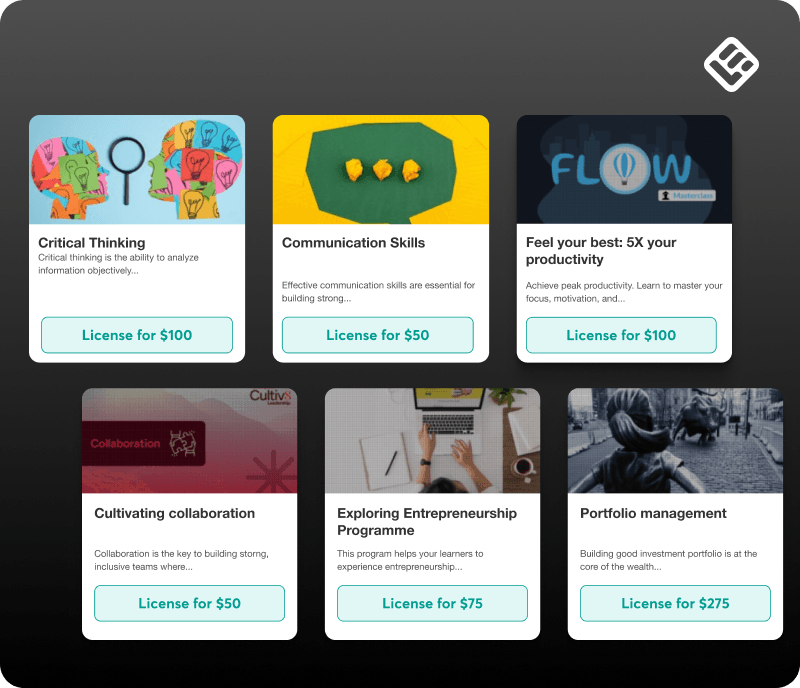
The other side: turning your existing content into an additional revenue stream
If you’ve already built high-quality courses, you can publish them in the marketplace and make them available to academies across the entire LearnWorlds network. Every time a school enrolls a learner in your course, you earn your set enrollment fee.
LearnWorlds charges a 10% commission on your gross revenue, invoiced separately and transparently. The rest lands in your Stripe account at the end of each monthly billing cycle, automatically calculated, with no manual tracking required.
For founder-led businesses or content creators whose primary revenue comes from high-value corporate contracts, this creates a genuinely different kind of growth. Your existing content starts working for you in channels you’d never have the capacity to pursue on your own, helping you reach a network of nearly 13,000 academies and over 32 million learners, without an additional marketing budget or sales effort.
If you want to keep things selective, private listings let you share courses directly with specific trusted partners rather than making them visible to the entire catalog. You stay in control of who can access your content and how it’s distributed.
And if you ever want to step back, you can unpublish your courses at any time. Learners already enrolled retain their access until their agreement expires (they’re never disrupted), but the course stops being discoverable by new buyers going forward.
A content ecosystem, not just a feature
When both sides are active, something larger starts to take shape.
More courses enter the marketplace. More academies rely on it to expand. The catalog grows stronger and more diverse. Academies that need content can move faster. Academies that have content can extend their reach. And the platform becomes more useful to everyone as a result.
That’s what makes Course Hub more than a feature. It’s a distribution layer and a content ecosystem in one, a place where growth on one side accelerates growth on the other.
Final thoughts
You can still create your core content. That doesn’t change. But you don’t have to build everything around it from scratch.
Course Hub gives you a way to expand your catalog, say yes to bigger opportunities, test new ideas, and reach new audiences. All this without slowing down your team or stretching your resources past your comfort zone.
Whether you’re just getting started, filling gaps in a growing catalog, or running a training business where your real value is the live work you do with people. The catalog you want doesn’t have to wait until you have the capacity for it.

Julia Prus
Julia is a Product Marketing Manager at LearnWorlds, where she turns product releases into clear value and makes sure what ships actually gets used.She has 8+ years of experience in product and growth marketing across B2B & B2C SaaS and digital products, working across startups and scale-ups to bridge product and marketing.
 Back to blog
 Scroll to top
Related Articles