Table of Contents
Key takeaways
- An online learning community is shared purpose, active participation, and reciprocal value, working together, not just audience size.
- Owning your platform (email, newsletter) protects growth from algorithm risk.
- Community-led monetization works best when members become contributors, not just consumers.
Course platforms are commodities. Anyone can spin one up. What’s much harder to copy is a group of people who trust each other, show up consistently, and help each other get results. That’s the asset Brandon Cestrone built, and it’s why LearnWorlds invited him to World of Learning to walk through exactly how he did it.
Cestrone, founder of CS Insider and co-founder of Edu Fellowship, spent four years turning a dying, spam-filled LinkedIn group of 200,000 people into a 1.2-million-member professional network. For course sellers,edupreneurs, and L&D teams thinking about community as a growth lever rather than a nice-to-have feature, his framework is one of the more complete playbooks available.
“This struggle creates the moat around your business that competitors can’t cross.”
Brandon Cestrone, Co-founder, CS Insider & Edu Fellowship
The rest of this piece walks through his framework in the order he built it, starting with the one distinction that determines whether any of the rest works.
From audience to community: Broadcasting vs co-creation
Before getting into tactics, Cestrone starts with a definition problem: most people who think they’re building a community are actually just building an audience. Here’s how he draws the line.
Cestrone’s framework rests on three ingredients:
- Shared purpose
- Active participation
- Reciprocal value
Miss one of these ingredients, and you end up with an audience or a chat room with no direction.
The clearest way to tell an audience and a community apart isn’t a metric but a question:
“An audience member asks, What’s in it for me? A community member asks, How can I help?”
That shift changes what a group is worth to your business:
- Broadcast is one-to-many: You post, people consume, maybe they buy. That’s fine, but it tends to cap out.
- Contribute is many-to-many: Members create, answer, and support each other, and the value compounds.
- Audiences tend to buy once: Communities generate referrals and word-of-mouth because members have a stake in the outcome.
- Communities can double as market research: Surfacing product feedback and ideas you’d otherwise pay for.
Cestrone breaks communities into four working types. Knowing which one you’re building (or which one your members actually want) changes what “success” should look like.
Type 1: Communities of practice — Problem-solving
People in the same profession help each other solve work problems, for example, software engineers sharing code fixes or marketers discussing campaigns. There is high monetization potential because professionals pay for career growth.
Type 2: Product communities — Product adoption
Users of the same tool help each other get more value from it, like Salesforce users sharing tips. Success looks like members answering each other’s questions faster than company support can.
Type 3: Learning communities — Skill-building
Groups focused on building a skill together, such as language learners, coding bootcamps, and certification study groups. The challenge is retention, since people tend to leave once they’ve reached their goal.
Type 4: Interest communities — Connection
People united by a hobby or cause rather than work. Some examples include photography groups, book clubs, and fitness communities. These build a more emotional connection, but they’re harder to monetize.
Learning-focused and practice-based communities tend to monetize best, since members join specifically to build a skill or solve a recurring job problem, not just to socialize.
Once you know which type you’re building and why people are actually there, the next question is how Cestrone rebuilt a community that had already fallen apart.
How a dying LinkedIn group became a 1.2M-member powerhouse
Cestrone didn’t start from a blank page. He found a dormant LinkedIn group of about 200,000 members, mostly spam, reached out to the owner, and proposed a partnership to fix it.
The first six months were unglamorous:
- Cleaning out spam, crypto pitches sitting next to L&D posts
- Posting real questions instead of promotional content
- Testing formats like polls, discussion prompts, and educational images
- Surveying members to learn what they actually wanted
What members wanted turned out to be simple: more ways to connect. That insight led to the group’s signature ritual of monthly “speed mixers,” fast-paced five-minute networking rounds that are still running years later.
The cleanup phase got the group healthy again. What came next is what took it from 200,000 to 1.2 million.
The framework that grew one online learning community to 1.2 million members
With the group stabilized, Cestrone shifted from cleanup mode to growth mode. Three moves mattered most.
1. Move from a rented to an owned platform
Once the group started gaining traction, Cestrone moved to reduce his dependence on LinkedIn itself:
“I need to start building something that is owned, not dependent on LinkedIn, because LinkedIn could basically close the group down…the algorithm could change.”
Capturing emails and building a newsletter is what turned a rented address into an owned asset. For training providers that want to scale training delivery, the same principle applies to client relationships: the more you keep ownership of the relationship rather than routing it through a platform or channel you don’t control, the less exposed you are when that channel changes its rules.
2. Scale through member ownership
As engagement grew, Cestrone made a habit of turning active posters into contributors by inviting them to run sessions, host AMAs, or lead discussions on topics they’d already shown expertise in. Members who become creators bring their own networks with them, compounding growth without paid acquisition.
3. Pair reach with intimacy
The model pairs a free, high-reach discovery layer (the LinkedIn group) with a smaller, more intimate premium space for members who want deeper engagement. It’s the same logic behind moving a free Discord or LinkedIn community into a paid Circle or similar platform. Free earns reach, while premium earns revenue and depth.
If you’re a course seller interested in building an online learning community, you can find a checklist with Cestrone’s top advice below.
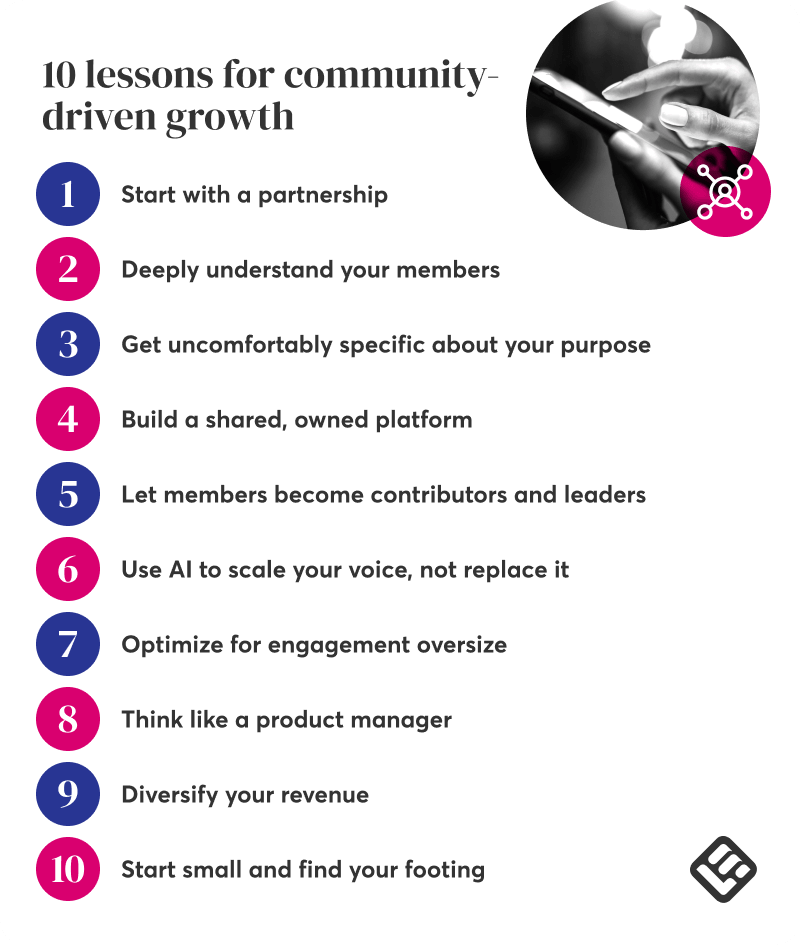
10 lessons for community-driven growth
Here are ten takeaways that Cestrone wished he’d known earlier.
1. Start with a partnership
Reviving an existing group with an aligned co-owner can save years compared to building an audience from zero. It’s not an option for everyone, but it’s worth exploring before defaulting to a cold start.
2. Deeply understand your members
Cestrone warns that most community builders skip this step entirely, assuming they already know what their audience wants:
“Most community builders, maybe, will think, ‘OK, I just got to create content’, and then they’re going to come, and they’re going to be engaged. They assume they understand their members’ problems, but assumptions alone can kill engagement.”
Brandon Cestrone, Co-founder, CS Insider & Edu Fellowship
He suggests doing things that don’t scale at first, like one-on-one conversations, surveys, and onboarding flows that surface where people drop off.
3. Get uncomfortably specific about your purpose
Broad purpose feels safer, but it dilutes engagement. Cestrone explains what happens when a community tries to speak to everyone at once:
“When your shared purpose becomes too broad, engagement suffers… members start feeling like they’re in the wrong room.”
His advice is to start with one narrow challenge and expand once it’s working, not before.
4. Build a shared, owned platform
Don’t depend solely on a social platform whose algorithm you don’t control. A newsletter or another owned channel lets you keep communicating with members even if the platform changes the rules.
5. Let members become contributors and leaders
When someone posts something valuable, invite them to run a session on it. It builds a content pipeline, gives members a reason to stay invested, and hands them recognition and brand-building in return.
6. Use AI to scale your voice, not replace it
Asked how he keeps up with content across two communities and a full-time job, Cestrone pointed to how he uses AI as an extension of himself, not a substitute for judgment:
“I use AI to do certain things. I use Claude projects… and I build very specific instructions with Claude to help me do the work of five people, whether that’s brainstorming, content ideas, polls.”
7. Optimize for engagement oversize
Cestrone is clear about which number actually matters when building an online learning community:
“I think it’s more important to have 100 super engaged members and 1,000 unengaged members.”
In practice, that can mean pruning inactive members or re-evaluating whether your purpose still matches what people actually want.
8. Think like a product manager
Treat community-building as a series of experiments to test formats, track what happens, and iterate based on results rather than assumptions. Cestrone treats each month as a new hypothesis to prove or disprove.
9. Diversify your revenue
A community can be the product itself (paid access), the on-ramp to a course, a cohort-based offer with alumni access, tiered free/paid spaces, or the top of the funnel for consulting or services. There’s no single right model. In fact, the point is not to rely on just one.
10. Start small and find your footing
Don’t scale before you understand your community and what you’re trying to achieve. Cestrone deliberately used cheap, low-commitment tools early on and only invested in more expensive infrastructure once the fundamentals were proven.
One honest caveat runs through all ten. Cestrone runs two communities alongside a full-time job, and he’s candid that it’s not a model to copy: “I would not recommend that, because when you split your time, it’s hard to focus.”
Community building rewards focus over ambition. Pick one, understand it deeply, and resist the urge to scale before the fundamentals are actually in place.
How to combine free and premium community spaces: Practical tips
Here’s what the free-plus-premium model looks like in practice, distilled into steps you can actually apply.
- Use a free, high-visibility platform (LinkedIn, Facebook, Slack) as the discovery layer. It’s where new people find you with the lowest barrier to entry.
- Route engaged members toward an owned asset like an email list or newsletter, so growth doesn’t live entirely inside someone else’s algorithm.
- Reserve a smaller, paid or gated space for your most engaged members, where discussion goes deeper, and intimacy replaces reach.
- Build recurring rituals (a monthly event, a regular prompt) rather than relying on ad hoc posting. Rituals are what make a community feel alive between big launches.
- Track engagement, not just membership count, and prune or re-engage inactive segments rather than letting them dilute the room.
None of this requires a large team or an expensive stack. But it does require sequencing the free and paid layers correctly and only expanding once each layer is actually working.
Where this fits if you’re running a training business
The framework above is built for creators and L&D communities, but the same logic holds for B2B training providers managing multiple client relationships.
If you’re delivering repeatable, enterprise-ready training programs to multiple clients, community is an important retention lever. A cohort that talks to each other between live sessions completes more of the program. A client-facing community built with built-in community tools inside your academy, rather than on a rented social platform, is one more reason a client renews instead of shopping around.
The same principle shows up on the creator side, too. Subscription-based course businesses see the same effect, since community reduces churn by giving learners a social reason to stick around, not just a content one.
See how LearnWorlds can help you build an engaged, owned community without stitching together three separate platforms.

Kyriaki is the Organic Content Strategist at LearnWorlds, where she writes and edits content about marketing and e-learning, helping course creators build, market, and sell successful online courses. With a degree in Career Guidance and a solid background in education management and career development, she combines strategic insight with a passion for lifelong learning. Outside of work, she enjoys expressing her creativity through music.
 Back to blog
 Scroll to top
Related Articles