

Table of Contents
I’m sure you’ve noticed a surge in online learning over the past few years. It makes sense, 73% of students now prefer to learn online [1], a preference that’s reflected in the market’s incredible projected growth—more than $80 billion USD by 2028 [2].
If the interest is there, then why are online course completion rates sometimes so low? While they vary according to course type and support, sometimes they sit all the way down at just 10-15% [1]. The culprit often lurking behind such low numbers? Low learner engagement.
Learner engagement is the level of active participation and personal motivation a learner shows during a course. Student motivation and engagement in online courses are what determine whether learners persist or drop off. If you’re seeing lots of enrollments but high drop-off levels in your online courses, you might need to rethink your learner engagement strategies.
Platforms like LearnWorlds help make this possible, along with smart planning and strategy implementation. Let me walk you through how it all works—and the research that supports it.
What is learner engagement?
Learner engagement is the level of attention, curiosity, and motivation that a person brings to the learning process. In other words, how actively they participate and apply what they learn. Engaged learners not only do better in your course, but may also be more likely to pass on referrals to future students.
There are two types of learner engagement: active vs passive engagement. Passive learners consume but don’t analyze and apply, while active learners contribute and reflect, connecting ideas and putting them to use.
To bump up your course completion scores, you’re aiming for the latter: active learning engagement.
Types of learner engagement (with examples)
Outside of passive and active student engagement in online learning, we can break things down further into four main types: behavioral, cognitive, emotional, and social. And because it’s important in learning and development (L&D) contexts, I’m adding a fifth, too: physical/cultural.
Each type of engagement links to a learner’s intrinsic and extrinsic motivations and has its own set of tactics you can follow to design strategies around them. Together, these five types form a compact model you can use to understand and strengthen learner motivation across different online environments.
Behavioral engagement
You notice behavioral engagement in what your learners are doing. Behavioral engagement examples are easy to spot in a physical classroom environment —hands raised, lively discussions, and so on. But in an online context, it could look like learners participating in weekly discussion boards or completing assignments.
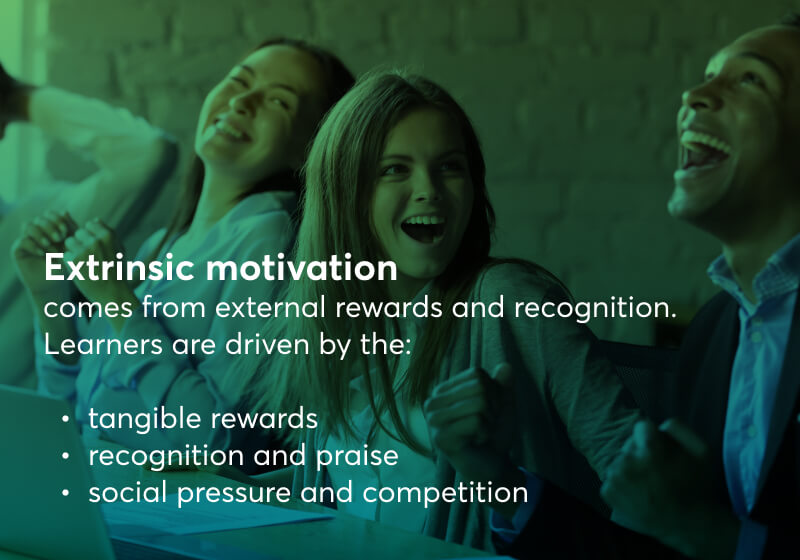
Extrinsic motivators lead our tactics here, and can include:
Sara Cortellazzi, Senior Product Marketing Manager at LearnWorlds, brings a wealth of knowledge to the table. She shares several insightful ideas on how to tap into extrinsic motivators, drawn from her extensive experience in the field:
Cognitive engagement
You’re not always going to see cognitive engagement in action, as it’s how your learners think, reflect, and solve problems. Cavanagh (2019) notes that learners have limited cognitive resources, so using thought-provoking hooks when transitioning between content or chunking information can help you keep your students engaged.
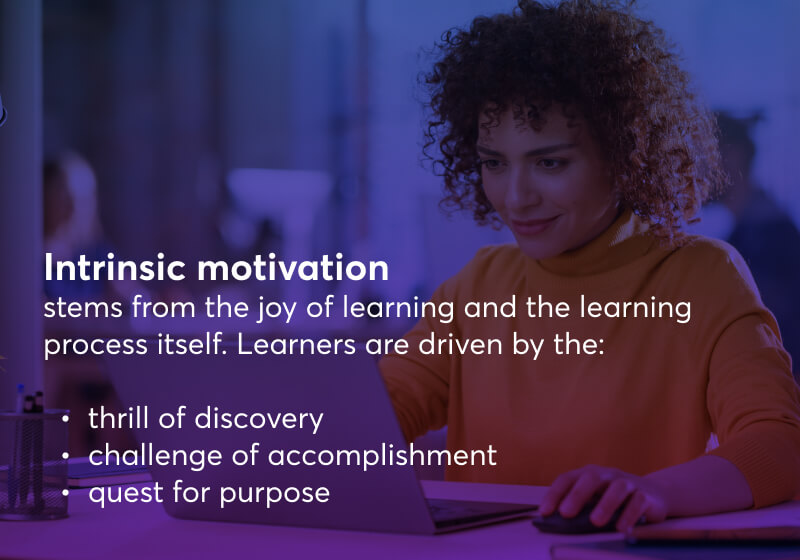
Your tactics for this engagement type rely primarily on intrinsic motivations and should be led by curiosity and meaning:
Keep in mind that motivation is a spectrum, not a binary choice. By strategically combining features that address both intrinsic and extrinsic drivers, LearnWorlds helps you build a motivational ecosystem that keeps your learners engaged and on the path to successful completion.
Emotional engagement
Emotional engagement is what shapes a learner’s learning experience and how they will connect with your material. If they don’t care about it, it’s going to be much harder to keep them engaged.
Tulving (2002) shows that storytelling—imagine a learner connecting with a real-world story in your content—and imagery can trigger emotional memory. This helps students remember and apply what they learn.
This engagement type plays on a mix of extrinsic and intrinsic motivators, so your tactics could look like:
I keep students interested by taking learning outside the classroom. I post short, simple videos on YouTube and social media sites explaining specific techniques. Videos also give students something to revisit in their own time and help them stay motivated between classes. I also encourage them to share their own progress videos, which helps them with confidence and motivates others.
Julia Temeer, Founder at Violinspiration
Social engagement
When I was a language teacher, I saw great results from using social engagement tactics with my online learners. This type of engagement thrives on interaction, and there’s research that shows how well it works. Ambrose et al. (2010) found that collaboration and peer exchange strengthen motivation and understanding.
In my classes, this looked like group projects and games to prepare students and test their knowledge while letting them learn with and help each other.
There’s a mix of intrinsic and extrinsic motivation behind these tactics. You could:
Physical/Cultural engagement
If you’re using online learning in the workplace, you’ll notice that it often takes a physical or cultural form of engagement. And by this, I mean that learners will simulate or connect training to real company roles or values as a form of engagement.
This could look like your sales trainee completing a sales simulation as part of their online course, then immediately using what they learned while on a live call with a real prospective client.
This type of learner engagement is pretty extrinsically driven, so your tactics might include:
Here’s everything rolled all together in an easy-to-scan table.
Below are examples of learner engagement strategies, including the types, tactics, and contexts that work best for each one.
With tactics and understanding in place, you can move on to strategies for enhancing learner engagement. In other words, getting your students actively involved and those course completion rates up.
Pre-course strategies (laying the groundwork)
If you’re getting ready to launch a course, or the one you have just launched isn’t bringing the completion numbers you want, take a look at what’s happening before day one. At your pre-course planning.
Use targeted marketing
Targeted marketing makes sure you attract learners whose goals and needs match what you offer in their course. With the right audience lined up, you reduce the risk of people dropping out once they realize your course wasn’t for them.
Try to build your outreach around:
If you’re using LearnWorlds to host your course, you can pair this outreach with your landing pages and automated email sequences. Doing so can keep you organized and make sure the right course reaches the right learners.
Set clear expectations from the very beginning
Use your course page or sign-up confirmation emails to make sure your learners know what to expect from your course right away. When your learners understand what to expect and how they need to prepare for your course, they might be more confident heading into it. And, they’re less likely to bump into unexpected roadblocks that might cause them to drop the class.
Use this expectations and success criteria checklist to guide you:
Use a trailer or demo snippet
Using a short trailer of your course, like 60-90 seconds long, can build interest and increase learner engagement and trust before they get started.
Use this demo snippet to cover things that are best demonstrated visually, like what the learning platform looks like and how students can navigate it. It’s also a great way to get them excited about what’s to come and show them engagement opportunities like gamification features or learner forums.
Here’s a sample script you can tweak:
Course trailer + syllabus overview micro-script (60–90 seconds)
1. Welcome (5–10 seconds)
Introduce yourself, the course, and the main benefit.
“Hi, I’m [Name], and in [Course Title] you’ll learn how to [key outcome].”
2. What learners will achieve (15–20 seconds)
State the concrete skill, mindset, or result they’ll walk away with.
“By the end, you’ll be able to [apply skill/do task] and [solve a real-world problem or reach a goal].”
3. How the course works (15–20 seconds)
Give a snapshot of structure and pacing.
“The course runs over [X modules/weeks]. Each includes short videos, quick activities, and a reflection or quiz to help you apply what you learn.”
4. How to access and use the platform (10–15 seconds)
Guide learners through basic navigation so they feel confident from the start.
“Once you enroll, you’ll find everything inside your LearnWorlds dashboard. You can track progress, join discussions, and download materials right from each lesson page.”
5. Engagement and fun (10–15 seconds)
Highlight the interactive and community elements that keep learning engaging.
“You’ll earn milestones as you move through the course, which can help you track your progress. You can also connect with peers in discussion spaces and explore interactive videos designed to keep you active rather than just watching.”
6. Next step (5–10 seconds)
End with encouragement and a clear call to action.
“Ready to get started? Click enroll, and I’ll see you in the first module.”
My script tip? Keep it personal, and speak like you’re welcoming each learner in person. Upload the video to your LearnWorlds landing page and send it in your pre-course welcome email.
💡 Check out this guide on course navigation and custom completion rules to get more tips on how to set your learners up for success.
Personalization Redefined: 17 E-learning scenarios
In-course strategies (keeping the fire burning)
After you’ve looped in and connected with your target audience of learners, you still need to work to keep them actively engaged. I’ve got 10 in-course strategies for you to use that combine well with built-in tools in LMSs like LearnWorlds. Have a look.
1. Use drip schedules and milestones
Drip your course content week by week so each new release feels purposeful and manageable. Visible milestones—like completion bars or “next step” badges—help learners track progress and feel rewarded along the way.
Use your LMS for this—in LearnWorlds, you can set automated drip releases and progress milestones to make pacing easy.
2. Add interactive video hotspots
Add short checkpoints like clickable hotspots, polls, or branching prompts, to keep learners from zoning out. With LearnWorlds’ interactive Video Editor, you can embed these directly inside your videos so learners engage with the material in the moment.
3. Keep lessons short with microlearning
Microlearning builds confidence and prevents cognitive overload. I touched on this already, but break your information into small, standalone units.
This is especially helpful for busy employees or students who need to work learning around their other responsibilities. Each micro-lesson should close with a quick takeaway that learners can immediately apply.
4. Maintain a weekly Q&A cadence
Schedule weekly or biweekly Q&A sessions—live or asynchronous—to check deeper understanding and surface common challenges. When you check in regularly with your students, it can help them feel less isolated and more supported in their learning.
And this doesn’t have to stop after the course ends. I took a course a year ago where the instructor still regularly invites me to Q&As to make sure I’m getting the support I need well after finishing the formal course. I love it, and it makes me more likely to buy a future course.
5. Assign group roles for collaboration
We’ve established that group activities can be great for engagement, but they work best with some structure involved. Use defined roles like facilitator, timekeeper, or reporter, to make sure everyone participates.
You can use breakout rooms in Zoom for group activities, but in my experience, an LMS will serve you better. LearnWorlds has community spaces and group activity settings that can help you organize teams and track individual participation.
6. Use discussion prompts with deadlines
Open any discussion threads with purpose and deadlines. I would give my learners a few days to post and a specific timeframe to reply to their peers. Time-limited prompts kept our forums active and prevented discussions from fading out before real exchange happens.
7. Reward progress with badges or certificates
Recognition is a powerful motivator. While I taught mostly little kids, offering recognition worked with my grumpy teenage high schoolers and even my adult students, too.
You can award badges when learners finish modules or complete key activities, and offer certificates for overall completion. LearnWorlds makes it easy to automate both, so recognition can happen the moment learners hit each milestone.
8. Add short reflection forms after each module
Prompt learners to write one or two sentences on how the course material connects to their work or goals. Simple forms or journal activities at the end of a module can turn content into personal insight.LearnWorlds’ form builder lets you capture these reflections right within your course.
9. Automate progress nudges
As great as your course may be, neither you nor your students are going to be able to give it their full attention 24/7. So use automated progress emails (saves you tons of time) or in-platform notifications to re-engage students who’ve been inactive for a few days. A quick nudge like “You’re 70% done!” or “Your next lesson is ready” can pull them back in.
10. Post recognition and feedback publicly
A strong course community can better motivate learners and help them feel supported. Use yours to share weekly shoutouts for top contributors, completed projects, or milestone earners. When you give recognition in a public space, it can build motivation and a sense that progress is seen and valued.
Make participation equitable (5 quick tactics)
Keeping learners engaged also means keeping participation fair and accessible, and able to match different learning styles. Equity in classroom participation ensures every voice has room to contribute, especially in hybrid or online classrooms.
Here are five quick tactics inspired by Tanner (2013) and higher-ed best practices from the University of California, Merced:
For accessibility, make sure each learner can access your content with captions, alt text, readable layouts, and mobile-friendly formats. If you’re not tech-savvy, don’t worry. Modern student learning management systems have these capabilities built in to make it easy.
Post-course strategies
The course creator I mentioned, who sends me regular updates and Q&A invites, is a great example of someone who uses post-course strategies to keep her students engaged. Things don’t stop once a student finishes a course, and how you follow up can determine if they buy from you again or refer other students.
Here are some strategies that have worked for me as a learner.
Keep learners connected after completion
The creator who keeps me in the loop also keeps me connected to her content. I always know what’s going on with the course I took from her and what she’s planning next. Because of this, I’ve circled back to review course updates she made after I finished and am already planning to buy her next one when it’s ready.
Here’s how you can keep your learners connected:
Even one week after finishing, a quick re-engagement email (eg “How have you used what you learned so far?”) can bring people back to reflect or explore something new.
Use automation to keep engagement going
These kinds of follow-ups don’t have to take much time. Automations handle the consistency for you, and they’re surprisingly effective.
A few smart triggers can turn a one-time learner into a repeat participant. I know this because that’s exactly how I end up enrolling in new courses from creators I’ve used before.
Here are some simple automation recipes you can follow.
Again, take advantage of your LMS’s features here. You can set these up directly in LearnWorlds’ User Automations by choosing a trigger and linking it to a personalized message.
Turn completion into connection
Many courses I’ve taken on platforms like Udemy or Coursera keep a place open for learners to interact with each other after the course. Once you’ve bought the course, you can stay a participant for life. I consider these “lite” communities, cause while they are helpful, you can take them so much farther.
Use your LMS to create a dedicated course community. Keep it open after the course ends so learners can keep sharing how they apply what they’ve learned. Use moderators, like students who did well and engaged a lot in the course, so you don’t have to be super hands-on
And use these tactics to take the community from “lite” level to one with a deeper connection for students:
💡 Keep learning: 10 ways to build a community: A complete guide for course creators
Online engagement playbook: synchronous vs asynchronous
You might use self-paced learning and/or run course segments live, but however your learners access course content, you want to keep synchronous and asynchronous aspects in mind. Both are essential for engagement, but have different use cases depending on your course formats.
Synchronous: good for live or cohort sessions
Synchronous learning happens in real time through avenues like live webinars or virtual classroom sessions. This means everyone is learning together at the same time, usually at the teacher’s pace. For this type of learning, your goal is to keep your learners interactive and actively participating.
Asynchronous: good for self-paced or flexible modules
With asynchronous learning, your students are accessing and working through the learning content on their own time and at their own pace. This gives learner autonomy and flexibility, but also makes connection and engagement more challenging, especially peer-to-peer. It benefits from having some structure and lots of built-in interactive opportunities.
Here’s an online engagement playbook you can adapt to either synchronous or asynchronous engagement strategies.
My engagement tip: Blend both modes when you can to encourage students to engage. Host a live poll, then post the results in your forum for asynchronous discussion to spark collaborative learning.
💡Here’s some more info on how to create engaging course content that sticks.
Measure and improve (your engagement metrics)
All of these great strategies and tactics don’t hold much weight if you don’t track their effectiveness. Using analytics to gather and interpret data supports data-driven adult learner engagement strategies that help you see what’s working and what needs adjusting.
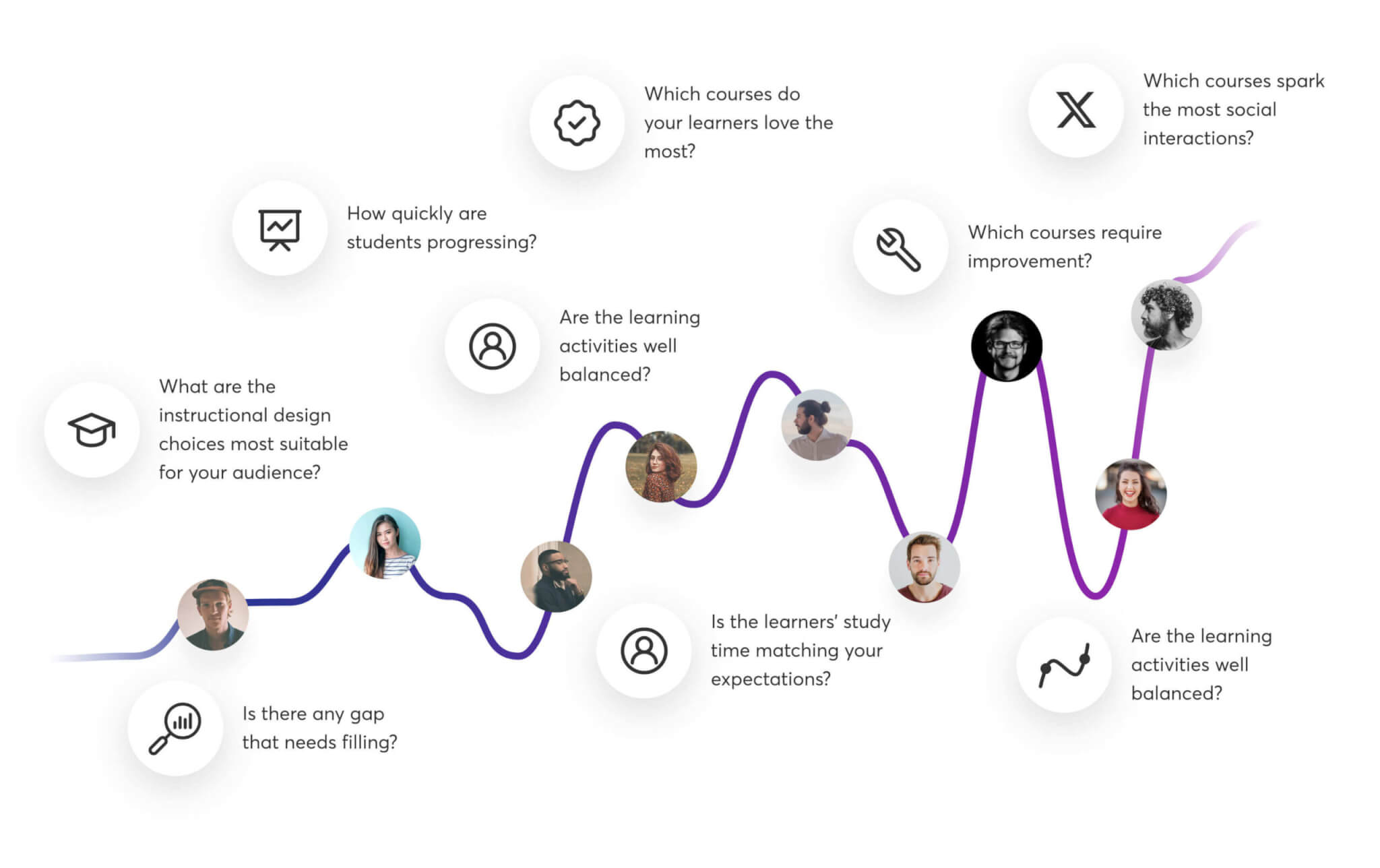
Here’s what you want to be checking (weekly, ideally):
Use the table below to check key engagement metrics, know when you need to act, and what to do.
At the risk of sounding like a looping record, tracking metrics is another place where your LMS comes in handy. LearnWorlds has a complete analytics dashboard that shows you all of the course metrics you can expect. And if you’re using other platforms, Canvas/CatCourses analytics can help you capture similar engagement data for comparison.
But if you’re not sure how to start, check out LearnWorlds’ help center guide for how to track engagement.
Case study snapshot
I don’t know about you, but I like to see examples of how things can look in real life. So let’s bring all this together with a case study. This one comes from one of LearnWorlds’ customers, an online school specializing in information technology and computer science training courses.
The problem:
This online IT school noticed a pattern: plenty of enrollments, but a sharp drop in logins halfway through. Many students were close to dropping out.
The intervention:
They used LearnWorlds automations to tag and re-engage inactive learners. Anyone who hadn’t logged in for 30 days received a short, personalized check-in email. At the same time, the team revived its course community with weekly instructor posts—short prompts, new resources, and student highlights—to draw people back in.
The outcome:
More than 400 inactive students returned and completed their courses, leading to a 30% increase in completion among at-risk learners. Email open rates climbed to nearly 50%, and the school saw stronger engagement across its forums.
Here’s how you can replicate it:
Like the outcome? Follow this checklist to replicate it:
Using these consistent follow-ups, especially when you can personalize and automate them, can help you recover lost learners by giving them a little extra attention and a small push.
Time for action
You’ve got the strategies, and now it’s time to test them. LearnWorlds gives you all the tools you need to build, track, and scale engagement easily from a single platform.
Jump in with a free trial and start seeing what’s possible for your learners this week.
Sources

Rosemary is LearnWorlds’ Content Marketing Manager. She has over 2 decades of experience in omnichannel marketing and content writing for the IT and SaaS industry. Her expertise lies in crafting effective content marketing strategies that attract, engage, and nurture customers, enabling LearnWorlds to reach its target audiences with precision.

Ciera Lamb
Ciera is a freelance content writer and editor connecting companies with their ideal audiences through blog articles and other online content. She approaches her writing with curiosity and research and enjoys the ever-present learning that comes with being a content writer. She is also an avid scuba diver, an aspiring Dutch speaker, and lover of all things nature.
 Back to blog
 Scroll to top
FAQ
Everything you have ever wondered, but were too afraid to ask...
