


Table of Contents
Key takeaways
- Customer education reduces churn, speeds up adoption, and scales your customer success efforts without adding headcount
- Building a program that works takes a clear strategy: know your audience, set measurable goals, choose the right delivery channels, and track the KPIs that connect learning to business outcomes
- The best customer training programs treat education as an ongoing part of the customer experience, not a one-time onboarding event
Customers who don’t understand your product don’t stick around. Τhe usual fixes (more support agents, bigger onboarding decks, extra CSM time) buy you time but don’t solve the problem.
Knowing how to improve customer education is how you fix the root problem. A well-built customer education program helps customers get value faster, use your product with confidence, and stay longer. It also takes pressure off your support and customer success teams in the process.
This guide covers everything you need to build or sharpen an existing customer education program: strategy, content formats, the right KPIs, real-world examples, and platform guidance all in one place.
What is customer education?
Customer education, also referred to as customer training, is any organized, purposeful learning activity designed to help prospective or existing customers get more value from your product or service. It supports the full customer lifecycle: from onboarding new users to deepening product knowledge for long-term accounts.
It goes well beyond help articles and tooltips. A mature program includes structured courses, customer education certifications, live sessions, and self-serve content libraries. It can serve customers who need step-by-step product guidance, and double as a marketing channel that builds trust with prospects before they ever sign up.
Customer education is especially valuable when:
- Your product is complex or has a steep learning curve (common in SaaS)
- Your product requires users to change existing habits or workflows
- You serve enterprise accounts with multiple user roles and needs
- Your product is frequently updated with new features
- Your support team is fielding the same basic questions repeatedly
If any of those sound familiar, you don’t just have an opportunity to think about how to improve customer education, but a business case for it.
Benefits of customer education
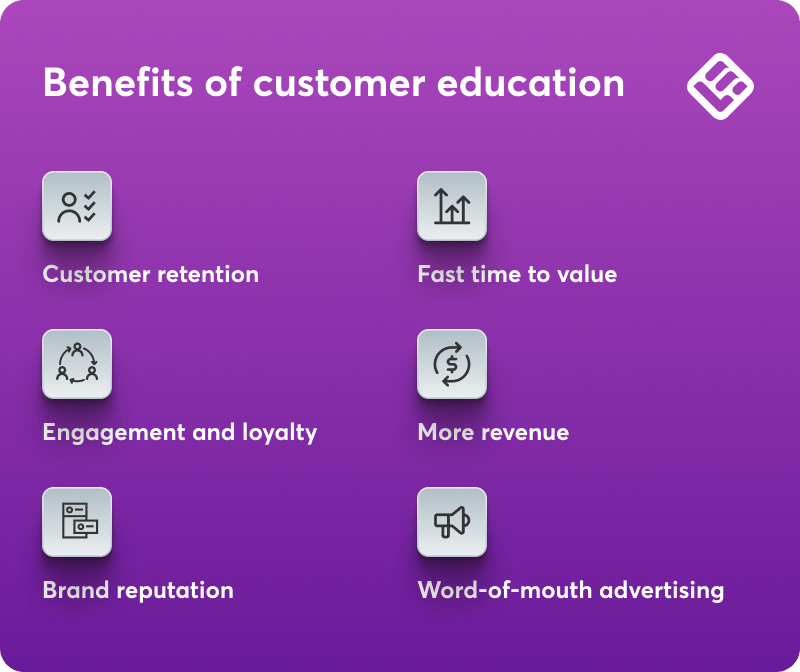
Understanding how to improve customer education starts with knowing what a strong program actually delivers. A well-executed customer education initiative does more than teach customers how to use your product. It shapes the entire customer relationship and the business results that follow.
Here’s what that looks like in practice.
Higher customer retention
Customers who understand your product don’t need to look elsewhere. Beyond onboarding, ongoing education helps them discover new features, develop deeper product knowledge, and get more out of what they’re already paying for. Higher satisfaction directly impacts retention.
Lower support costs
When customers can solve common issues on their own through on-demand guides, customer education videos, or a knowledge base support ticket volume drops. Your team handles fewer repetitive questions and has more time for complex, high-impact work.
Faster time to value
Onboarding is the first test of your customer relationship. A structured customer training program shortens the gap between sign-up and that first moment of real value, allowing customers to get up and running quickly without waiting on a support agent or CSM.
See how Blip onboarded their customers 41% faster with LearnWorlds and what that meant for their business.
Stronger customer engagement
Live webinars, community forums, and peer learning create connections between customers and your brand, and among customers themselves. Engaged customers are more loyal and more likely to become advocates.
Increased revenue
Educated customers adopt more features, renew subscriptions, and upgrade to higher plans. You can also choose to monetize your program by offering certifications, which adds another revenue stream to your business.
Better brand reputation
Companies known for their customer training efforts build a reputation for caring about customer success. That perception extends beyond your existing customer base, attracting new business and giving your sales team something concrete to point to.
Brand advocacy
Happy, confident customers talk. Positive word-of-mouth, reviews, and referrals bring your brand in front of new prospects without paid acquisition costs. Your NPS and CSAT scores improve, and your best customers become part of your growth engine.
Is it time you built one? Read our blog on 10 Warning Signs You Need a Customer Education Program to see if a customer training program is a top priority for your business.
How to improve customer education: building a winning strategy in 9 steps
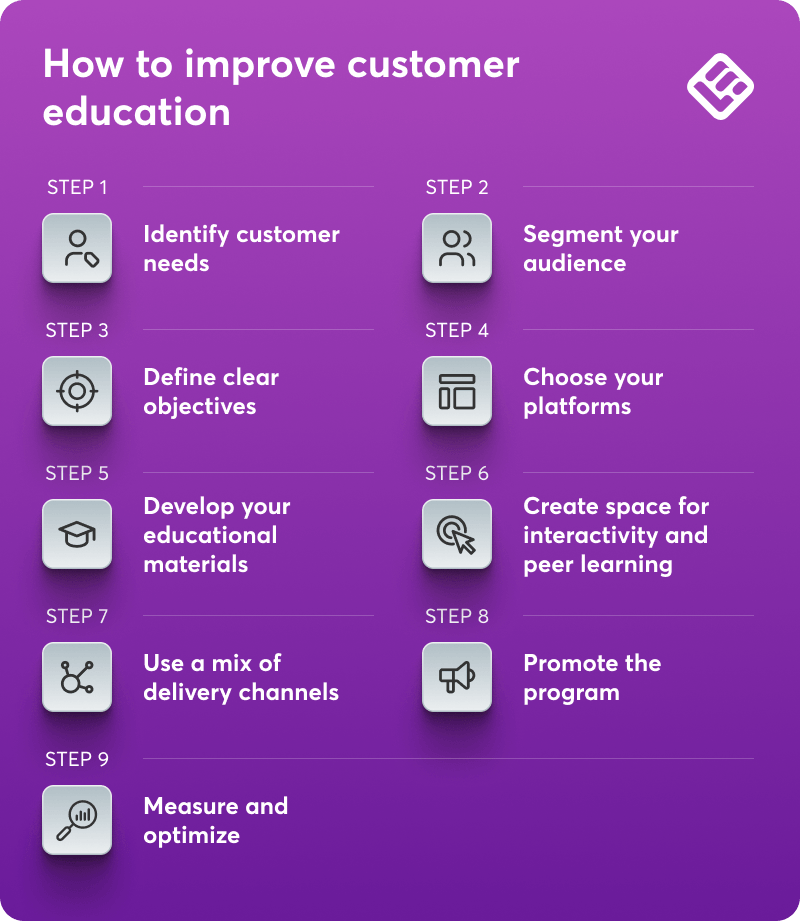
Careful planning is the difference between a customer training program that drives real business results and one that gets built once and quietly ignored. These nine steps will help you develop a customer education strategy that scales.
Step 1: Identify customer needs
Start by understanding what your customers struggle with. Your best sources of truth:
- Surveys and feedback forms
- Customer interviews
- Product analytics
- Support tickets and recurring questions
Common issues and knowledge gaps reveal where to focus first. Let customer behavior tell you what they actually need instead of building content based on a hunch.
Step 2: Segment your audience
Not all customers need the same training. Segment your audience so your customer education plan delivers content that’s genuinely relevant to each group.
Common segmentation criteria:
- Job role: a power user needs different training than an executive who wants high-level dashboards
- Stage in the customer journey: new customers are onboarding while seasoned ones are expanding to new features
- Use case: how they’re using your product shapes what they care about
- Company size or tier: enterprise accounts might get a tailored onboarding playbook; smaller accounts go through a self-serve path
- Location or time zone: useful for scheduling live sessions or localizing content
Use whatever data you already have in your CRM to build simple segments. Even basic tags like “Admin” vs. “End User” or “Onboarding” vs. “Expansion” go a long way.
Step 3: Define clear objectives
Your customer education strategy should connect directly to business goals. Use the SMART methodology to set objectives that are Specific, Measurable, Attainable, Relevant, and Time-bound.
Some examples:
- Reduce intro-level support tickets by 20% within six months by launching an onboarding course covering the top support topics
- Increase the percentage of users who complete onboarding within 7 days from 40% to 70% in the next quarter through a guided course
- Increase the percentage of customers who have activated the reporting feature from 35% to 60% within one quarter by launching a dedicated course on advanced analytics features
A common mistake in customer training is building content without tying it to measurable outcomes, so don’t skip this step. It’s one of the most overlooked aspects of how to improve customer education effectively.
Step 4: Choose your platforms
Research the market and evaluate the platforms that best fit your needs. You’ll need to cover content creation, delivery, user management, and reporting. The next section of this guide covers the main platform categories and what to look for in each.
Step 5: Develop your educational materials
Create a variety of content formats to address different learning styles and preferences. Customer education methods that work well include:
- Recorded demos and walkthroughs
- In-app tooltips and contextual help
- PDF guides and support articles
- Customer education videos
- Knowledge checks
- Case studies
- Live and on-demand webinars
- Self-paced, always-on online courses
- Knowledge base articles and step-by-step guides
- Certifications
A few principles for better engagement: break content into short modules, gamify where possible with badges or points, offer certifications to make learning feel worthwhile, and make sure everything is accessible on mobile.
Step 6: Create space for interactivity and peer learning
Digital customer education works best when it’s not purely passive. Build in opportunities for connection:
- Live webinars and product walkthroughs
- Real-time Q&A sessions
- Discussion forums and community groups where customers share tips and experiences
A strong community reduces low-level support tickets, builds advocacy, and takes some of the relationship management burden off your customer success team.
Step 7: Use a mix of delivery channels
Deliver your customer training content across multiple touchpoints.
- Training academy: the most comprehensive option for structured learning paths, certifications, and a centralized customer training experience
- Customer portal or help center: for quick access to how-to guides and FAQs
- In-app: contextual help delivered at the moment customers need it most
- Email: for sharing tips, announcing new content, or directing customers to relevant resources
- Social media: for bite-sized customer education content and community building
- Live sessions: webinars and Q&As that create real-time connection with your brand
One practical tip: repurpose content across channels. A help article becomes a video script. A webinar becomes a course module. A blog post becomes a social media carousel. Customer education content creation doesn’t have to mean building everything from scratch but making what you have work harder.
Step 8: Promote the program
A customer training program only works if customers know it exists. Promote it through:
- In-product nudges when new content is relevant
- Customer-facing teams who reference it in conversations
- Website and blog placement for new visitors
- Email campaigns to drive ongoing engagement
- Social media to share highlights and new releases
Promotion isn’t a one-time launch campaign, so make sure it’s part of your ongoing communications.
Step 9: Measure and optimize customer education metrics
Track performance across three levels:
- Learning and engagement metrics: course completion rates, quiz scores, certificates issued, time spent on content
- Business KPIs: product adoption, activation rates, renewal rates, support ticket volume
- Customer feedback: CSAT and NPS surveys, in-course ratings
Use what you find to reshape your customer training strategy—not just the content, but the channels and formats too. The best programs evolve as your product and customer base do.
Choosing the right platform for customer education
The right customer education technology makes the difference between a program that runs itself and one that creates more work than it saves. The platform you choose needs to cover content creation, delivery, user management, and reporting, ideally from one place.
Here are the main categories to consider.
Online course platforms
An online course platform that allows you to build a dedicated customer education center is the most comprehensive option for businesses serious about customer training. Customer education platforms let you create and deliver structured learning paths, issue certifications, manage users, track performance, and integrate with your existing tech stack.
The main advantages:
- Centralized content management
- Built-in authoring and AI tools
- Support for multiple content formats and delivery methods
- White-labeling to match your brand
- Analytics that connect learning activity to business outcomes
The trade-offs to keep in mind: setup can take several weeks and may require technical support, and some platforms have a steeper learning curve given the breadth of features. Cost is also a factor for smaller teams, though the efficiency gains typically outweigh the investment quickly.
LearnWorlds is built specifically for this use case. It supports everything from course creation and live sessions to community building, certifications, and CRM integrations without requiring you to juggle multiple tools. Try it now with a 30-day trial.
Help center and knowledge base platforms
Tools like Zendesk or Intercom are well suited for self-service support content: FAQs, how-to articles, and troubleshooting guides. They’re easy to set up and integrate naturally into your support workflow, but they’re limited in terms of structured learning, certifications, and deeper engagement tracking. Therefore, they are best used as a complement to a customer training academy, not a replacement.
In-app guidance platforms
Tools like Pendo or WalkMe deliver contextual, in-product education at the moment customers need it: tooltips, product tours, and interactive walkthroughs triggered by user behavior. They’re excellent to support onboarding and feature discovery, but don’t cover deeper learning or certification.
Webinar and virtual event platforms
Platforms like Zoom or Webex support live customer training sessions and Q&As. They work well for community building and real-time engagement, but content isn’t easily repurposed or tracked at the learner level without additional tooling.
The case for consolidating
The more tools you use, the more complexity you introduce for your team and your customers. Where possible, consolidate. A platform that handles all in one place reduces admin overhead, gives you cleaner data, and creates a more coherent experience for learners.
Customer education KPIs: how to measure success
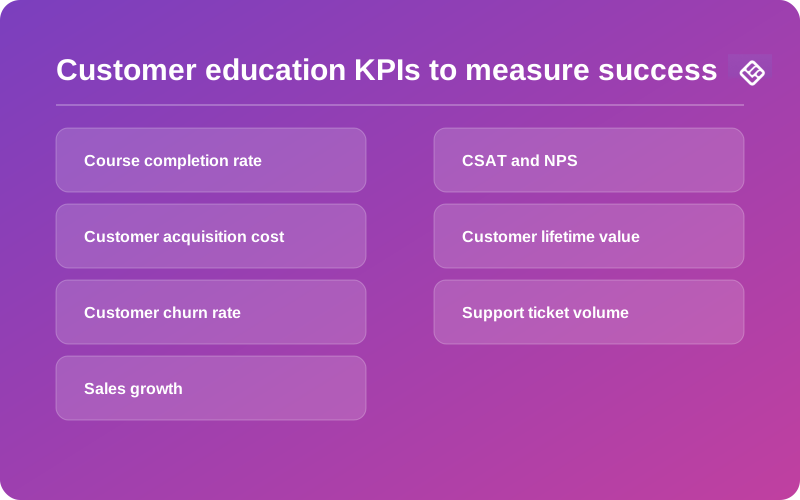
Knowing how to measure customer education is just as important as knowing how to build a customer education program. Without the right metrics, you can’t prove impact, justify investment, or know where to improve.
The following seven customer education KPIs cover both learning performance and business outcomes. Track them regularly and use them to refine your program over time.
1. Course completion rate
Course completion is the first indicator that your customer training program is working. It tells you whether customers are engaging with your content and seeing it through. Beyond completion, other engagement metrics worth tracking include time spent on activity, quiz scores, and certifications issued. Most platforms surface these automatically.
and certifications issued. Most platforms surface these automatically.
2. Customer acquisition cost (CAC)
Customer acquisition cost measures how much you spend to win each new customer. Customer training drives this number down in two ways: by establishing your brand as a trusted authority that attracts inbound leads, and by turning existing customers into advocates whose word-of-mouth referrals are essentially free acquisition.
3. Customer churn rate
Churn is one of the most consequential metrics for any subscription or SaaS business. Retaining a customer costs up to five times less than acquiring a new one, plus loyal customers consistently spend more over time.
Customer training addresses churn at multiple points: onboarding reduces early churn by shortening time to value; ongoing education keeps customers engaged and discovering new features; self-serve resources reduce frustration and friction that often lead to cancellation.
4. Sales growth
Customer training contributes to sales growth by boosting brand awareness, building perceived authority, and making it easier for your sales team to close since prospects see a mature training program as evidence of the support they’ll receive post-purchase. It also drives upsells and renewals from within your existing base.
One caveat: sales growth results from multiple concurrent initiatives, so isolating the exact contribution of customer training requires careful attribution.
5. Customer Satisfaction (CSAT) and Net Promoter Score (NPS)
CSAT measures how satisfied customers are with your product or experience. NPS measures how likely they are to recommend you. Both are direct reflections of customer education quality. Customers who understand and get value from your product consistently score higher on both.
Promoters are respondents who score 9 or 10 on a 0–10 scale. Detractors score 0–6. Passives (7–8) are excluded from the NPS calculation.
6. Customer lifetime value (CLV)
CLV measures the average revenue a customer generates for as long as they remain your customer. It’s one of the most important indicators of long-term business health, and measuring customer education’s impact on it tells you whether your program is driving real commercial value.
Customer training increases CLV by encouraging deeper product adoption, reducing churn, and creating the conditions for upsells, cross-sells, and renewals without manual push from your sales or customer success teams.
7. Support ticket volume
The cleanest way to measure the impact of customer training on support is to compare ticket volume before and after training is introduced. A complementary method is to compare tickets from trained vs. untrained customers to isolate the effect more precisely.
A sustained drop in support tickets means lower operational costs, better quality of service for complex issues, and a support team that can scale its impact without scaling its headcount.
Real-world customer education examples
The best way to understand what a strong customer training program looks like is to see one in action. These six companies have built standout customer education centers that drive adoption, loyalty, and long-term growth.
HubSpot Academy

HubSpot develops software for inbound marketing, sales, and customer service. To onboard new customers and support them beyond the initial setup, it offers HubSpot Academy, a fully free educational platform covering topics like email marketing, social media, and content strategy.
Courses use a mix of webinars, guides, and video-based learning, and several lead to industry-recognized certifications including social media, content marketing, and inbound sales. A built-in chatbot helps learners quickly identify the most relevant course for their goals.
Salesforce Trailhead
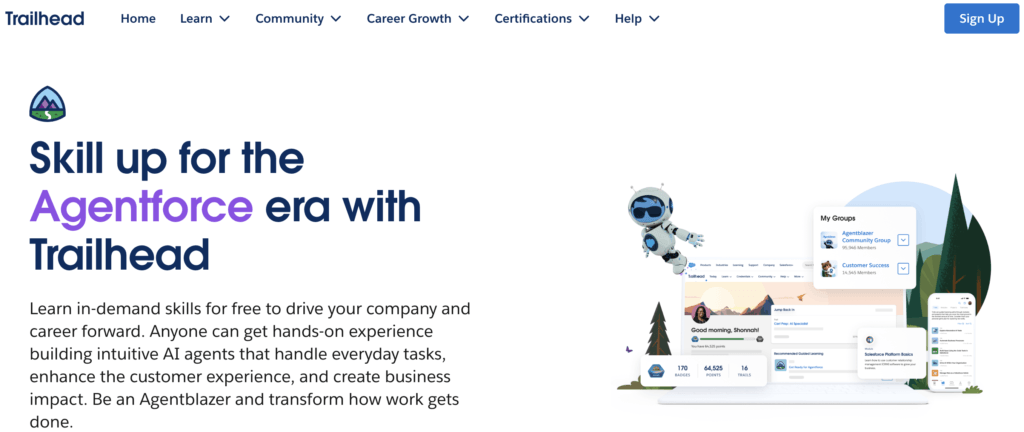
Salesforce built Trailhead as a gamified learning platform where users can develop in-demand skills, earn resume-worthy credentials, and pursue certifications. Modules include interactive quizzes and real-world challenges, and the platform uses badges and points to keep learners motivated and progressing.
It’s a strong example of how customer education certifications and gamification can make product training genuinely engaging, not just functional.
LearnWorlds Academy
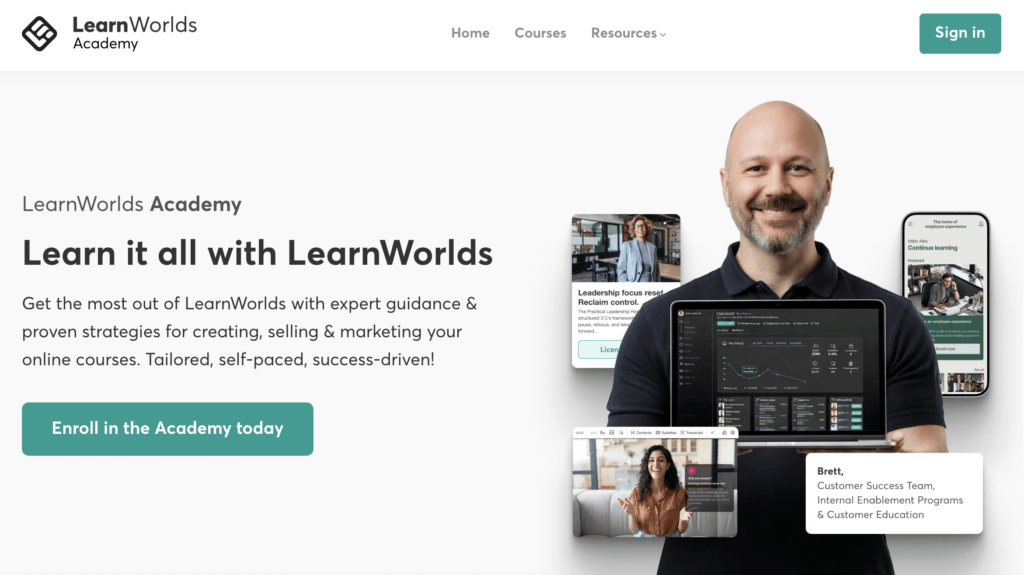
LearnWorlds Academy is our own customer education center: a free, membership-based platform that gives users access to a wide range of courses and resources covering everything from course building to lead generation and user management.
The academy combines video lessons, articles, case studies, and interactive quizzes into a cohesive learning experience. It’s complemented by daily webinars, on-demand resources like checklists, ebooks, and templates, and a customer support team available to help at every stage.
LinkedIn Learning

LinkedIn Learning offers its users a vast library of around 23,300 courses from nearly four thousand industry experts, spanning business, technology, and creative fields. Personalized learning paths, skills assessments, certifications, and group learning options make it one of the most comprehensive customer training programs available.
Learners can filter courses by job title and industry, and a free month-long trial gives new users the chance to explore the content before committing.
Canva Design School
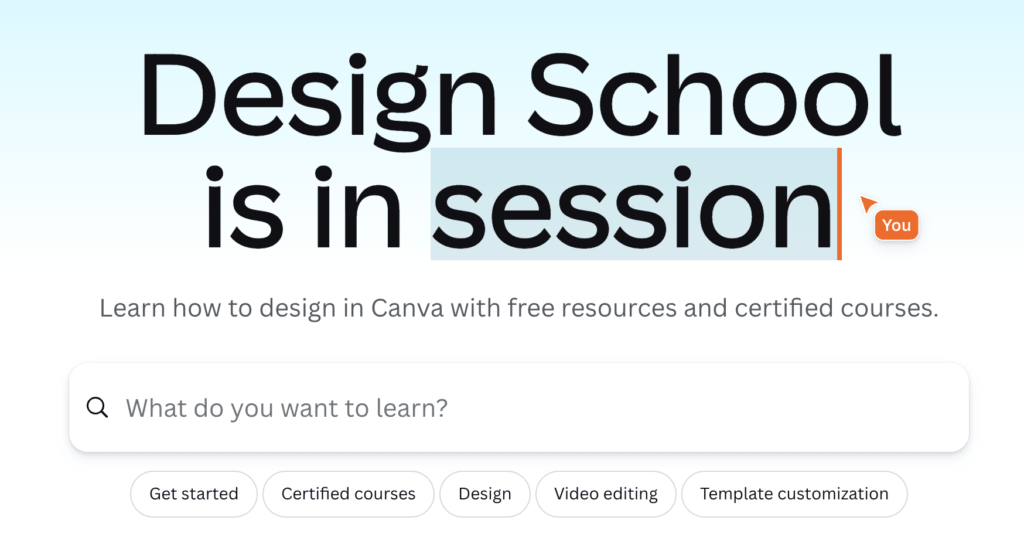
Canva’s mission is to make design accessible to everyone. Design School extends that mission into customer training. It offers free, interactive courses that walk users through the platform step by step, combining video learning with hands-on activities.
Popular courses include Create Videos with Canva, Managing Content in Canva, and Create Websites with Canva. Learners can also earn certifications in Canva Essentials, Teacher Essentials, and Graphic Design Essentials — no account required to get started, though certification does require a free login.
Zendesk Training
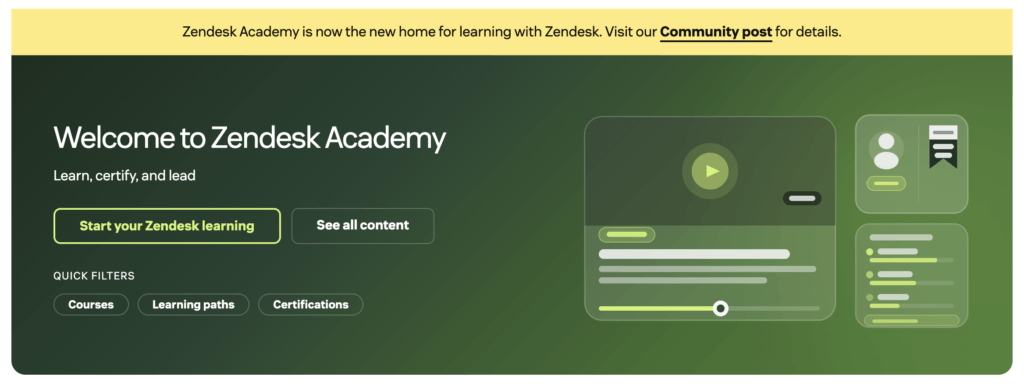
Zendesk Training offers both free and paid learning paths, with the paid track leading to Zendesk certification. Free resources are organized by company role (admins, agents, and developers each have their own path) making it easy to deliver relevant customer training without overwhelming learners with content that doesn’t apply to them.
Certification options include Zendesk Support Administrator, Zendesk Guide Specialist, and Zendesk App Developer. Despite a broad course catalog, the filtering and bundling options keep the experience manageable.
The future of customer education
Customer education trends point towards programs that are more personalized, deeply embedded in the product experience, and tightly tied to business results.
A few shifts worth paying attention to:
AI is making personalization practical
Rather than putting every customer through the same learning path, programs can now adapt based on a customer’s role, behavior, and progress surfacing the right content at the right time without manual effort.
Customers expect to learn inside the product
Contextual guidance that appears at the moment someone needs it rather than in a separate help center they have to go find is becoming the standard practice.
Video and interactive content keep winning
Short videos, hands-on tasks, and scenario-based learning consistently outperform static PDFs and long-form guides.
The pressure to show ROI is real
Customer education teams are increasingly expected to connect training to business metrics like product adoption, renewal rates, and support ticket volume.
Peer learning is pulling its weight
Customer communities and peer knowledge sharing frequently complement structured courses extending the reach of a program and building genuine engagement.
Ready to improve your customer education program?
If you’ve been thinking about how to improve customer education and its business impact, the answer lies in doing it more systematically.
LearnWorlds gives you everything you need to build a world-class customer training program, from course creation and interactive video to certifications, community, analytics, and integrations with your existing tech stack. Over 15,000 brands trust LearnWorlds to train their customers, partners, and teams.
See what your customer education program could look like with a 30-day free trial, no commitment required.

Androniki Koumadoraki
Androniki is a Content Writer at LearnWorlds sharing Instructional Design and marketing tips. With solid experience in B2B writing and technical translation, she is passionate about learning and spreading knowledge. She is also an aspiring yogi, a book nerd, and a talented transponster.
 Back to blog
 Scroll to top