


Table of Contents
Key takeaways
- Customer education in SaaS is the practice of teaching customers how to get real value from your product across their entire lifecycle
- Done well, it reduces churn, accelerates product adoption, and lets your Customer Success team scale without growing headcount
- LearnWorlds gives SaaS teams the platform to build, deliver, and measure those programs, from a simple onboarding track to a fully certified customer academy
What is customer education in SaaS?
Customer education in SaaS, or customer training, is a strategic initiative that teaches customers how to use your product effectively. In more detail:
Definition
SaaS customer education is the structured practice of helping customers build the knowledge and skills they need to be successful with your product through webinars, certifications, and self-paced content, across their entire lifecycle. It’s a proactive, ongoing effort that starts before the customer signs up and extends well beyond onboarding.
Customer education, onboarding, and support touch the customer lifecycle and often overlap, but they work in different ways. This table gives a quick overview of each one.
| Customer education | Customer onboarding | Customer support | |
|---|---|---|---|
| Duration | Ongoing | One-off | One-off |
| Format | Courses, certifications, webinars, guides | Guided setup, welcome flows | Tickets, live chat, calls |
| Initiated by | You (even before the signup) | You (at signup) | The customer |
Why SaaS companies specifically need customer education
SaaS has a problem that most other business models don’t: the relationship doesn’t end at purchase. Every month, customers decide whether to stay. That recurring revenue model is what makes SaaS so exposed to uncertainty.
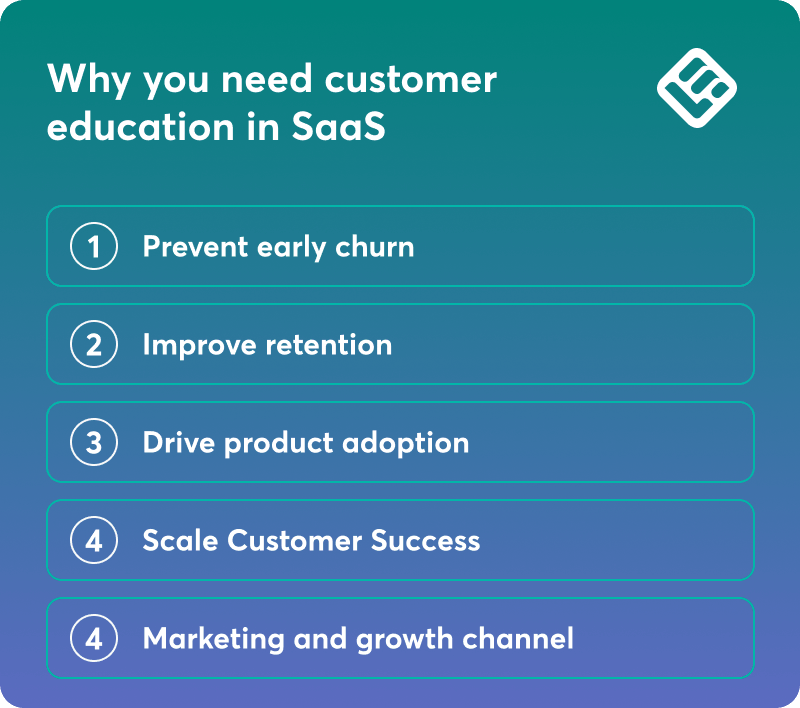
These four areas are where customer education has the most direct impact.
Prevent early churn
Early churn and Time to value (TTV) are two of the most important and closely linked metrics in SaaS. TTV depends on how quickly customers understand what your product can do for them, and for many, that understanding never comes.
Userpilot’s User Activation Rate Benchmark Report found that only 37% of sign-ups reach activation on average, the point where a customer has experienced enough value to build a habit around the product. The other 63% stall before they ever get there.
Structured education compresses TTV by giving customers a clear path from signup to first success. When they know what to do and in what order, they reach value faster, and they’re far more likely to stick around.
Improve retention
When customers don’t get value from your product, they churn. When users hit friction early, they stop exploring, they stop gaining any benefit out of it, and eventually they stop paying.
A customer education program interrupts that pattern by giving users the knowledge they need to move forward independently without waiting on a CSM call or submitting a support ticket.
That’s what retention data consistently shows: A study by Intellum and Forrester Consulting showed that companies see a 22.3% increase in average retention rates for products targeted by training.
Drive product adoption and feature discovery
Most SaaS products are used at a fraction of their capacity. Customers find one workflow that works and stick to it, missing out on features that would make them more successful.
Customer education closes the feature discovery gap in a way that in-app tooltips can’t, offering deeper product knowledge and engagement. A structured learning path tied to the features customers haven’t touched yet is what actually changes behavior. It’s the difference between a customer who uses 20% of your product and one who uses 80%.
Scale Customer Success without adding headcount
“Our CSMs were drowning in the same questions” is one of the most common things SaaS founders say when their CS team hits a scale ceiling. As your customer base grows, so does the demand for onboarding calls, check-ins, and QBRs. Without a scalable way to deliver that knowledge, you’re adding CSMs as fast as you’re adding customers. Eventually, your CSM team will hit a ceiling.
SaaS customer education allows you to scale customer success through always-on customer training: Self-paced courses, certification tracks, and on-demand training modules handle the knowledge transfer that used to require a human on every call.
Blip, which built its academy on LearnWorlds, is a good example: their team cut time to onboard new customers from 73 days down to 43 days. That’s 41% faster, with the same headcount.
If in a week, our team could onboard five companies, now they can onboard ten companies in one training session, in one day.
Lara Oliveira
Community Learning Experience Specialist at Blip
As a marketing and growth channel
The companies that grow fastest treat customer education as a pre-sale function.
A well-built customer academy does something a product page can’t: it demonstrates expertise and builds trust before a prospect ever speaks to sales. Published courses, certifications, and learning resources rank in search, get shared in communities, and show up in the research process of buyers who are evaluating you against competitors.
The same logic applies at any size. A SaaS company that publishes genuinely useful education around its category earns the trust of its future customers, as well as its current ones. We’ll look at how HubSpot, Canva, and others have done exactly this later in this guide.
Marketing and customer success teams rarely collaborate on this, but when they do, customer education programs generate pipeline as well as retention.
Components of SaaS customer education through the customer lifecycle
Customer education isn’t a single course or a help center. It’s a program that maps to the customer journey from the moment someone signs up to the point they become a product champion. Here’s how the four stages work.
| Onboarding | Feature adoption | Expansion | Advocacy | |
|---|---|---|---|---|
| Self-paced content, video walkthroughs | Behavior-triggered education | Advanced learning tracks | Certification programs, community | |
Onboarding path: product basics and the first value moment
The first 30 days are make or break. Customers are testing the waters, forming habits, and deciding whether your product is worth their time. Your onboarding education should do one thing above all else: get them to their first win as fast as possible.
At this stage, structure your CE program around a single, linear learning path. Keep it short and focused:
- 3–5 self-paced modules covering only the essentials
- Short video walkthroughs (under 10 minutes each) tied to specific actions in the product
- A clear progress indicator so customers always know where they are
- One defined “graduation” moment—the action that signals they’ve completed onboarding
You don’t need to cover everything. Trying to do so will overwhelm customers and soon backfire.
Feature adoption: ongoing education and fresh content
Once customers are active, the challenge shifts to deepening product usage. Every product update, every new feature, and every underused workflow is an education opportunity.
At this stage, your CE program needs two things running in parallel:
- Behavior-triggered learning paths. If a customer hasn’t touched a feature in 30 days, they get a module about it. The content finds them, rather than waiting for them to go looking.
- A fast content publishing process. Fast-moving SaaS products have a content freshness problem: every time the product changes, the training needs to change with it. A structured academy lets you publish a new module the moment a feature ships, so the training is ready when the feature is.
Expansion: upsell and cross-sell enablement
Educated customers are more likely to expand. When someone has mastered your core product, they’re more receptive to learning about what else you offer and sign up for higher plans to unlock advanced capabilities.
At this stage, your CE program should:
- Include learning tracks that lead naturally from core product mastery toward higher-tier features or adjacent products
- Share completion data with your CS team: a customer who just finished an expansion-focused course is your most qualified upsell conversation
Advocacy: certification programs and community
The goal of this stage isn’t to sell more but to create customers who do the selling for you. When someone is genuinely successful with your product, they talk about it, they recommend it internally, and they bring it with them when they change jobs.
At this stage, your CE program should offer:
- A certification track: a credential customers can add to LinkedIn, mention in a performance review, or share with a colleague evaluating the same tool. That kind of visibility is good for them and good for you.
- A community space where customers learn from each other and strengthen the relationship with your brand.
Read more about how to improve customer education.
5 SaaS customer education examples to inspire you
The best way to understand what customer education for SaaS looks like is to see how other companies have built theirs. Each of the examples below took a different approach, and achieved very different things because of it.
1. HubSpot Academy

HubSpot built one of the most recognized certification programs in B2B SaaS. The HubSpot Academy covers inbound marketing, sales, and CRM skills courses that are free to anyone, not just HubSpot customers.
At scale, HubSpot Academy became a brand awareness engine. Hundreds of thousands of certifications issued annually mean HubSpot’s name is attached to the career credentials of marketers and salespeople worldwide, achieving a level of loyalty that no ad campaign could buy.
2. Intercom Learning Center
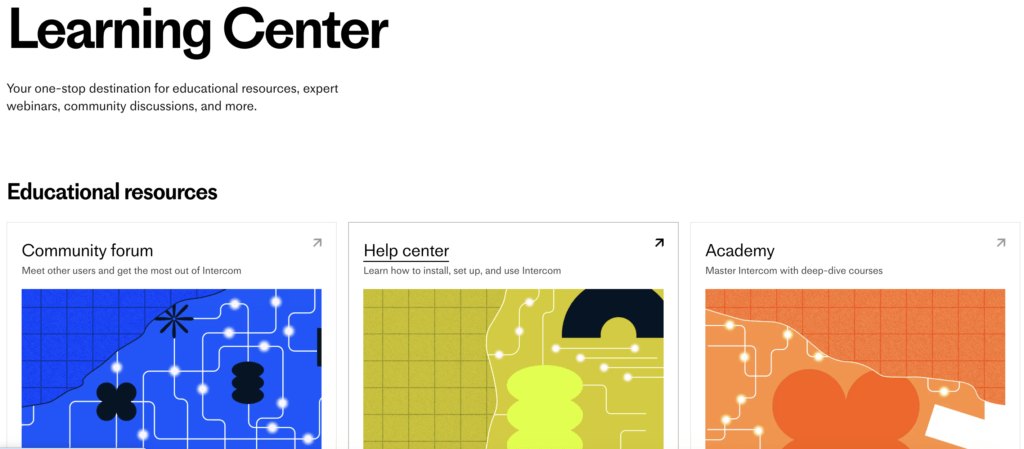
Intercom structured its customer education around onboarding: getting new users to value quickly through guided learning paths built into the product experience.
Intercom Learning Center helped reduce reliance on human-led onboarding at scale. Customers who completed structured learning got to value faster and required significantly fewer CS touchpoints early in their lifecycle.
3. Canva Design School
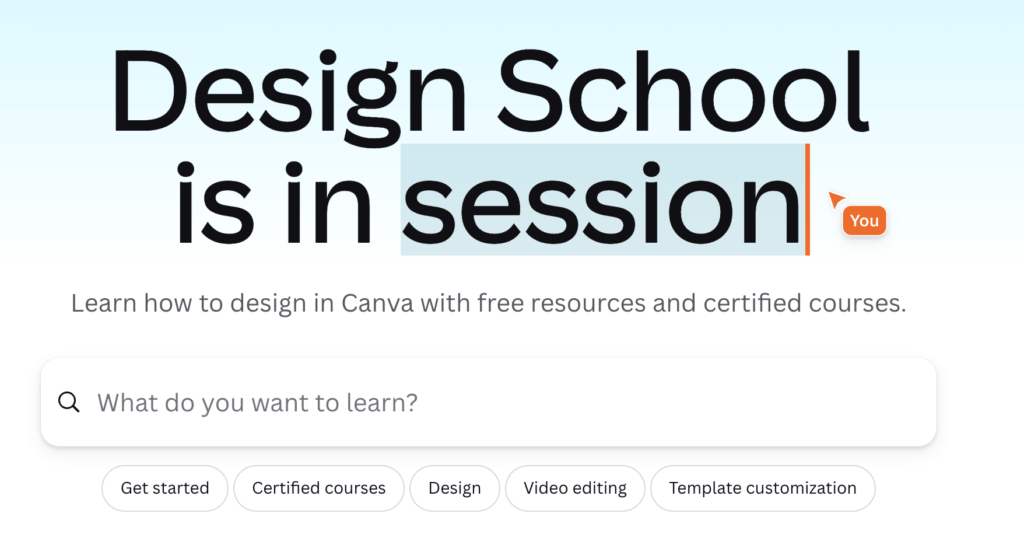
Canva Design School offers free education focused not on the tool, but on design itself. Courses teach design principles, typography, and visual communication, using Canva to do it.
By teaching use cases rather than features, Canva drove deep product adoption. Users who completed Design School courses became proficient and engaged.
4. Loom
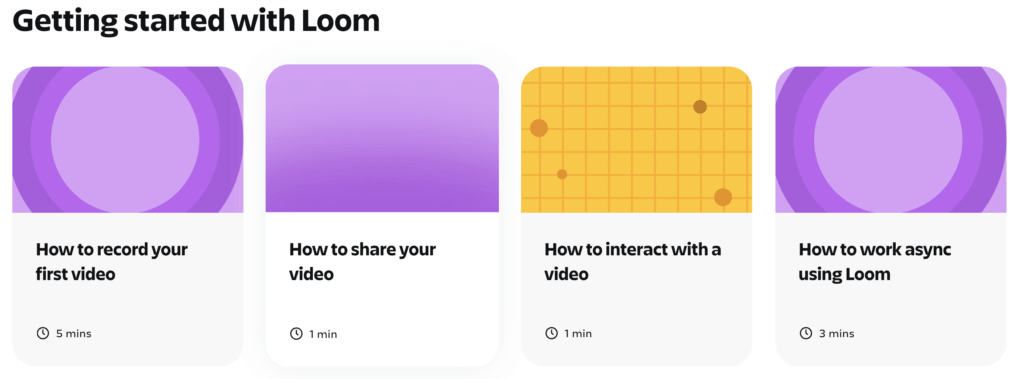
Loom took a video-first approach to customer education, using short asynchronous video tutorials to demonstrate exactly how to get value from the product. Loom also offers live and on-demand webinars.
The format matched the product’s own value proposition. Customers could watch a two-minute walkthrough and immediately apply it, compressing time to value and reducing early-stage drop-off.
5. LearnWorlds Academy
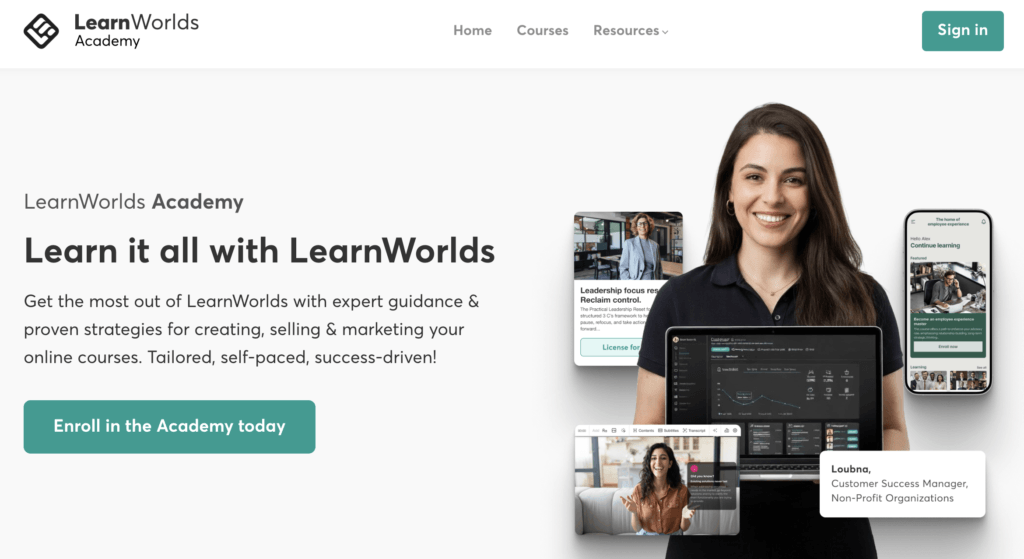
LearnWorlds Academy teaches customers how to get the most out of the platform, from building their first course to managing payments and customizing their school. Content is structured into self-paced tracks, organized by stage, and available on any device.
Customers can get started, find answers, and go deeper without ever needing to contact support. The academy reduces onboarding friction, shortens time to first course launch, and gives users a reason to stay engaged with the platform long after signup, which is exactly what a CE program is supposed to do.
Measuring customer education success: 6 KPIs and metrics
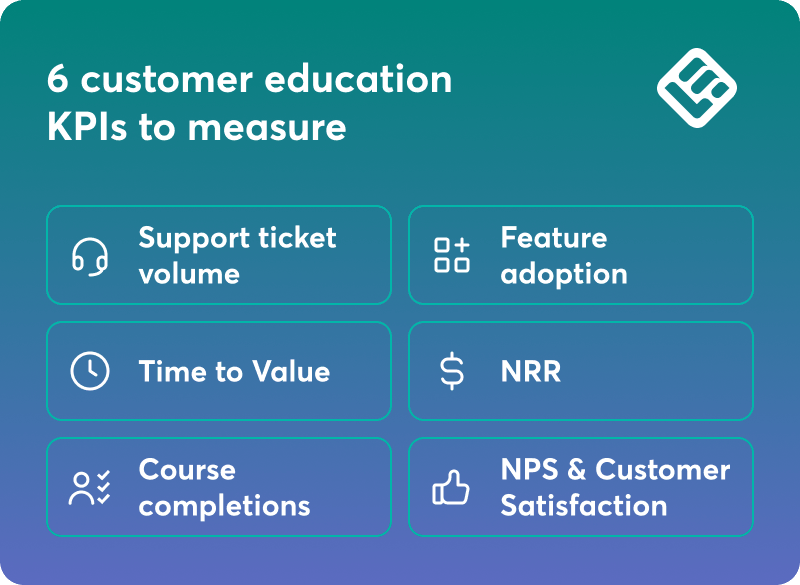
Tracking the impact of your customer education program helps prove what’s working, defend the budget, and decide where to focus next.
| KPI | What it measures | |
|---|---|---|
| Support ticket deflection rate | % of tickets avoided because customers found answers in the CE program | |
| Feature adoption rate | Change in feature usage before vs. after customers complete relevant training | |
| Time to first value (TTV | Days from signup to the first defined success milestone | |
| Course completion rate | % of enrolled customers who finish a course or track | |
| NPS / CSAT post-training | Satisfaction scores from customers immediately after completing a program | |
1. Support ticket volume (deflection rate)
This is often the first metric customer education teams use to prove impact, because the link is direct and easy to measure. When customers can find answers through structured training rather than submitting a ticket, the ticket volume decreases.
If the ticket volume remains the same, look at whether your training content actually maps to the questions your support team receives most. A mismatch between customer queries and training content is usually the culprit.
2. Feature adoption rate
Are customers actually using the features your customer academy covers? Compare usage data before and after a customer completes a relevant course. If the training is working, adoption should move.
If feature adoption is low, the content may not be hands-on enough. Instead of explaining what a feature does, build your modules around specific workflows and walk customers through real use cases.
3. Time to first value (TTV)
The number of days between signup and a customer reaching their first meaningful milestone. SaaS customer education directly compresses TTV by giving customers a clear, structured path rather than leaving them to explore on their own.
If it’s high, your onboarding track may be too long, or not focused enough on what customers should do first. The fix is usually to cut content, not adding more. Identify the single action that correlates most with long-term retention and build the onboarding track around getting customers there as fast as possible.
4. Net Revenue Retention (NRR)
This is the metric that gets programs taken seriously at the executive level. Compare NRR between customers who completed your customer training program and those who didn’t. If educated customers expand more and churn less, the program is a direct revenue contributor.
If it’s low, customer education may not be reaching customers at the right lifecycle stage. Expansion-focused training needs to land when customers have already found value in the core product, and linked to customer behavior rather than a fixed date.
5. Course completion rate
Tells you whether customers are actually finishing what they start. A low completion rate doesn’t necessarily mean the content is bad. It often means the course is too long, the learning path isn’t clearly mapped, or customers don’t feel a strong enough reason to finish.
Start by looking at drop-off points. If customers are leaving at a specific module, that module is the problem. Also consider whether there’s a meaningful reward for completion: a certificate, a badge, or access to the next track. Completion rates tend to rise when finishing something unlocks something else.
6. NPS/CSAT post-training
These scores aren’t a measure of how much customers enjoyed the course. They’re a measure of whether the program did its job. Customers who finish a program feeling more confident and capable tend to rate the product itself more favorably and are more likely to recommend it. Track them against your pre-program baseline; a meaningful uplift is a signal the training moved the needle on product satisfaction.
If scores aren’t moving, the training may be covering the wrong things. Go back to outcomes: what should a customer be able to do independently after finishing, and is the content actually getting them there?
How to build a customer education program for your SaaS depending on your growth stage
A customer education program doesn’t look the same at every stage of company growth. The scope, structure, and resources you put behind it should reflect where your business is today. Here’s how the program typically evolves as you scale.
Early-stage
At this stage, your priority is to build a viable customer academy. Start with the content that will make the biggest impact on your most common pain points.
Priorities:
- Identify the top three reasons customers contact support in their first 30 days
- Turn those answers into short self-paced modules (five to 10 minutes each)
- Build a simple onboarding track and start directing new customers to it
- Measure ticket deflection and TTV before and after
Growth-stage
Now you’re ready to expand the academy. You have enough customers to justify the investment and enough usage data to see where adoption gaps exist.
Priorities:
- Launch a branded, white-labeled academy on a dedicated subdomain
- Build out your four-stage curriculum: onboarding, feature adoption, expansion, advocacy
- Segment learning paths by customer tier, role, or product line
- Introduce certifications to drive engagement
- Connect your academy to your CRM to track who’s learning and trigger automated enrollments
Enterprise SaaS
Enterprise programs need to operate at a different level of sophistication.
Priorities:
- Build a fully white-labeled academy that reflects your brand
- Deliver learning paths in multiple languages where your customer base demands it
- Implement role-based access so enterprise customers manage their own user groups
- Set up account-level analytics to track certification rates and completion by customer or contract
- Create a partner enablement track alongside customer-facing content
Download our free ebook Scaling smarter in SaaS to find out more about scaling customer education and customer success based on your growth stage.
AI in SaaS customer education: what’s changing in 2026
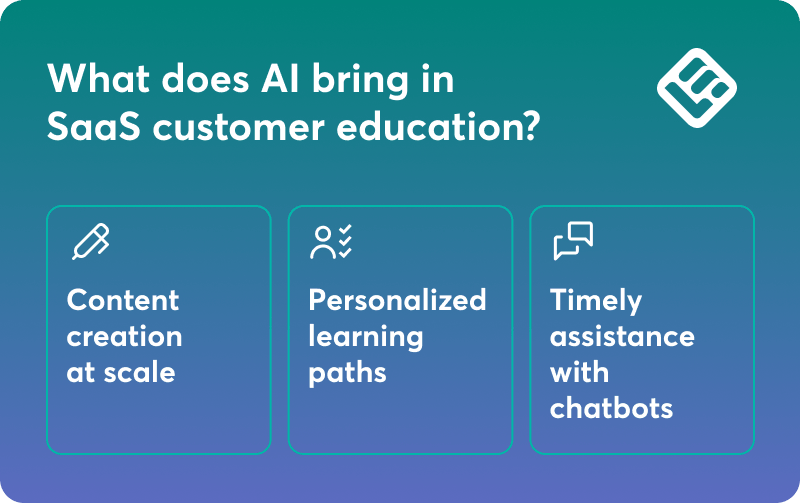
AI is changing two things about customer education: how fast you can produce content, and how relevant that content can be to each individual learner. Neither of these was possible at scale two years ago.
When it comes to building SaaS customer training programs, we’re seeing:
AI-generated course content at scale
Writing training content has always been time-consuming. AI cuts that time significantly by repurposing existing resources, generating course outlines, quizzes and other original content. Watch our webinar on-demand to see how we used AI to cut down production time for our own training academy.
Personalized learning paths based on customer behavior
AI-powered platforms track specific actions customers take inside your product and respond with relevant training content. For example, a customer who completes a setup step, gets a module on what to do next. The training responds to what customers are actually doing, rather than serving everyone the same content in the same order.
AI-powered knowledge bases and chatbot integration
Rather than sending customers off to a search bar, embedded AI chatbots can answer questions in context, surfacing the relevant module, explaining a concept, or walking a customer through a specific workflow.
How to choose a customer education platform for SaaS
Not every LMS is built with SaaS customer education in mind. Most were designed for employee training, which has very different requirements. When you’re evaluating a platform, here’s what actually matters for a customer-facing program.
Key criteria to evaluate:
- White-labeling: Can you fully brand the academy with your own logo, domain, and design? Customers should feel like they’re learning inside your product, not your vendor’s.
- CRM integrations: Does it connect natively to HubSpot? You need enrollment triggers, usage sync, and lifecycle visibility.
- Analytics: Can you track completion, progress, and engagement at the account level, not just the user level? CS leaders need to report on customer cohorts, not individual learners.
- Certification and badging: Are certificates auto-issued on completion? Can they expire? Can customers share them on LinkedIn?
- AI content authoring: Can your team build courses without needing a developer or an instructional designer? The faster you can publish, the more current your content stays.
LearnWorlds is purpose-built for this use case. It’s the platform trusted by SaaS teams who need a white-labeled, analytics-rich, CRM-connected customer education program. Explore the full customer training solution and start a free trial and build your first course today.
FAQs
Customer education in SaaS is the structured practice of teaching customers how to use your product effectively across their entire lifecycle through webinars, certifications, user communities, and self-paced content. It goes beyond onboarding to cover feature adoption, expansion, and advocacy.
Customers who understand your product deeply are less likely to leave. Structured SaaS customer education removes friction that causes early churn, accelerates time to value, and keeps customers engaged with features that make them successful long-term.
Onboarding covers the first steps in the customer lifecycle, focusing on getting them started and reaching their first success moment. Customer education covers the full lifecycle, covering feature adoption, expansion, and advocacy.
The most meaningful metrics are support ticket deflection rate, feature adoption rate before and after customer education, time to first value, course completion rate, and NPS/CSAT post-training. Long-term, companies measure the impact on Net Revenue Retention by comparing cohorts of educated vs non-educated customers.
At minimum: a structured onboarding track, self-paced modules covering core features, and a way to measure completion and engagement. As the program matures, add feature adoption paths triggered by behavior, expansion tracks tied to upsell moments, and a certification program for your most engaged customers.
SaaS customer success training typically focuses on equipping your CS team with the skills to manage renewals, run QBRs, and handle escalations. Customer education is the program you build for your customers. The two are related but they serve different audiences.
The platform needs to fit your customer-facing brand, connect to your existing tech stack, and let your team update content without a developer. Look for white-labeling, native CRM integrations, in-depth analytics, certification capabilities, and AI content authoring. LearnWorlds for customer education and training is an all-in-one platform that covers these needs.
Yes, in multiple ways. AI helps teams produce and update course content fast enabling them to keep up with product updates. AI-driven personalization surfaces the right learning content to each customer based on how they’re using your product, and chatbots help them overcome friction in real time.

Androniki Koumadoraki
Androniki is a Content Writer at LearnWorlds sharing Instructional Design and marketing tips. With solid experience in B2B writing and technical translation, she is passionate about learning and spreading knowledge. She is also an aspiring yogi, a book nerd, and a talented transponster.
 Back to blog
 Scroll to top