Table of Contents
Key takeaways
- Training requirements in US sport come from federal law, state law, and governing bodies. Some, like SafeSport, renew on a fixed cycle.
- Recent coach training in general safety and injury prevention fell from 34% in 2019 to 26% in 2024.
- The seven steps below use FCF Academy, the Colombian Football Federation’s education platform, as a worked example of getting a training program ready for the next cycle.
Someone outside the building writes the training requirement. Someone inside has to deliver it on a schedule that keeps running.
Take safeguarding as an example. A 2017 federal law sits behind SafeSport training across US Olympic and Paralympic sport, and that training renews on a fixed cycle. Add concussion education, which varies from state to state, and new modules added to licenses coaches already hold. The result is an ongoing education program, with each requirement on its own schedule and its own rules.
Whether you run education for a federation, an association, a coaching academy, or an athlete development program, someone on your team has to keep it moving, often without a dedicated budget. This article covers what those requirements look like today, then seven practical steps to get your program ready before the next cycle starts.
Every requirement comes with a renewal date
The U.S. Center for SafeSport serves more than 50 national governing bodies and has supported more than 5,000 organizations with abuse-prevention education. U.S. Soccer’s Policy 212-3 shows the cycle in practice.
Employees, board members, and adults in regular contact with minor athletes complete a 90-minute core course in year one, annual refreshers in years two through four, then the core course again in year five.
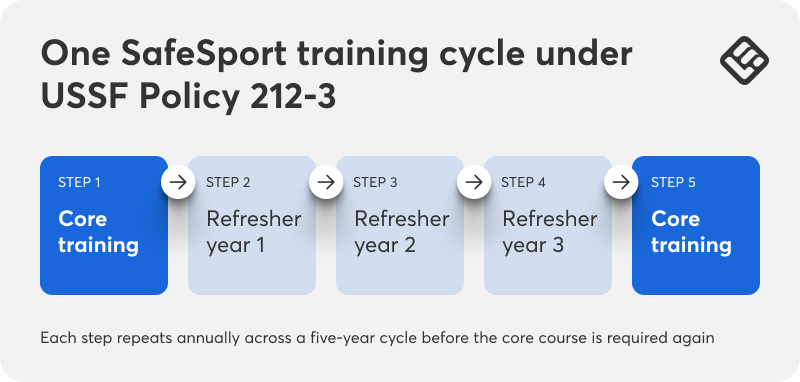
SafeSport is one requirement among several. The table below brings the others together.
Evidence | What it means in practice | |
|---|---|---|
Concussion education | A review of state laws as of July 2017 found that 34 states (68%) required concussion-specific training for coaches, with requirements varying by state | Organizations working across states may need to track different rules by location |
New license requirements | U.S. Soccer is adding ACL injury-prevention education for coaches completing the C license and above, affecting more than 100,000 coaches | Education requirements can change after a coach already holds a license |
Parent expectations | Nearly nine in 10 youth sports parents (88%) believe coaches should pass a criminal background check | Families expect coaches to be screened |
Requirements keep rising. Training keeps falling.
While requirements grow, coach participation in recent safety and injury-prevention training has fallen, from 34% in 2019 to 26% in 2024.
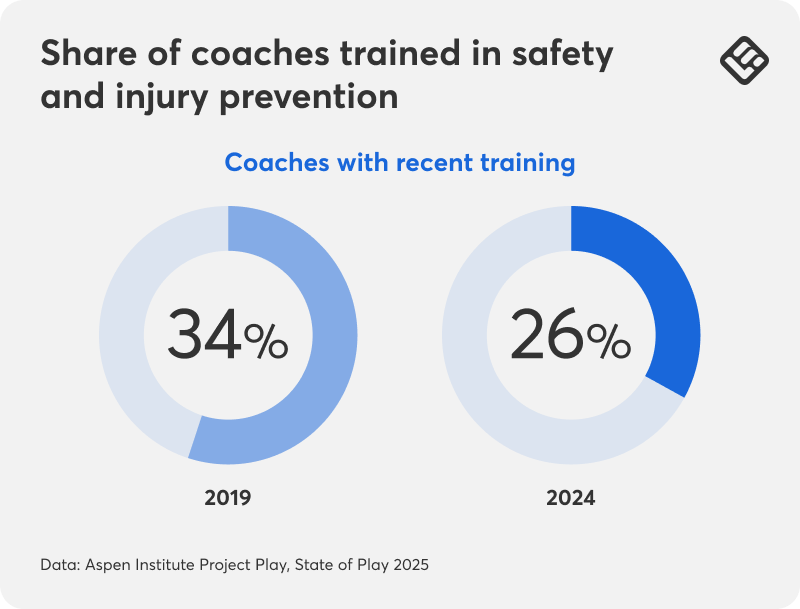
That gap is the practical problem for anyone running education in a sports organization. Every requirement still has to reach everyone it covers, and each of them has to complete it on time, every cycle.
How one national federation rebuilt its coach education
FCF Academy is the official education platform of the Colombian Football Federation. Since 2016, CONMEBOL has required federations to run mandatory coach licensing, and without a Pro, A, or B license, a coach can’t work in official competition.
FCF delivered that licensing through universities and scattered tools. A university partner spent close to a year without delivering a usable platform, while the flagship License C program ran through WhatsApp groups and single Zoom links sent manually on the day of training.
“We started with a university, and honestly, it went very badly…”
Felipe Castro Arévalo, Director of FCF Academy.
Felipe went looking for a white-label platform the federation could own and run itself, and built the first version of FCF Academy on LearnWorlds in one week. Two years later, it has enrolled more than 3,500 learners, certifies up to 2,000 coaches a year, and is 10x more affordable than the university option they started with. FIFA and CONMEBOL now recognize it as a federation education success case.
💡Read the full story: FCF Academy transforms football education into a scalable learning ecosystem
FCF’s experience runs through the steps below as a worked example.
Seven steps to take before your next training cycle
Each step works for a federation, an association, a coaching academy, or an athlete development program, and each one gives you something concrete to bring to your next planning meeting.
1. List every requirement and who it covers
Build one table with a row for each requirement. Add columns for who sets it, who it covers, how often it renews, and when it’s next due. Include federal and state requirements, anything set by a governing body you belong to, and the standards you set for your own coaches and staff.
Here’s what one row could look like.
Requirement | Who sets it | Who it covers | How often it renews | Next due | |
|---|---|---|---|---|---|
SafeSport training | Federal law, applied through governing body policy (for example, U.S. Soccer Policy 212-3) | Employees, board members, adults in regular contact with minor athletes | Core course, yearly refreshers for three years, core course again in year five | Your date | |
Then put every due date on one shared calendar, grouped by audience, and look for the months where renewals stack up. Plan your reminders for those months first.
2. Map where your training actually lives
List every tool your program runs on today: group chats, video call links, shared drives, spreadsheets, email threads, and any partner’s system. Next to each one, answer two questions. Can you see who completed what, and when? And who holds the learner data?
At FCF Academy: Before its own academy, FCF ran its License C program on WhatsApp groups and Zoom links, with little structure, assessment, or progress tracking. With licensing spread across universities and scattered tools, the federation had no control or visibility over its own program.
3. Check completion group by group while training is running
Pull completion rates for each club, region, team, site, or cohort, and set them next to your overall rate. A healthy average can hide a group that is falling behind.
Then check the timing. Can you see progress while a cohort is still training, or only after the deadline has passed?
At FCF Academy: Learners now follow structured learning paths with formative and summative assessments, and the academy tracks each learner’s progress individually.
4. Work out what one learner costs you
Add up a year of spending: outsourced delivery fees, platform or license fees, staff hours spent organizing sessions and chasing renewals (at their hourly cost), and per-person costs such as background checks. Divide the total by the number of people who completed training.
Per-person costs grow with every coach you add. The Oregon Youth Soccer Association spends $165 per coach on federal background checks, which comes to $16,500 for every 100 coaches screened.
At FCF Academy: Cost also decides who can take part. “There’s no point launching a 600-hour program that costs $10,000 where you’ll sell ten enrollments at most,” Arévalo said. FCF Academy is now 10x more affordable than the university option they started with.
5. Set a deadline for anything you’re waiting on
If a partner is building or running part of your program, write down what “delivered” means and the date you’ll stop waiting.
While you’re at it, decide what to keep with partners and what to run yourself. Specialist content can make sense to buy in. Recurring licensing and safeguarding training changes whenever a rule does, so it pays to control those updates directly. U.S. Soccer runs its D, C, and B licenses as blended courses through its own Learning Center, and the NFHS Learning Center offers more than 60 free courses serving more than 19,500 high schools.
At FCF Academy: FCF gave its university partner close to a year. “At 11-12 months, I said: No more, this can’t keep going this way,” Arévalo said. When he started looking for an alternative, he knew what he needed: a white-label platform the federation could own, launch without a development team, and manage itself.
6. Launch a first version, then expand
Choose one program to move first, such as a license or a mandatory course, and get it running in a structured format. Add courses and audiences once that first program is working.
At FCF Academy: The first version of FCF Academy took one week to build. Two years in, its roadmap includes 20 virtual courses and nearly 6,000 learners, with new programs in psychology, nutrition, sports law, and club administration in development.
7. Build around the people you train and the devices they use
Group your learners by role, such as coaches, technical staff, athletes, parents, and administrators, and give each group its own path through the content. Then ask a coach or athlete to complete a module and a certification step on their phone, and note where they get stuck.
At FCF Academy: The academy serves three schools from one platform: coaches and technical staff, players and parents, and club management professionals. Learners filter by school and level, and 65% of them access the academy on mobile, since coaches and players rarely sit at a desk.
Start with the first two steps
Requirements will keep changing, and each change arrives with its own renewal date. Steps 1 and 2 are a good place to start this month. A list of what you owe and a map of where your training lives will show you which of the other steps matters most for your organization.
Ready to own your next training licensing cycle?
LearnWorlds gives sports organizations a place to deliver online training and certification under their own brand. Start a free trial and see how your courses would look on your own academy.
 Back to blog
 Scroll to top
Related Articles