

Table of Contents
I’ve been writing employee and retention content for employers for three years now, and I sift through a ton of research to keep that content sharp. After all that sifting, I’ve noticed a trend: employee and staff training and development is no longer a nice-to-have. It’s a must.
But research suggests it’s one of the toughest challenges companies face, with nearly six in ten HR leaders [1] saying that helping their people learn and grow is one of their biggest struggles.
I’m here to tell you that while employee training and development may seem difficult, it’s not unattainable, especially if you follow a framework.
Why training and development matter more than ever
When people take advantage of chances to learn and develop, the benefits of training employees start to show.
Here’s what the data says:
And let’s not forget AI and automation. As automation and AI continue to redefine work itself, training has become the best safeguard against employees feeling obsolete in ever-more-competitive job markets.
So, whether you’ve been considering upskilling vs reskilling, some sort of training and development for your employees is going to be needed, and soon. Like in the next 5 years, soon.
Why? The World Economic Forum predicts that 59% of the global workforce will need to upskill by 2030. So yes, work training needs matter, right now.
Types of employee training and development programs
OK, so I’ve hit you with a bunch of stats. Now it’s time to get grounded and check out what you can incorporate at your own organization. Here are the different types of training and development programs for employees you could consider.
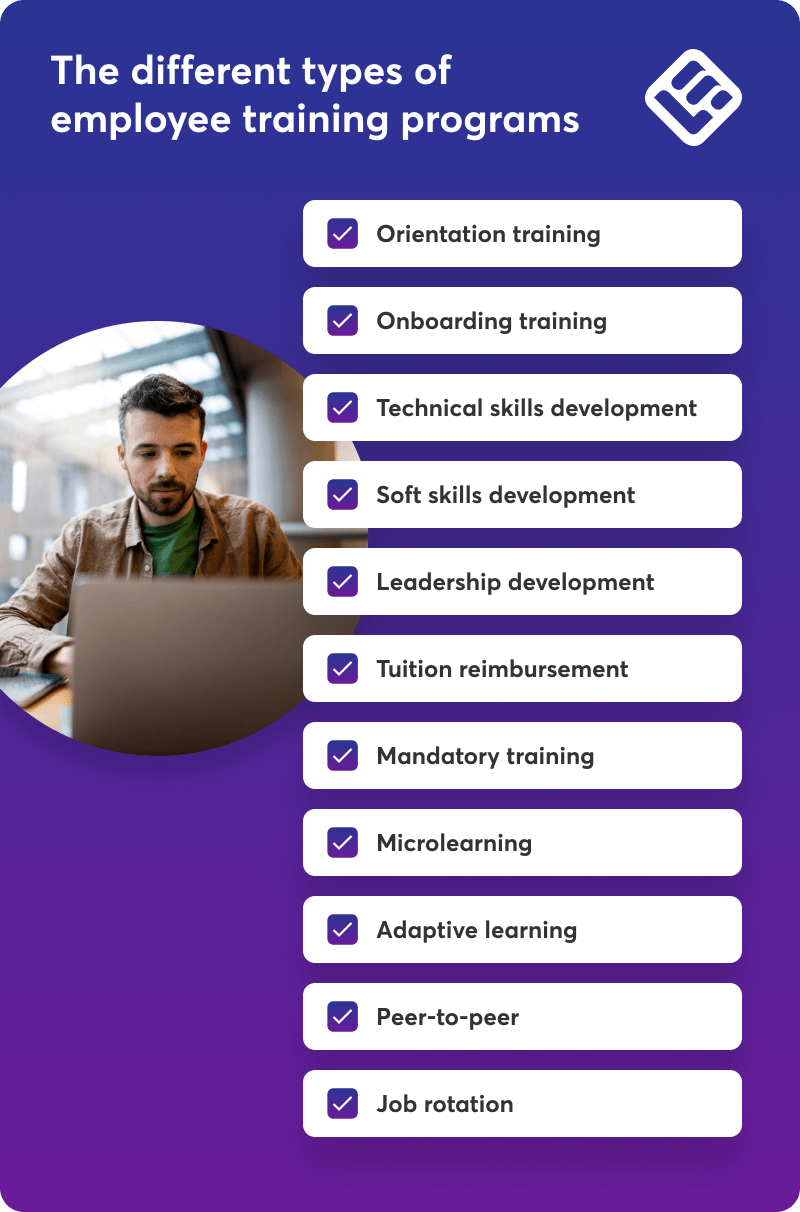
Orientation training
Orientation is the first impression new hires get of your company. It’s when you introduce them to your mission and values and prep them for what their experience working with you will be like.
Someone from HR usually leads this, and they walk your new-hires through topics like:
In addition to dotting your i’s and crossing your corporate t’s, orientation training is also a chance to help your new employees feel welcome.
And just to be clear, onboarding vs orientation are not the same thing. Orientation is short-term and broad, more like the “who we are and how things work.” Onboarding, on the other hand, prepares employees to grow into their new role.
Onboarding training
Once orientation ends, onboarding begins. This is where your employees learn how to do their specific job. It focuses on what they need to succeed in their new department or role:
Strong onboarding training and development programs link employees to mentors and teach them how their work supports the company’s mission.
Most employers I’ve seen use standard 30-, 60-, and 90-day onboarding phases to run their onboarding programs. This keeps things consistent and also makes it easy for HR to measure progress over time.
Technical skills training
With technical training, your goal is to focus on—you guessed it—the hard or technical skills people need to perform specific tasks. These are measurable, role-specific skills.
If you need to keep your technical training flexible and continuous, and you want it to grow, use blended learning methods. This could look like combining instructor-led sessions with online modules or simulations that help your employees practice these skills hands-on.
Soft skills training
This kind of training strengthens the human side of work and covers skills like:
When considering soft skills vs hard skills training, don’t overlook the importance of human-led qualities in the workplace. Even with—I’d argue, especially with—AI being used in everything, soft skills still have an important place in professional development.
Soft skills programs can have a lot of variety, from training and development for managers to conflict resolution coaching or guided peer feedback sessions. The point is to help people understand not just what to do, but how to do it well with others through staff development programs.
Leadership development programs
These programs focus on building leadership training for employees at every level, so banish any thoughts you might have had about them being reserved for grooming future execs. They teach people how to motivate, delegate, coach, and make better decisions.
And the ROI can be big. Companies with effective leadership development programs see up to a 50% improvement in employee retention. That’s a huge win in both saving hiring costs and keeping your teams stable.
Mixing real-world projects with mentorship is one way I’ve seen employers set up leadership development plans, and I think it’s pretty effective. This combination can help employees practice leadership in scenarios that apply to their actual work, and not just learn about it in theory.
Tuition reimbursement programs
With a tuition reimbursement program, you’re putting your money where your mission is. This is where you agree to fund or partially fund continued education: a master’s degree, a certification, or even short professional courses.
The return is twofold: professional development programs for employees help them bring fresh insight and up-to-date knowledge into the business, and they stay longer because they feel genuinely invested in.
Some companies explore tying reimbursement to performance goals, meaning employees qualify after a certain amount of time or once they’ve met agreed-upon milestones. Others make it open to everyone from the start, but you might want to consider balancing up-front costs with long-term ROI when considering which approach you choose to take.
Mandatory and compliance training
Mandatory training isn’t glamorous, but it shows up in some way regardless of the industry. You know the ones: they make sure employees understand the rules, laws, and safety standards that protect everyone.
Common compliance training examples include:
The challenge is to make compliance training meaningful. To keep employees from going through the motions, the best programs use real-life scenarios and short refreshers to keep knowledge relevant.
Microlearning
I’m going to paraphrase Cambridge University Press here: microlearning is a supplement that injects small doses of new skills or information between training sessions.
This could look like a short video, checklist, or quiz used to reinforce a single concept without interrupting daily work.
Microlearning keeps learning active and easier to absorb, and it addresses one of the biggest barriers to employee retention and training. That is time.
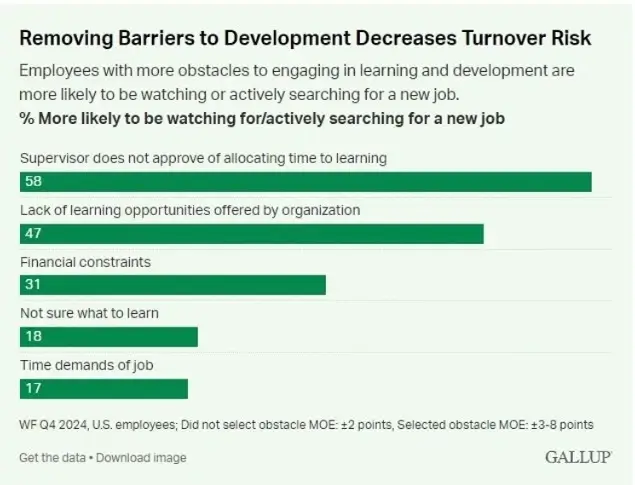
It’s practical for teams with limited time and helps employees retain knowledge through regular exposure to the content they need to know.
Adaptive learning
Adaptive learning uses technology to personalize elearning for employee development so each learner gets exactly what they need.
An experienced sales rep who nails a product knowledge quiz might automatically skip to advanced negotiation scenarios, while a new hire might get extra examples and reinforcement. It’s data-driven learning that flexes in real time and works really well when supported by training tools like learning management systems (LMS). See how an LMS for employee onboarding and training works in practice.
You’ll see adaptive platforms more often now because they blend personalization with scalability, which works great if you have a lot of distributed teams. It’s a great way to keep training relevant when faced with inevitable workplace changes and different learner needs.
Peer-to-peer learning
Peer learning is pretty simple: your employees teach each other. This type of learning tends to be fairly organic, and it happens when people share knowledge directly through methods like:
This kind of learning strengthens collaboration and makes learning a shared responsibility.
Because this isn’t a very formal or structured type of training, it’s usually up to the organization to create a work environment that supports peer learning. In practice, this comes down to encouraging employees to share what they know and making learning part of everyday conversation.
Job rotation
Way back in the day, I worked at a restaurant that lived and breathed through this type of employee training and development.
Job rotation gives employees the chance to step into new roles or departments temporarily. It’s one of the best ways to broaden experience and uncover hidden strengths. And as you can see from my example, it’s applicable in all types of industries.
These rotations can last weeks or months, but the goal is the same: to develop adaptable employees who see the business as a whole and feel confident offering support in multiple roles.
Costs and budgeting for employee training
Training is an investment, and like any investment, it needs a clear plan and measurable goals to be its most effective. To give you some concrete training investment statistics to work with, I used TrainingMag’s 2024 Training Industry Report. All the numbers you’ll find in this section come from there.
They’ve been issuing this report for over 43 years now, so I trust them when it comes to building context through cold-hard facts and stats.
Understanding the cost of employee training
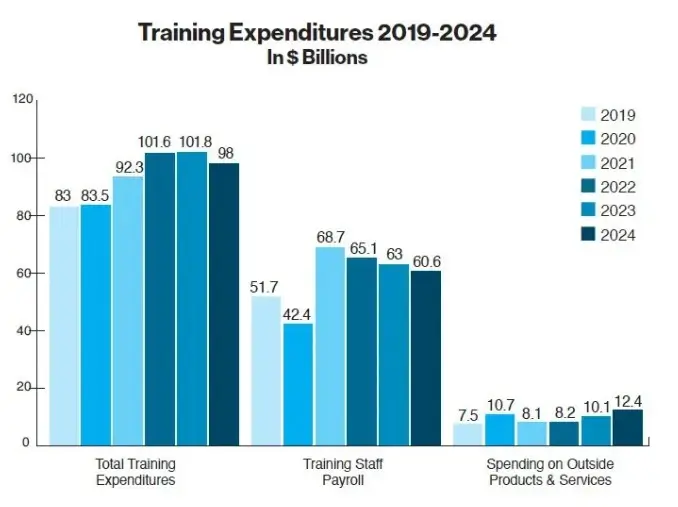
While not necessarily indicative of what you should expect to spend, here are some averages.
In 2024, U.S. companies spent $98 billion on employee training, which is a 3.7% drop from 2023.
That dip doesn’t necessarily mean training is losing importance, but that it reflects tighter budgets and a growing demand to prove ROI. Along those same lines, the average spend per learner also fell, from $954 to $774.
These numbers shift a lot when it comes to company size, so your training budget per employee will vary accordingly:
You might wonder why large companies tend to spend less, and the biggest reason is that these large organizations benefit from scale. They can spread the cost of technology and course materials across thousands of employees, which brings the per-learner average down.
Once they’ve invested in a learning platform or built a library of training materials, the marginal cost of training each new employee is minimal.
Smaller businesses don’t have that same advantage, which means every training dollar carries more weight. If you’re in that position, it’s even more important to connect spending directly to performance and retention outcomes.
Based on company size, here’s what the average training budget for companies looked like in 2024:
Those totals include salaries for training staff, technology costs, and outside vendors. Roughly 13% of the average budget went to learning tools and technologies, with onboarding (13%), compliance, and manager training and development (12% each) taking the largest shares.
Here’s a simple way to look at how those costs usually divide up:
In case you’ve been wondering what these numbers really tell us, it’s this: training budgets will always vary, but the mix of costs matters more than the total. What counts is how well those dollars will help your employees grow.
Calculating ROI and how to justify training costs to leadership
If you want leadership buy-in, you’ve gotta show how training ties to results. Demonstrating the ROI of training programs helps make that case, and using a straightforward ROI framework can support you.
Here’s how to start:
Let’s say your company spends $40,000 running a six-month leadership development program for 20 new managers.
Before the program, annual turnover among this group averaged 18%—about four departures a year. After the program, turnover drops to 10%, saving roughly two replacements.
If the average replacement cost is $25,000 per role, that’s $50,000 in savings against a $40,000 training cost—a net positive ROI in the first year alone.
This little example highlights the direct link between training cost vs retention and shows how even small improvements in employee stay rates can offset training expenses in a big way.
According to our TrainingMag report, 8% of organizations listed a lack of ROI as one of their biggest training challenges. I find this a nice reminder that even as spending grows, connecting training costs to measurable business outcomes matters.
Building a smarter training budget
So, how do you build a training and development budget? Start by listing all your direct and indirect costs:
Once you’ve outlined your costs, connect each one to a clear purpose.
Say 13% of your budget goes to technology. What outcome does that support? Maybe it makes training easier to access or helps you track results. If onboarding takes the largest share, is it helping new hires get up to speed faster or stay longer?
From there, you can use a few simple steps to see how your training spend stacks up. Here’s how to calculate training costs in a clear, straightforward way.
Step 1: Add up your total costs
Include everything, including instructor time, tools and platforms, travel, facilities, and the time employees spend learning.
Step 2: Find your cost per learner
Divide the total cost by the number of people trained.
Example: You spend $35,000 to train 50 employees → that’s $700 per learner.
Step 3: Identify what changed
Pick one metric that training is meant to improve, such as retention, productivity, or customer satisfaction.
Step 4: Estimate the value of that improvement
Let’s say the training worked. Turnover among those 50 employees dropped by just two people. If it costs around $25,000 to replace each person, that’s $50,000 saved because those employees stayed.
Step 5: Compare savings to spending
Subtract your total cost ($35,000) from the savings ($50,000).
That’s a $15,000 net gain—proof your program paid for itself.
Once the budget-allocation decision-making people in your office can see that connection between training cost and retention, you might find them sitting up and paying closer attention.
How to build a training strategy that works
If there’s one thing I’ve learned these past few years, it’s that developing a training program for employees doesn’t start with tools but with figuring out what they need to learn.
Co-founder and Product Owner over at Winday, Aleksandr Adamenko, agrees with me.
One of the biggest mistakes is to focus training only on the “tick box” and not on the real needs of the team. Often, programs are created because “it’s necessary”, and not because employees really lack specific skills. At Winday Co, we always start with an analysis of the problems — what really hinders the team’s effectiveness — and only then do we create training content.
Aleksandr Adamenko, Co-Founder, Product Owner at Winday
This makes up the foundation of any effective employee development program or training strategy.
Do a training needs assessment
Before you roll out anything new, take a moment to find out where the gaps in knowledge really are.
These questions form the basis of your training needs assessment and keep you from building a program that looks pretty on paper but misses what your organization really needs.
Once you’ve got that info, start sorting it by priority. Some skills will need attention right now, but there are probably others that can wait. Find a balance that helps you spend smarter and stay focused on what drives immediate and long-term performance.
Set meaningful goals
Then turn those needs into goals that make sense in real terms. You might be tempted to classify them in terms like “meet future deadlines”, and while that’s a nice starting point, you want to be more detailed.
I find it helps to think of your employee development training goals in terms of specific, measurable outcomes.
Once you know what to fix, turn those needs into SMART goals—Specific, Measurable, Achievable, Relevant, and Time-bound. That means going beyond general targets to something like “reduce project delays by 15% over the next quarter.”
Framing goals this way keeps your L&D strategy realistic and easy to track, while making it clear to leadership and employees what success actually looks like.
Get leadership and teams on board early
If you want your program to work, you need leadership buy-in early. Loop in department heads and team leads, and ask what success looks like for their teams. Plan to show how training connects to that and helps them meet their goals by using outcomes from previous training efforts.
But maybe you don’t have any internal data from your organization to back up your pitch. If this is your first stab at incorporating training and development, you can always use external proof instead.
Pull training investment statistics or examples from case studies (I’ve given you a few in a later section) to show what kind of results training can lead to. Having a few solid numbers helps you make your case, even if your L&D strategy is brand new.
Align training with what the business needs
Every good training program ties back to what the business is trying to achieve. When you’re aligning training with business objectives, think about what outcomes really matter right now. That could be:
Your training goals should connect directly to one of those results, or something concrete like them. If you can’t explain how a session or course supports a KPI, it probably needs a rethink.
Use a simple structure to guide your plan
Once you’ve gathered your insights and goals, it’s time to turn them into something you can act on. That’s where a clear framework helps. I like to use an employee development framework like ADDIE because it keeps things practical.
ADDIE works like this:
You start by analyzing what your people need most and why. Maybe customer satisfaction scores dropped, or you’re rolling out new tech that requires reskilling. Then you design your approach around those needs, whether that’s workshops or mentoring.
Next comes developing the actual content and tools, followed by implementing the training in a way that fits your team’s schedule and workflow. Finally, you evaluate how it all performed and whether people actually learned what you needed them to.
You want this process for creating a training plan grounded in purpose and feedback. Each stage feeds the next, so over time, your training can use measurable progress to grow.
Pull it all together with a clear plan
With all the pieces gathered, you can build a training implementation plan that outlines who’s doing what and how you’ll measure success. It’s the part where strategy turns into execution—the “how to” behind how to implement training programs.
And let’s loop back to keeping people in the loop. Decision-makers and the employees your training aims for should stay informed during all stages of this strategy’s development.
Tools you need to deliver training for employees
These tools come in handy for large to medium-sized companies and are especially useful for reaching far-flung remote employees and contractors.
Most importantly, they give you the means to develop and grow training and development programs in an organized, deliberate way outside of traditional training methods.
Learning management systems (LMS)
A learning management system (LMS) is the software that runs your training. It’s where you build employee training courses, store materials, and track who’s completed what.
If you’ve ever uploaded a module or checked someone’s progress, chances are that all happened inside an LMS. An LMS gives you one central place to manage learning rather than bouncing back and forth between spreadsheets and email reminders.
Nowadays, most of the best LMS staff development software also handles:
The newer AI-powered LMS versions take this a step further. They recommend content based on someone’s role or performance and adjust difficulty through adaptive learning. Compare employee training platforms to find the best fit for your team’s size and learning goals.
Video training tools
Videos can make training more dynamic and easier to remember. With training video software, you can turn complex or boring employee development courses into something people actually want to watch.
Tools like Loom, Camtasia, or Vimeo make it easy to record and upload clips. You can even embed them right into your LMS so they’re part of your course structure. I use Loom all the time to walk prospective clients through my basic processes so they know what to expect, like a little client onboarding procedure.
Presentation and content creation tools
Hey, maybe you need something a bit more basic than an LMS or even video. Sometimes a clear visual deck or short guide just works better.
Training presentation platforms like Google Slides, PowerPoint, Prezi, Canva, or Visme let you build content that’s easy to read and share. Pair them with a training content management system like Notion or Confluence to keep everything organized and version-controlled.
Remote employee training tools
Remote and hybrid work have changed how people learn. But that freedom of location can come with a disconnect when it comes to employee or contractor knowledge. With remote employee training tools, it’s easier to stay connected across time zones.
Platforms like Zoom, Microsoft Teams, or Slack help run live sessions and keep discussions going between lessons. They integrate easily with most LMS platforms, which helps tie everything together in one smooth experience.
Employee training and development tools: A quick overview
Here are those four tool categories with some vendors to help you with your employee training and development courses.
Measuring success: KPIs and metrics
You can’t manage what you don’t measure. The same goes for training. Tracking training metrics shows whether learning is doing what it’s supposed to do.
It helps to start by connecting your metrics to your training goals. If your goal is faster onboarding, track how long it takes new hires to reach full productivity. If it’s stronger leadership, look at retention or engagement within those teams.
No matter where you start, make sure your goals match a clear business outcome.
Common employee training KPIs
Here are employee training KPIs that many learning and development managers track to see if learning is paying off.
These training performance indicators are a starting point, but they’re not where you’re going to stop. A high completion rate, for instance, might look good on paper, but if behavior or performance doesn’t change, the training didn’t do what you needed it to.
What these numbers mean depends on context: who was trained, how learning was delivered, and what changed. To get this context, gathering feedback can help.
Pair metrics with real feedback
Data shows outcomes, but it helps to have human input to explain them. Short post-training surveys give you insights from your employees that the numbers can’t.
A few good training feedback survey questions include:
Follow-up surveys three or six months later show whether skills are sticking and translating into daily work. When you pair that qualitative feedback with performance data, you start to see a full picture of whether your training worked.
Make it visual with analytics dashboards
Modern training analytics tools turn scattered data into something you can actually use. Dashboards in your LMS pull together details like completion rates, scores, and ROI trends so you can see progress as it happens.
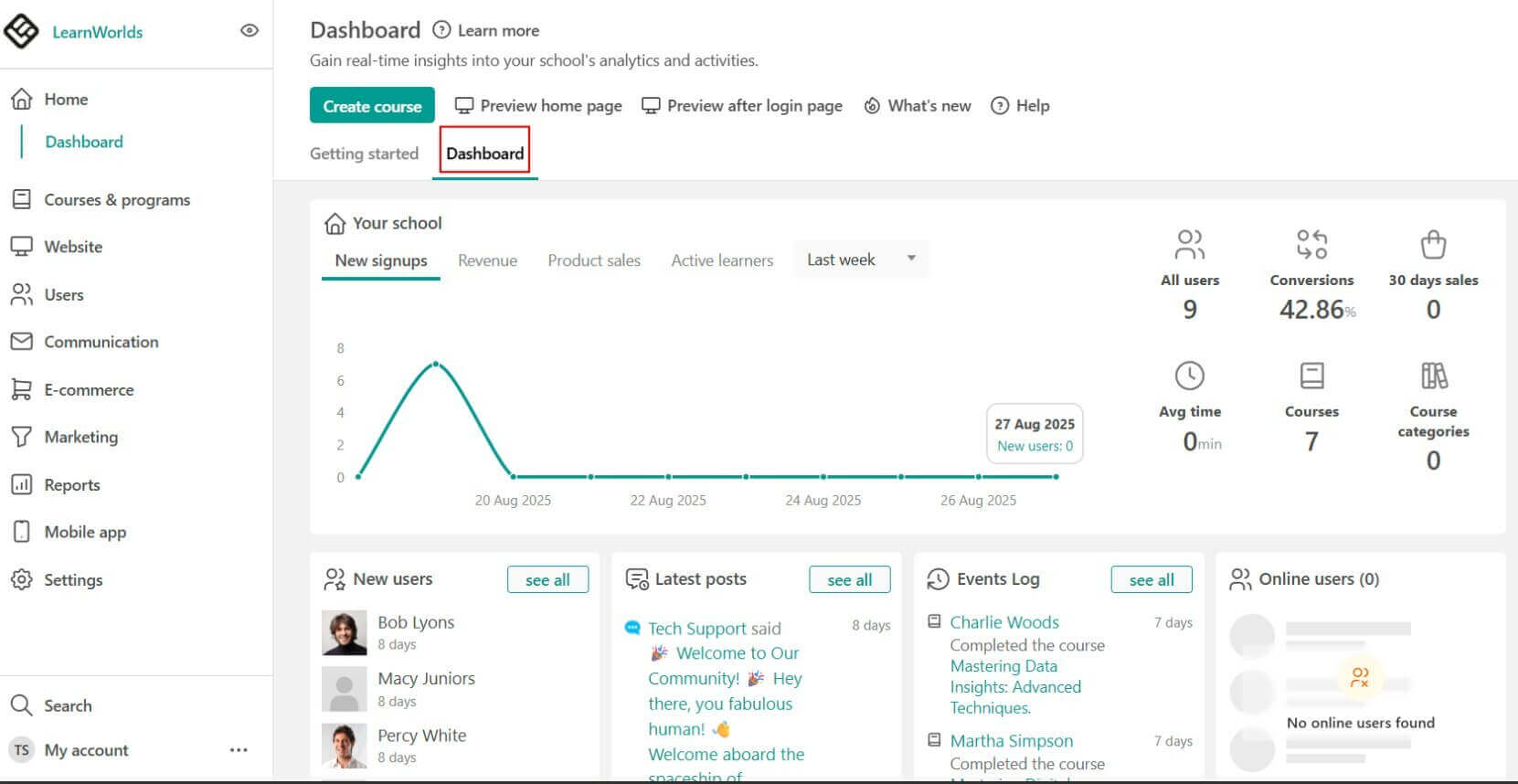
They can also act like an early warning system. A sudden dip in completions might mean the content isn’t landing or that timing’s off. And when you see a spike in productivity in one department, that’s usually a good sign you’ve found a model worth repeating.
Frameworks for measuring ROI
To show training’s value in business terms, I find it best to use structured models like the Kirkpatrick Model or Phillips ROI Model. These frameworks translate learning outcomes into result patterns that are easier to recognize.
The Kirkpatrick model is a classic. It’s simple, but it forces you to look beyond things like training attendance or satisfaction scores.
The model works best when you collect data at more than one level. For instance, if employees enjoyed the session (Level 1) but nothing changed in performance (Level 3), you know the delivery landed, but the content or follow-up didn’t.
The Phillips ROI Model builds on this by adding a fifth layer, ROI. It converts those Level 4 results into dollars by comparing the value gained against what you spent.
To calculate ROI, you first estimate the financial impact of your results—say, lower turnover, reduced error rates, or increased sales. Then you compare that value to what you spent delivering the training.
💡 Here’s an example:
If a customer service training program saves the company $50,000 a year in reduced rework and costs $25,000 to run, the ROI is 100%.
This model gives you a practical way to talk about training outcomes in financial terms. Both models together give you the structure to address the question every business asks about training: Did it work, and how do we know?
Use them as checklists to plan how you’ll gather data before the training starts, so when it ends, you’ve got the info you need.
Case studies: real examples of successful training efforts
You can read stats and frameworks from employee training companies all day, but sometimes it’s easier to see what good training looks like through examples.
I pulled two case studies to show how different organizations tackled learning challenges and built programs that worked.
Wagamama
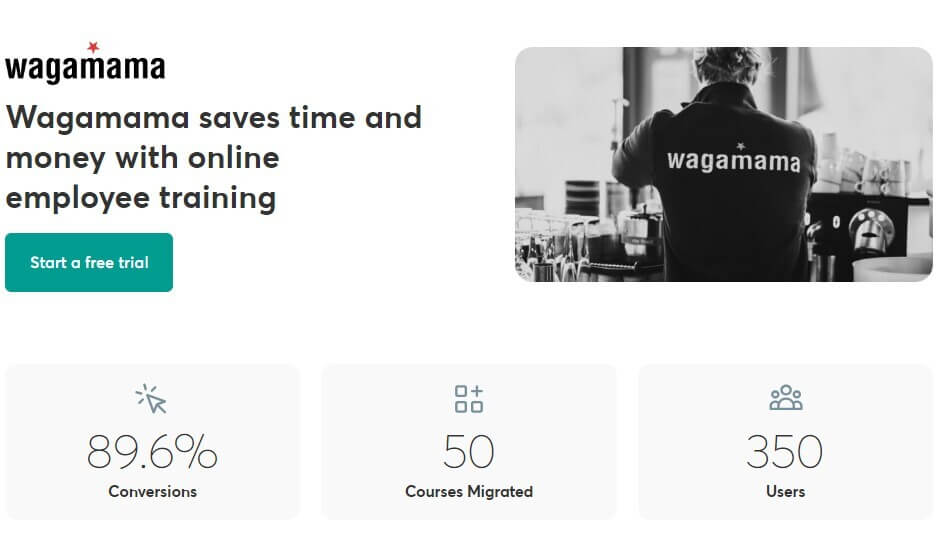
Global restaurant chain Wagamama needed a faster, more consistent way to train staff across its many locations.
Challenge: Their old LMS shut down, leaving them with only three months to migrate to a new platform. Not only did the new LMS need to be mobile-friendly and scalable, but it also needed to deliver consistent training for both kitchen staff and front-of-house teams.
Training/implementation approach: Wagamama migrated to LearnWorlds and, within weeks, was able to move over 50 courses from their previous LMS to LearnWorlds. They were also able to launch and branded online academy that standardized their global training and made learning accessible to every employee.
Results:
I like how Wagamama’s shift shows that even large service industry brands pivot quickly using training and development software that meets their organizational and employee needs.
European Institute of Esthetics (EIE Training Centre)
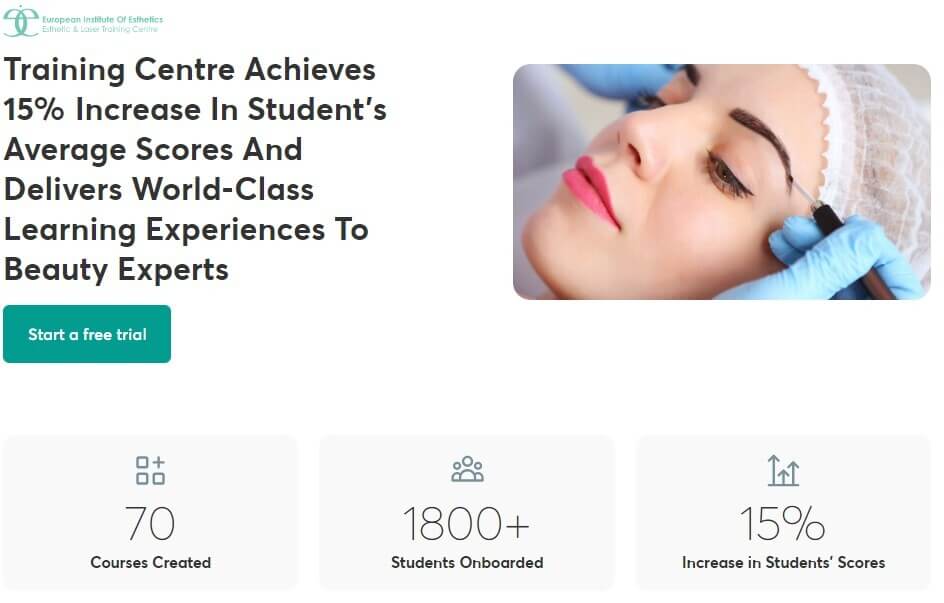
The European Institute of Esthetics (EIE) faced a different kind of challenge. When COVID-19 shut down their classrooms, they had to move hands-on training for estheticians online—fast—and still keep quality high.
Challenge: Overnight, their in-person programs were off the table. They needed an online model that would hold up under pressure and keep students engaged until in-person learning could resume.
Training implementation/approach: EIE used LearnWorlds to launch a hybrid program that blended self-paced theory with live virtual sessions. They built more than 70 digital courses, supported by a mobile-friendly platform that lets students study anywhere.
Results:
EIE’s shift is one of those real examples of employee training that proves even the most hands-on programs can adapt when the structure is right.
Practical tips for effective training rollout
So you’ve seen the numbers and you’ve got a solid list of tools. You understand the training types and what to look for—you’re almost ready for rollout. But before hitting “launch,” there are a few things I want you to keep in mind for a strong employee training rollout plan.
Give it a structure, but make sure it can be flexible too
Remember how time is one of the biggest roadblocks to training and dev? Create a schedule that balances your employees’ workloads while providing designated learning time.
Do this by planning smaller, blended sessions instead of full-day marathons. Give them the freedom to access training through their mobile devices so they can chip away at it in their spare moment.
If you’re scaling learning across teams or regions, think about how to pace it. Stagger sessions, reuse materials, and keep track of who’s completed what. And don’t forget to coordinate with managers and leaders.
Which leads me to…
Communicate early and often
An effective training communication strategy keeps everyone in the loop. Announce the program early, tell them what’s coming, why it matters, and how it connects to your employees’ career development goals.
Managers should know that they’re also responsible for reinforcing that message, not just HR.
Share updates as the program rolls out: when new modules open, where to find support, and what’s next. The more transparent you are, the more likely people are to show up ready.
Connect learning to real work
This one is so important. If you want people to care, show them how the training fits into their daily work. This is one of the best ways to engage employees in training, so make it useful and personal.
You can do this by linking modules to real projects, pairing theory with on-the-job tasks, or setting up quick check-ins where employees share what they’ve applied.
Plan for hybrid and remote teams
Accessibility matters more than ever, with teams often working for different offices and time zones. Keep materials online, mobile-friendly, and easy to revisit.
A few tips for hybrid training:
Gather feedback and adjust
Rollout isn’t “set it and forget it.” Use quick surveys, check-ins, and completion data to see what’s working. Ask your employees questions like:
Then act on what you hear. Small adjustments like changing the timing of modules or adding examples can improve outcomes.
Here’s my simple rollout checklist to help you stay organized:
Remember how your employees want training and development opportunities? LinkedIn Learning research shared that 84% of employees say that learning gives their work more meaning. They want to see that their workplace takes training seriously.
The rollout is where they see whether promises to support learning are talk or truth. When it’s done with care, clear timing, good communication, and visible support, it shows that learning is something your company genuinely values.
Bring structured employee training and development to your team
You now have the frameworks and strategies you need to build an effective employee training and development program for your organization. What’s keeping you from getting started?
LearnWorlds helps companies achieve organizational success with their employee training programs. Why not see what it can do for you? Start your free trial today.
Sources

Kyriaki is the Organic Content Strategist at LearnWorlds, where she writes and edits content about marketing and e-learning, helping course creators build, market, and sell successful online courses. With a degree in Career Guidance and a solid background in education management and career development, she combines strategic insight with a passion for lifelong learning. Outside of work, she enjoys expressing her creativity through music.

Ciera Lamb
Ciera is a freelance content writer and editor connecting companies with their ideal audiences through blog articles and other online content. She approaches her writing with curiosity and research and enjoys the ever-present learning that comes with being a content writer. She is also an avid scuba diver, an aspiring Dutch speaker, and lover of all things nature.
 Back to blog
 Scroll to top
FAQ
Everything you have ever wondered, but were too afraid to ask...

The 5 steps in the training and development efforts are:
The 7-step framework for creating an effective training program usually includes:
Related Articles