
Table of Contents
The demand for online learning extends beyond academic education and workplace skills. People seek fulfilling hobbies, explore topics that expand their perspectives, and pursue personal development through structured online courses.
This quest for knowledge creates enormous opportunities for content creators, influencers, and educators. Several monetization methods exist for selling online courses, each with distinct advantages and trade-offs. Understanding when to use memberships versus single courses, or subscriptions versus one-time purchases, helps align your approach with your business goals and audience preferences.
So if you’re (really) good at something and enjoy sharing your knowledge with others, don’t be shy – the creator economy is booming. Now is the time to jump in. You also don’t have to handle all the marketing on your own. Establishing collaborations with influencers or professional organizations is one way that can help you expand your reach.
There are several monetization methods for selling your online courses. You might already be aware of all or some of them, but do you know the pros and cons of each option?
If you’re unclear about your options, read on to find out the 5 most commonly used monetization strategies and when to use each one, including examples from popular online academies.
5 ways to monetize your online courses
If you’ve decided to create and sell online courses, we recommend offering more than one purchasing option wherever possible. You don’t need to pick just one of the following strategies and stick with it.
Offering more than one purchasing option increases sales by allowing customers to choose how they want to pay and their level of commitment to your academy. As your business grows, experiment with new business models to increase profit while better serving your audience.
Some strategies, like subscriptions, provide predictable revenue that supports financial planning and long-term business growth. But before choosing your strategy, get to know your production costs and equip yourself with the right tools. Both will support your approach and help set appropriate pricing, maximize revenue, and scale your online learning business effectively.
Let’s see what we’re talking about here in detail.
1. One-time purchase
Students pay a single fee that grants them lifetime access to course content. This straightforward approach remains common for individual course sales. One-time purchases differ from one-off purchases in that customers can pay in installments while maintaining lifetime access.
Benefits of one-time purchases:
Trade-offs to consider:
The engagement battle is by no means lost. You can still build rapport with your learners and turn them into repeat customers.
A few ways to do that:
✔️ create opportunities for learners to socialize and interact with you and others
✔️ stay top of mind with email marketing communications and an active social media presence
✔️ release new courses regularly to spark their interest
Investing in content marketing strategies, like blogging, and implementing basic SEO strategies, is also helpful in bringing people to your online academy.
One-time purchases work for:
Need help pricing your course? Read our comprehensive guide on pricing strategies for your online courses.
Now, let’s see an example of a course sold as a one-time purchase.
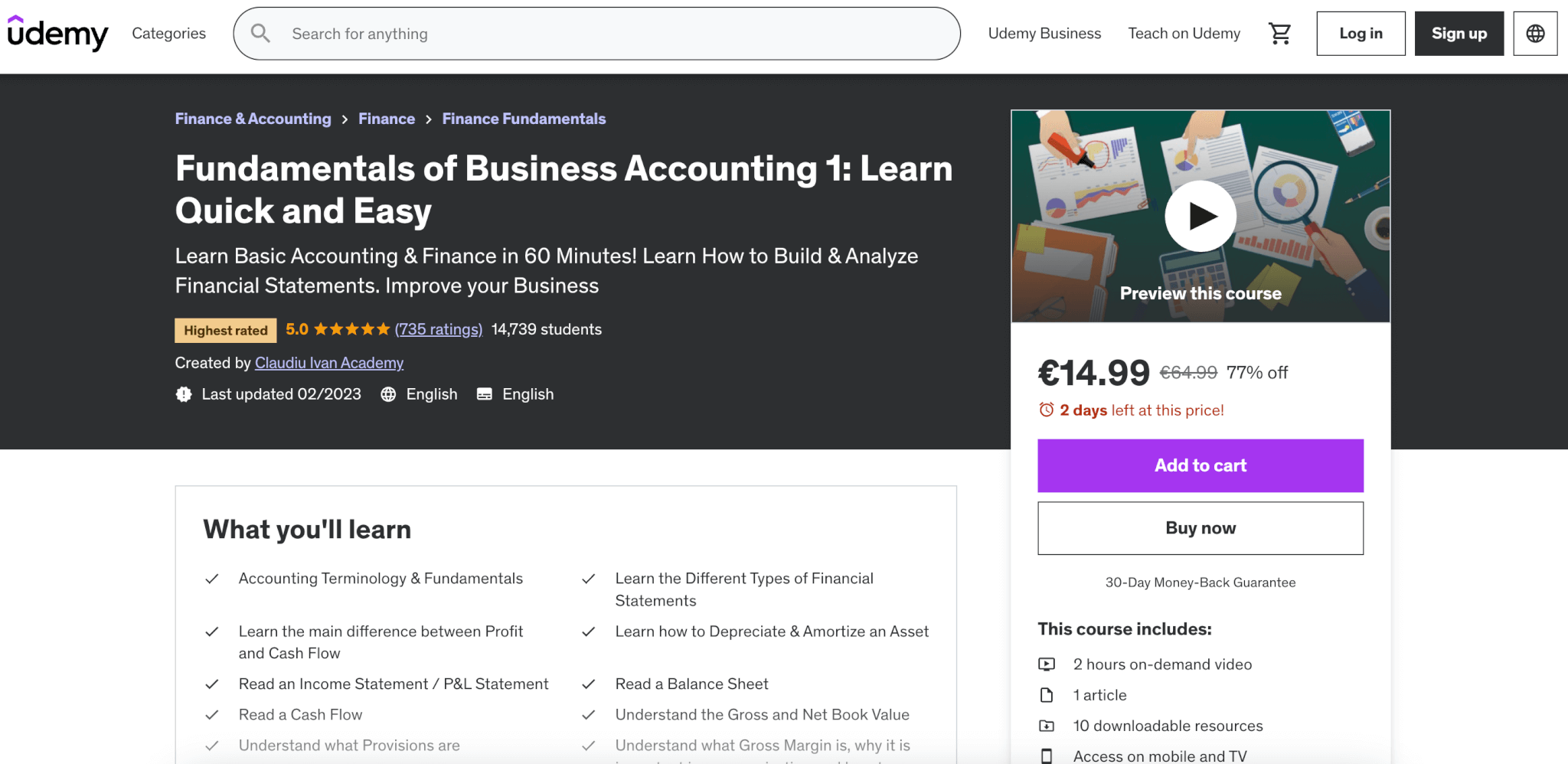
This course is sold on the popular course marketplace Udemy for a fixed price, granting learners forever access to the course – no fuss, no muss. This simple but comprehensive listing includes basic information about the online course.
2. Subscription
The subscription model means learners pay a recurring fee to access your course or academy, which can be a good way to generate recurring revenue. Subscriptions provide predictable revenue, helping you with financial planning and supporting long-term business growth.
And if you use a modern LMS like LearnWorlds, having the right tools is essential for managing subscriptions and scaling your online course business. You can create distinct subscription plans for your different audiences.
Benefits of subscriptions:
Trade-offs to consider:
A subscription-based strategy works for:
People are more likely to commit to a subscription if they can test the waters first, so we advise you to offer a free trial or refund policy.
Here’s an example of a subscription.
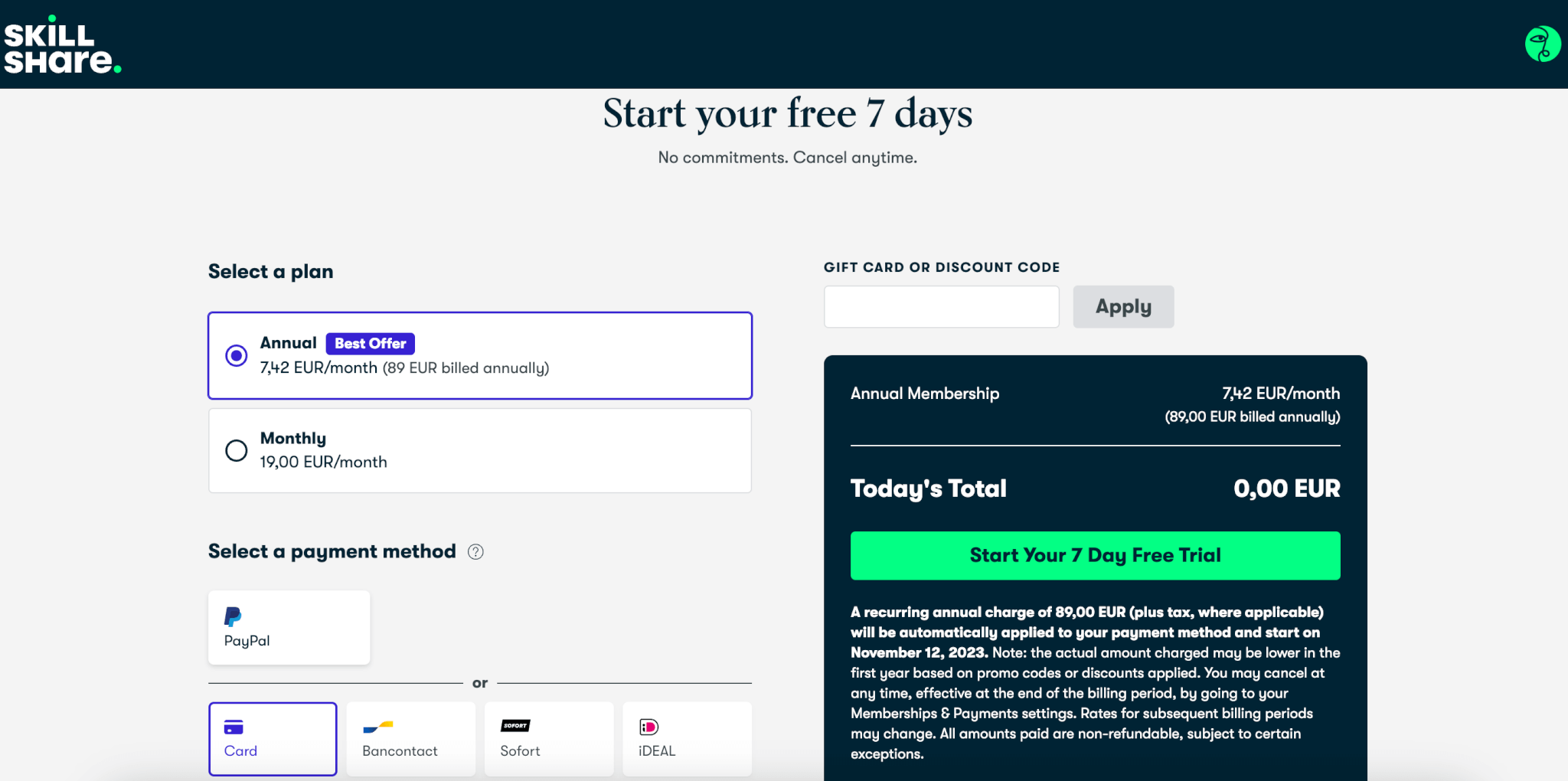
Skillshare offers a subscription-based membership to its customers, which can be paid either monthly or annually. The frequency of the payment is the only option that subscriptions offer, as opposed to memberships, which, as we’ll see right away, offer different perks per plan.
3. Membership
This is another popular monetization model, where students pay a monthly or annual fee to access a library of your courses, as well as ongoing access to exclusive content, community interaction, and specialized support for a recurring fee.
Creating a membership site is an excellent option for more seasoned content creators and knowledge entrepreneurs.
Memberships are similar to subscriptions, but they have a couple of key differentiators. The first is the tiered pricing strategy, which means access to content, events, and other perks, depending on the level of membership. The latter is usually set by the amount paid (in some cases, other criteria such as seniority might be factored in, but this is less likely).
The second differentiator is community, which must be reinforced continuously, as it’s an integral part of the deal. It’s the key reason why people sign up for membership in the first place – exclusive offers, events, and opportunities for networking and meeting people with similar interests.
This supports the premium position strategy that George Elossais, Founder at Trainwell, suggested in WOL 2025: “buyers ‘always wanted to compare,’ so the goal is building something ‘they can’t compare’ — at which point ‘you can pick the price.'”
To set up a membership site, you can use a community-building platform like Patreon or an LMS or online course platform, like LearnWorlds, for more learning features.
Elearning platforms additionally support diverse online content formats, like assessments and quizzes, videos, and ebooks, enabling you to create more engaging and valuable educational experiences.
Many memberships are also supported by YouTube channels.
Another option is to use a content management system like WordPress and enhance its ecommerce and learning functionalities with the plugins available.
Benefits of memberships:
Trade-offs to consider:
The most critical aspect of a membership site is engagement, so focus on organizing live events and offering exclusive benefits that will make your paying customers feel pampered.
Memberships work for:
Let’s see an example of a membership site.
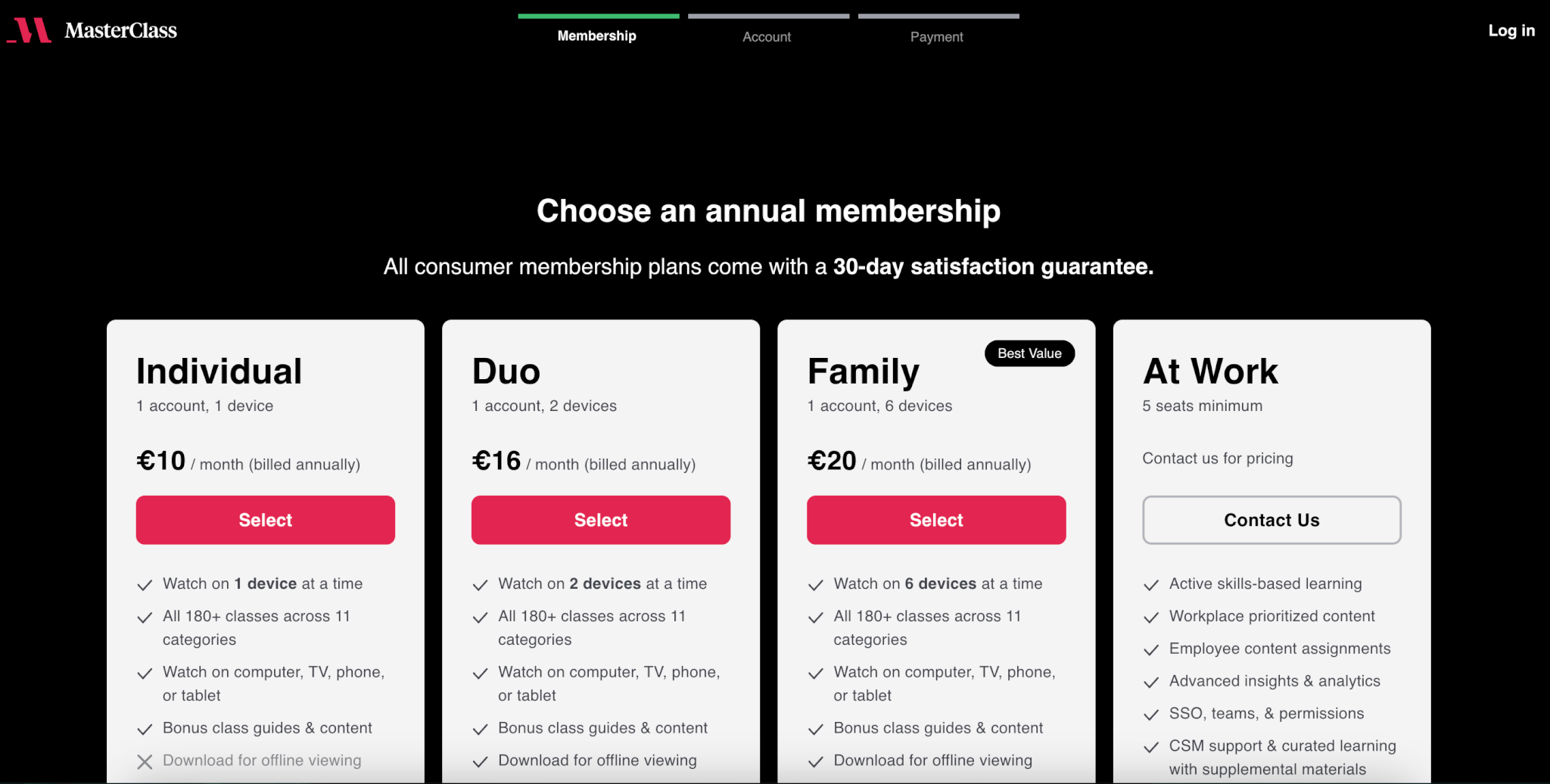
MasterClass has chosen the membership model to offer access to its large range of course offerings. Each plan comes with specific perks, giving customers more reasons to choose a low- or high-priced plan.
During WOL 2025, Melina Palmer, Author, consultant & CEO at The Brainy Business, also talked about pricing psychology and said that listing prices starting from high to low tends to work better. This is what her idea supports:
“Listed low to high: $5/month → $500 course → $5,000 package. Result: the $500 option suddenly looks steep… Listed high to low: $5,000 hands-on package → $500 course → $5/month option. Result: $500 ‘feels way easier’ by comparison.”
4. Freemium
With the freemium model, you offer a basic version of your course for free, providing a free version of your product to attract a large user base. Learners have the option to upgrade to a premium version for additional features and benefits. A common perk is earning a certificate at the end of the course, which is a great incentive for customers to sign up.
The freemium model also has minimal upfront cost for both creators and learners, making it an accessible course monetization strategy.
Note that the freemium model is not the same as a free trial. A free trial is access to content for a specific time period (usually between 7 and 30 days) and is used for subscriptions and memberships.
Benefits of the freemium model:
Trade-offs to consider:
Bring your A-game to convert leads into paying customers. Apart from offering a top-quality course, make limited-time offers that will incentivize them to buy the full course.
The freemium model works for:
Let’s see an example of a freemium offering.
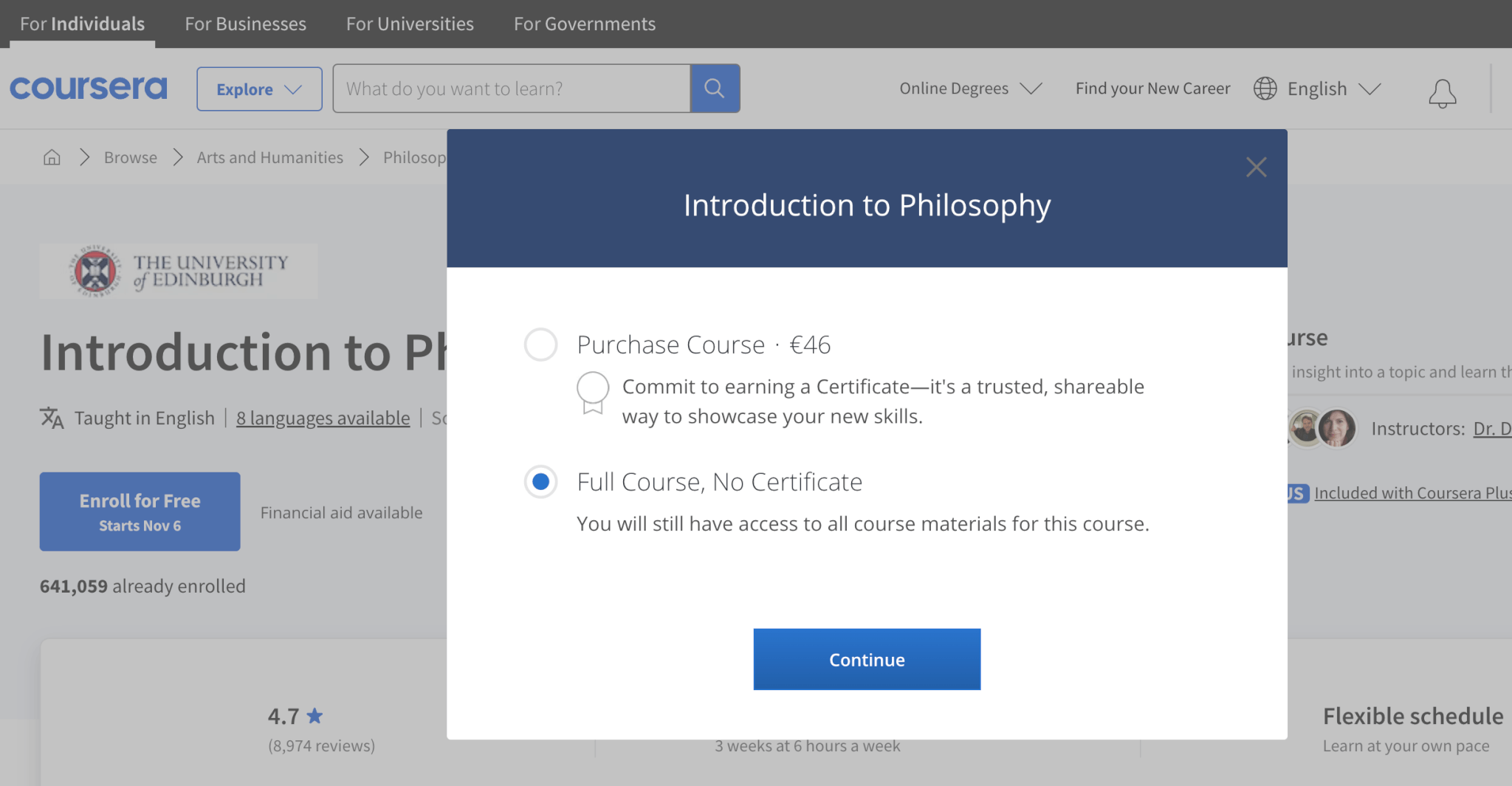
The popular online course marketplace Coursera offers many courses for free. The key difference between paying for courses? A free course doesn’t come with a certificate. If you want to learn for fun, you can learn for free. But if you want to boost your resume, you must make a purchase.
5. Course bundling
Course bundling is when you group and sell more than two courses together. The courses explore complementary topics, and the rationale behind this grouping is more…noble than profit – it offers a rounded learning experience and in-depth exploration of the topic at hand.
More often than not, courses sold together lead to the award of a certificate and some sort of specialization. The latter provided they’re offered by a large company or a recognized educational institution.
Packaging your course with other complementary products or services, such as ebooks, templates, or coaching sessions, is also a form of course bundling.
Benefits of course bundling:
Trade-offs to consider:
For these reasons, it’s best if each course is comprehensive and can be sold separately.
The course bundling model works for:
Here’s an example of course bundling.
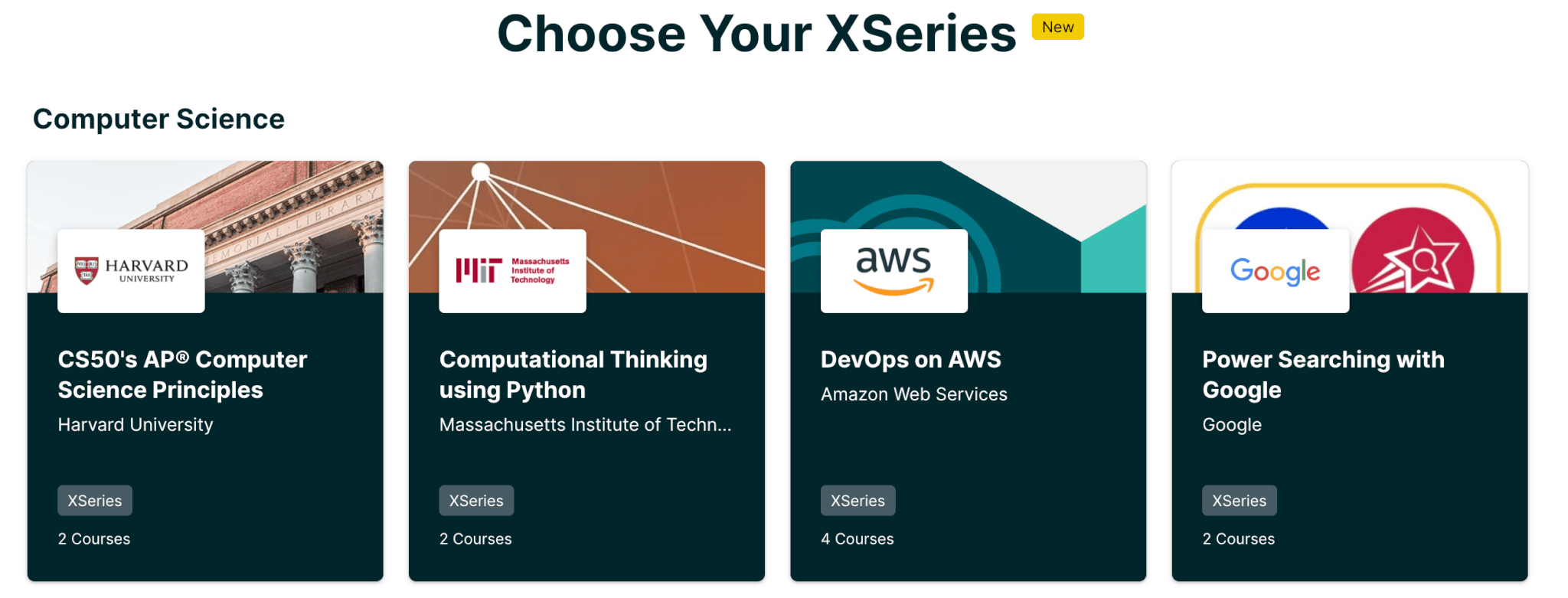
In this example from EdX, we see how you can group two or more courses to explore a topic in depth.
Want to sell more? 3 practical tips to do the trick
We’ve seen some monetization options you can use. Regardless of which ones you want to try, we have three additional tips that will help increase the order value on the spot.
1. Be generous
Reduced prices and increased profit seem like two conflicting notions. Not when you think about the long game, though.
If you want to create repeat customers, you have to treat them nicely. Plus, special offers motivate more people to buy from you, buy more than one course, or sign up for a more expensive membership.
You’ve got many options to create attractive offers, like discounts & coupons, or special prices for customers brought through referral and affiliate marketing programs.
Limited-time and early-bird offers are also popular before they create a sense of urgency, which, as it’s commonly known among marketers, does wonders for sales.
You can even offer a surprise freebie at checkout if the customer spends over a certain amount.
2. Use order bumps
What better time to sell more courses than when you’re already selling?
As the customer is on their way to pay, present them with a compelling offer such as a discount on a second product or suggest a complementary product.
Make it (very) easy for them to opt for the extra product, for example, by clicking a button and having it added straight into their cart.
3. Simplify checkout
Creating a safe and frictionless checkout environment is essential if you want to avoid cart abandonment incidents.
Think like a customer here: the cart should be clearly visible, and one click away, don’t ask for more information than required (now is not the time to know your customers), and allow customers to save their card details for faster checkout the next time.
Keep learning: How to make a course to sell: The ultimate guide for 2026
Get ready to sell
Which course monetization strategy caught your eye? Remember that at the end of the day, the monetization method you pick should align with your business and financial goals. It should also make sense for your target audience and the course topic.
Whatever the case, selling single courses and offering a freebie as a lead magnet is a great place to start, and then take it from there. What’s even better than this? No matter how you decide to sell your online courses, LearnWorlds can support you.
Whether you want to offer a part of your course for free, sell single courses or bundles, or set up memberships and subscriptions, our platform can fit the bill.
Beyond that, LearnWorlds’ advanced learning features and AI assistant will help you create valuable learning experiences that will stick with your learners.
Try LearnWorlds with a 30-day free trial now.
Further reading
- How to Create and Sell Profitable Online Courses: Step-by-Step Guide
- How to Create a Course Outline [With Templates]
- Sell Digital Downloads: The Complete Guide
- How To Create an eLearning Website with Templates & Examples
- How to Start a Profitable Online Course Business from Scratch
- 18 Best Online Course Platforms Comparison Guide
- Why the Creator Economy Is Booming and How You Can Join In

Androniki Koumadoraki
Androniki is a Content Writer at LearnWorlds sharing Instructional Design and marketing tips. With solid experience in B2B writing and technical translation, she is passionate about learning and spreading knowledge. She is also an aspiring yogi, a book nerd, and a talented transponster.

Kyriaki is the Organic Content Strategist at LearnWorlds, where she writes and edits content about marketing and e-learning, helping course creators build, market, and sell successful online courses. With a degree in Career Guidance and a solid background in education management and career development, she combines strategic insight with a passion for lifelong learning. Outside of work, she enjoys expressing her creativity through music.
 Back to blog
 Scroll to top
Related Articles